A groundbreaking study by researchers from the Institute of Archaeology of the Russian Academy of Sciences and the Kurchatov Institute National Research Center has shed new light on a remarkable late 10th-century treasure discovered in Veliky Novgorod. The findings, published in the journal Russian Archaeology, reveal the sophisticated craftsmanship and international connections behind a collection of silver beads dating back to the Viking Age.
Discovery of the Vozdvizhensky Treasure
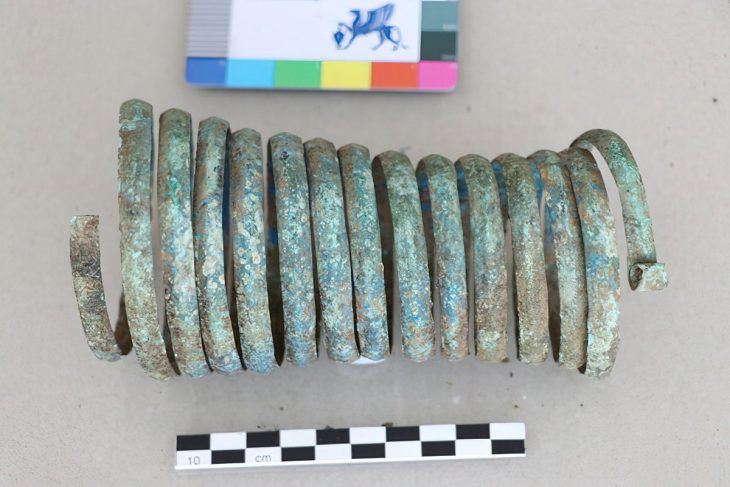
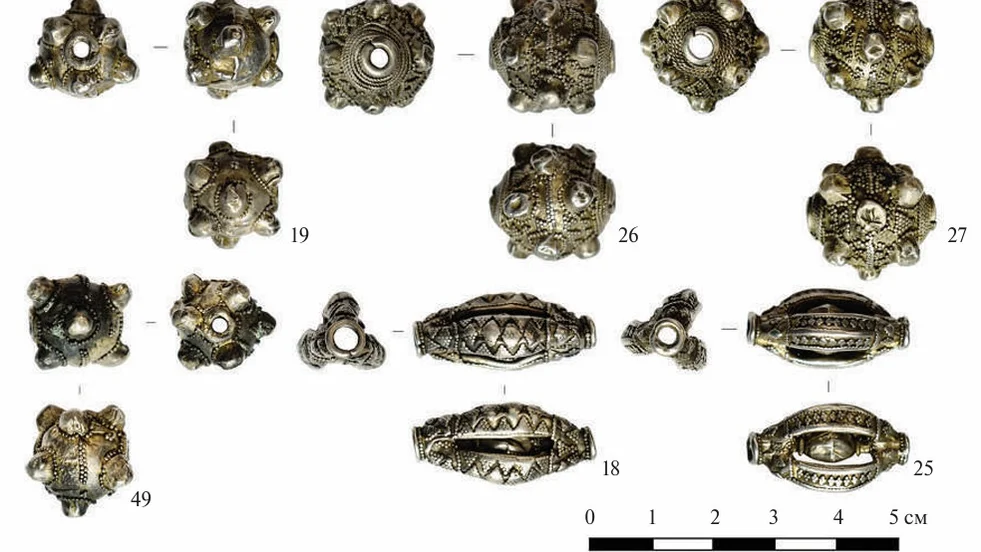
The treasure, known as the Vozdvizhensky hoard, was uncovered during rescue excavations conducted in the summer of 2024. Archaeologists discovered a collection of 39 silver beads of various styles alongside a temple ring with a single bead. Based on coin evidence found within the hoard, experts have dated it to the late 10th century.
This discovery is particularly significant because it represents the first major combined monetary and jewelry hoard from this period ever found within the city. Its urban context offers rare insight into wealth, trade, and cultural exchange in early medieval Rus’.
A Closer Look at the Beads
The hoard includes a wide variety of bead types: smooth, ribbed, granulated with triangular and diamond patterns, hemispherical, filigree, openwork, lobed, and spiral (volute) designs. Despite their diversity, researchers note that these beads are not entirely unique.
Similar examples have been found in well-known hoards across Europe, including the Gnezdovo Hoard, sites in the Novgorod Lake District, and Scandinavian locations such as Gotland and Vårby. These parallels highlight the extensive trade networks connecting Eastern Europe with the broader Viking world.
📣 Our WhatsApp channel is now LIVE! Stay up-to-date with the latest news and updates, just click here to follow us on WhatsApp and never miss a thing!!
Evidence of Trade and Cultural Exchange
The study reveals that the beads originated from multiple regions:
Granulated and openwork beads trace back to Great Moravian craftsmanship.
Hemispherical beads are believed to be a Western Slavic innovation.
Spiral (volute) beads are linked to Scandinavian production.
Lobed beads likely originated in Volhynia.
This diversity reflects a cosmopolitan “international style” that dominated elite fashion during the late Viking Age. Such jewelry was not merely decorative—it symbolized status, wealth, and cultural identity among early medieval elites.
Interestingly, similar beads have also been found in rural aristocratic burials across ancient Rus’ territories, suggesting that these luxury items gradually spread beyond urban elites.
Signs of Wear and Use
One of the most fascinating aspects of the study is the evidence of wear on the beads. Some types, particularly those with granulation and spiral designs, show significant abrasion, while more fragile hemispherical beads remain well-preserved.
Researchers propose that the hoard may contain elements from multiple necklaces—some worn for a long time and others relatively new. The presence of paired beads suggests they may have originally been sold or used in matched sets.
This pattern indicates that even worn jewelry retained high value, reinforcing the idea that such items were prized possessions rather than disposable fashion.
Advanced Scientific Analysis
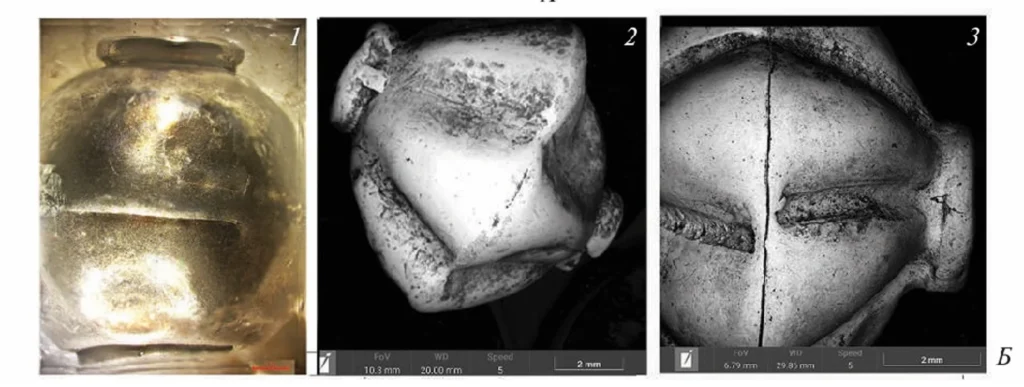
To better understand the construction and composition of the beads, scientists employed cutting-edge analytical techniques. These included optical microscopy, scanning electron microscopy, and energy-dispersive X-ray microanalysis.
The results showed that all beads were made from high-purity silver. In most cases, the body and decorative elements were crafted from single portions of metal, demonstrating advanced metallurgical control.
Further insights were gained through X-ray and neutron tomography conducted at the Kurchatov Institute. These non-invasive imaging techniques allowed researchers to visualize internal structures, soldering zones, and construction methods in unprecedented detail.
Notably, previously unseen internal defects—such as delamination and microcracks—were identified in nine beads. These findings provide valuable information about production techniques and material limitations in early medieval jewelry making.
Standardization in Medieval Craftsmanship
Another key discovery is the consistency in the size of structural elements such as granules, wires, and foil. This suggests that different craftsmen may have used standardized tools and techniques.
Such standardization points to a highly developed craft tradition, possibly supported by workshops operating within established production networks.
A Window into the Viking Age World
The Vozdvizhensky hoard offers a vivid snapshot of life in the late 10th century—a time of dynamic cultural interaction across Europe. Veliky Novgorod, a major торговый центр (trade hub), played a crucial role in connecting the Baltic region with the Byzantine and Islamic worlds.
Silver, often sourced from Islamic coinage, circulated widely and was frequently repurposed into jewelry. While this particular hoard’s coin composition helped date it, its jewelry tells a deeper story of artistic exchange and social hierarchy.
Why Was the Treasure Hidden?
Like many medieval hoards, the reason for its burial remains uncertain. It may have been hidden during a period of unrest, buried for safekeeping, or even offered as a ritual deposit.
Some historians speculate that the late 10th century—a time of political consolidation and shifting power structures in early Rus’—may have prompted individuals to conceal their wealth.
The Vozdvizhensky treasure is more than just a collection of silver beads—it is a testament to the sophistication, connectivity, and artistry of the Viking Age world. Through a combination of archaeological discovery and advanced scientific analysis, researchers have unlocked new insights into early medieval craftsmanship and cultural exchange.
As studies continue, this remarkable hoard promises to deepen our understanding of how ancient societies created, valued, and preserved beauty in a rapidly changing world.
Institute of Archaeology of the Russian Academy of Sciences
Cover Image Credit: Silver beads from the Vozdvizhensky hoard (a selection of the finds). Institute of Archaeology of the Russian Academy of Sciences