
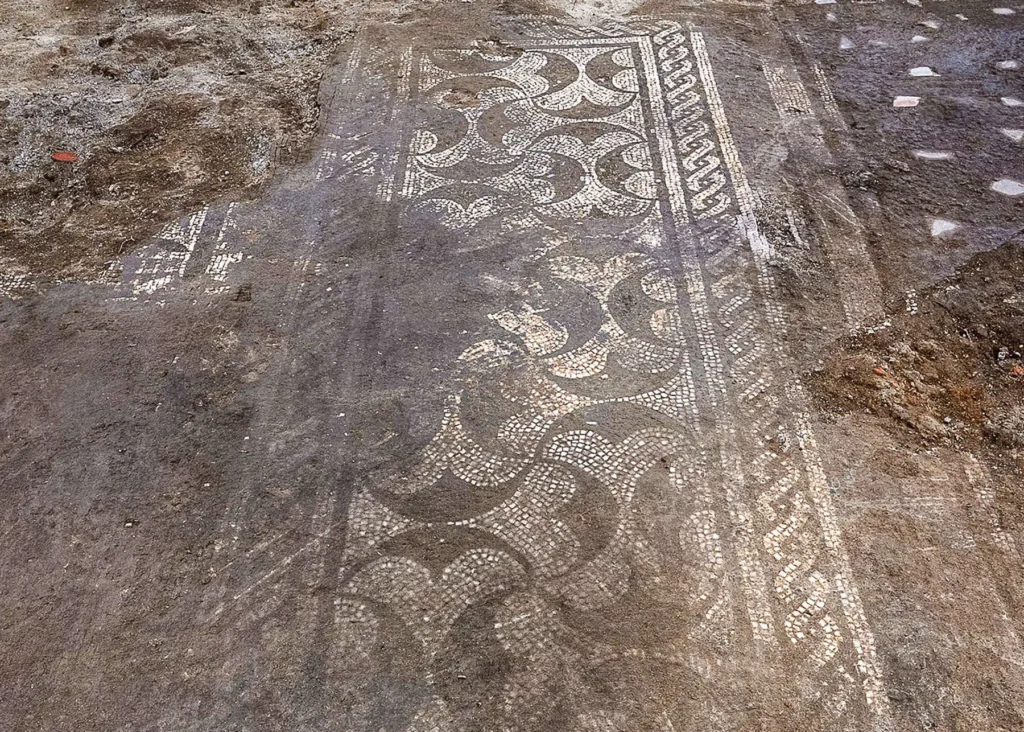
A report of illegal digging on the rural edge of Rome has led archaeologists to one of the most striking recent discoveries in the city’s western countryside: a Roman imperial-period villa with mosaic floors, painted walls and a white marble statue that may represent Silvanus, the rustic god of fields, woods and agricultural life.
The villa was uncovered at Castel di Guido, a large agricultural estate west of Rome, in an area connected with ancient Lorium, a settlement and imperial property along the Via Aurelia. The discovery was made during investigations by the Soprintendenza Speciale di Roma of Italy’s Ministry of Culture, after unauthorized excavation activity was reported on land owned by the Lazio Region.
The scientific investigation is being directed by Alessia Contino, an archaeologist with the Soprintendenza Speciale di Roma. What began as an emergency response to damage caused by clandestine digging has now revealed part of a large suburban villa, probably linked to the ancient Via Aurelia by a secondary road.
From illegal excavation to archaeological rescue
The case began on February 16, when the Metropolitan Police of Rome informed the Soprintendenza about unauthorised digging at the site. The following day, the Carabinieri’s Cultural Heritage Protection Unit became involved. A joint inspection followed, and by February 23, the area was being secured, fenced and monitored.
The illegal activity had already caused serious damage. Mechanical excavation had cut into ancient structures, leaving deep trenches and large piles of displaced soil around the site. Instead of treating the incident only as a criminal matter, archaeologists expanded the intervention into a controlled excavation, documenting the exposed remains and stabilizing the ancient walls and floors.
Alessandro Giuli, Italy’s Minister of Culture, said the rapid intervention by ministry officials and the Carabinieri had stopped a clandestine operation, secured the archaeological area and brought to light the remains of a major imperial-period villa in the Roman countryside.
Daniela Porro, Special Superintendent of Rome, emphasized that the discovery also highlights the archaeological richness of Rome beyond the historic center. The find, she noted, came from a protection system based on cooperation and fast response.
Mosaic rooms and painted walls
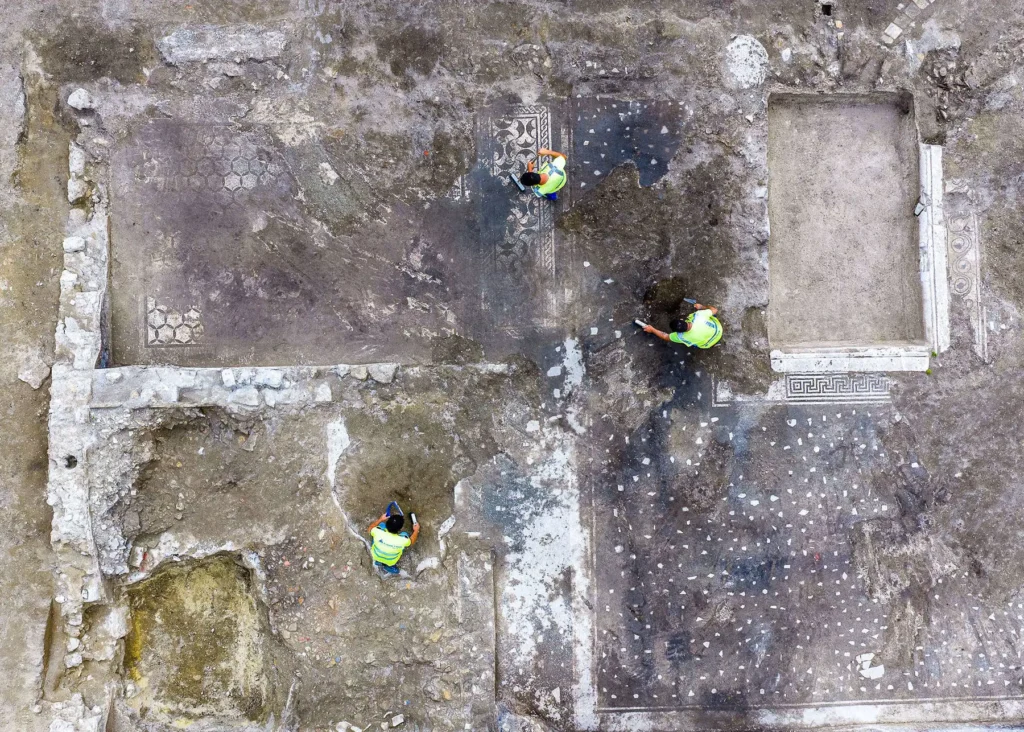
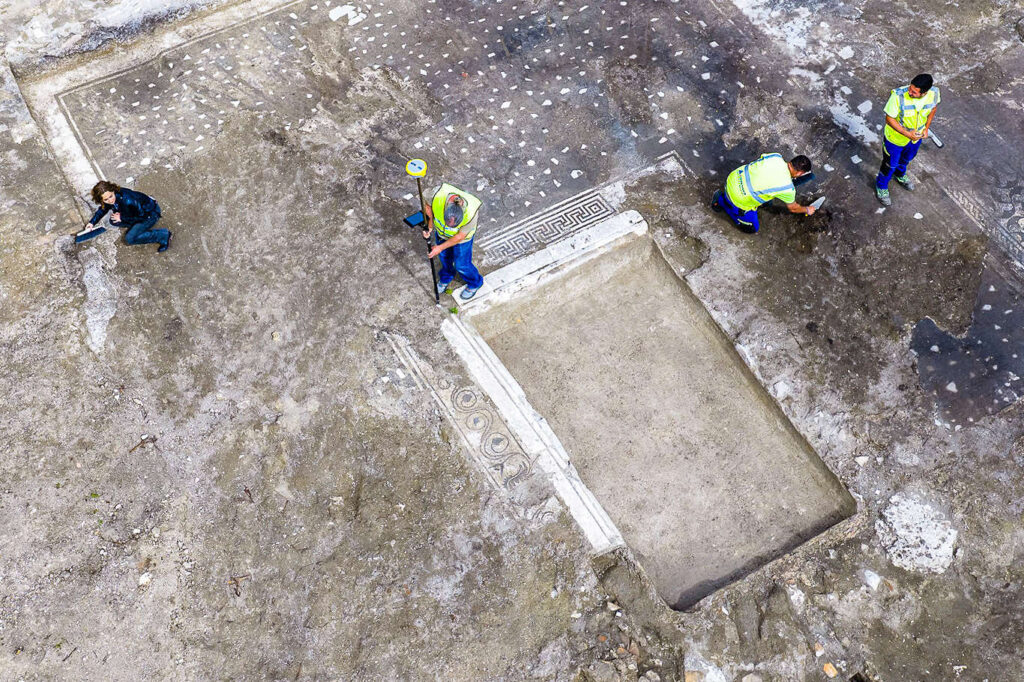
The excavation has so far identified a monumental entrance atrium, decorated rooms and other spaces with different functions. The villa’s entrance was organized around a large central impluvium, the basin used in Roman architecture to collect rainwater.
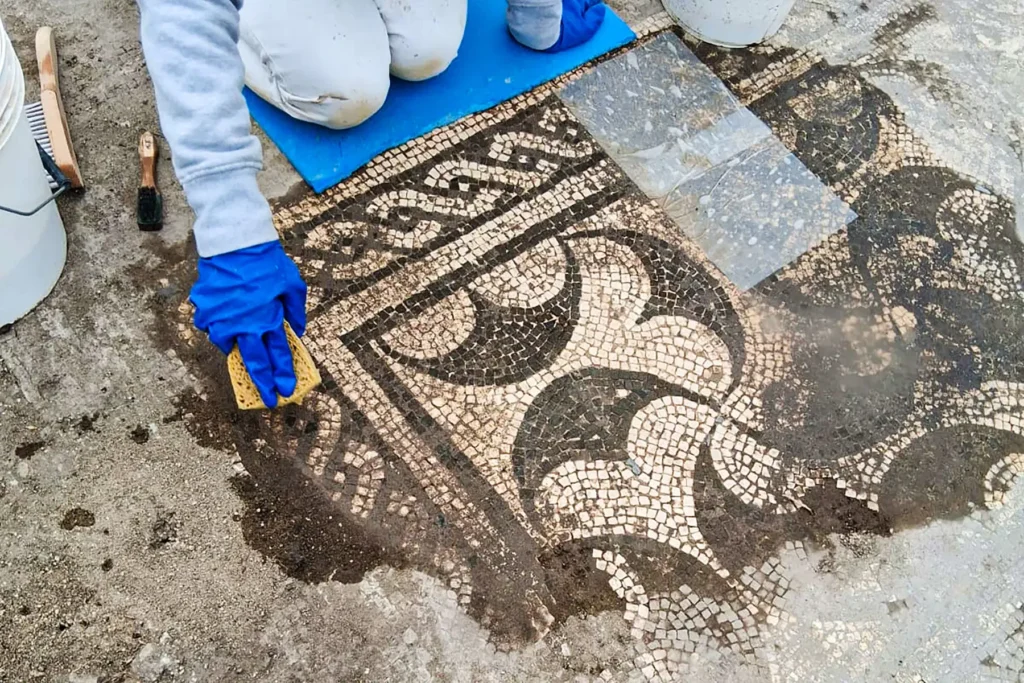
Around this basin, the floor was decorated with mosaics using geometric and vegetal motifs. Black tesserae, polychrome marble inserts and a large threshold with braided framing and black pelta motifs on a white ground point to a residence of considerable refinement.
Traces of wall painting also survive. Archaeologists found a lower red-painted band still in place, while fragments recovered from disturbed soil suggest that the upper walls may once have carried yellow and probably blue panels, enriched with human figures and plant designs. These pieces likely collapsed during the villa’s abandonment in antiquity.
Four rooms developed around the atrium. Three preserve parts of their original mosaic floors. One room had a black-and-white mosaic divided into nine square panels with geometric designs. A second displayed black octagons on a white background. A third used black rectangles with concave and convex sides, a pattern typical of refined domestic decoration in Roman elite houses.
Near one of these rooms, archaeologists also found a basin lined with cocciopesto, the waterproof mortar widely used in Roman construction. A nearby space, still only partly investigated, may have been linked to production or agricultural work. That detail matters: this was not only a luxury residence. Like many Roman villas, it likely combined elite domestic life with the management of land, food production and rural resources.
A marble figure from the impluvium
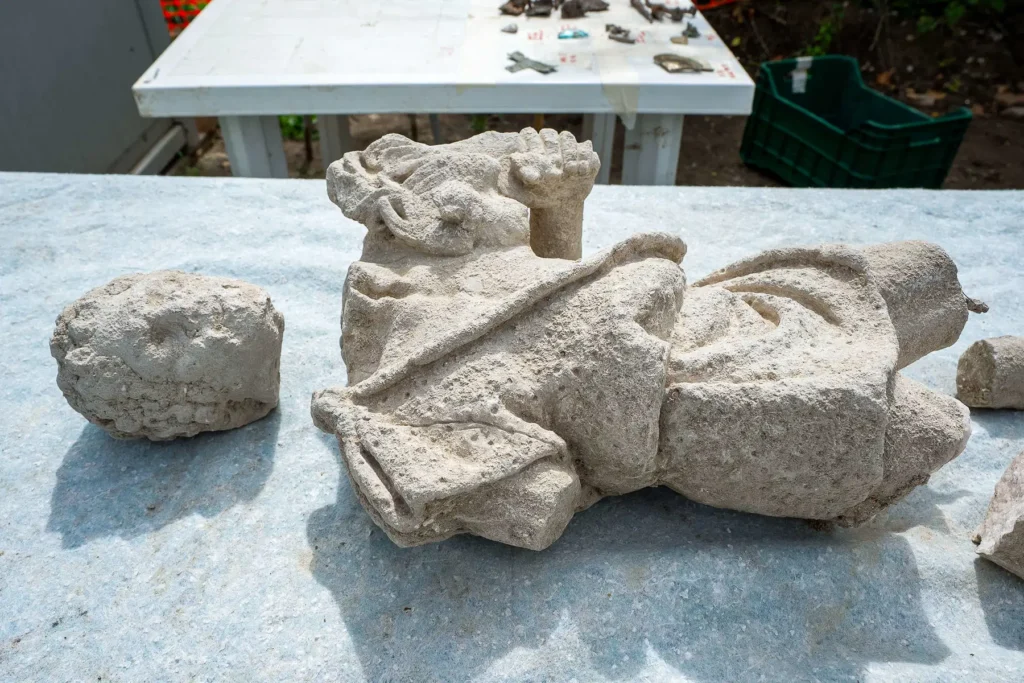
One of the most important finds is a fragmentary white marble statue discovered inside the impluvium basin. The sculpture stands about 80 centimeters high and depicts a bearded adult male wearing a short tunic with a strap across the shoulder.
The figure carries a basket-like element on the shoulder, with two birds visible on the front and fruit on the back. The right arm appears to have bent forward, probably supporting a small domestic animal, perhaps a calf or piglet.
The first interpretation suggests that the figure may represent Silvanus, a Roman rural deity associated with woods, fields, boundaries and the protection of agricultural activity. The identification is not final. Scholars have also considered other possibilities, including a Silenus from a Dionysian context, a seasonal figure or a shepherd.
Still, the rural imagery fits the setting. In a villa built within an agricultural landscape, a figure connected to fields, animals and fertility would not be accidental decoration. It would have spoken directly to the world that sustained the estate.
Castel di Guido and the imperial landscape of Lorium
The location gives the discovery wider historical weight. Castel di Guido lies in the territory of ancient Lorium, a station on the Via Aurelia at the twelfth mile from Rome. Ancient sources connect Lorium with an imperial estate, especially with Antoninus Pius, who spent part of his youth there, later built a residence in the area and died there in AD 161.
Hadrian and Marcus Aurelius are also associated with the district. The presence of the imperial court helped turn this western suburban landscape into a preferred zone for high-status residences.
Other important villas were already known nearby, including the Villa delle Colonnacce and the Villa delle Olivelle. The newly discovered villa now adds another piece to the map of elite settlement around Lorium and raises the possibility that aristocratic families close to the imperial sphere, or even members of the imperial household, may have been connected with the property.
The quality of the mosaics, painted walls and marble sculpture points to owners of very high social standing. For now, archaeologists remain cautious. The villa has not yet been fully excavated, and future work will be needed to clarify its full plan, phases of use and relationship to the wider Lorium estate.
A villa probably begun in the 1st century AD
Preliminary dating suggests that the villa may have been built and decorated from the first half of the 1st century AD, when elaborate mosaic and painted decoration became common in aristocratic residences. The building may have been gradually abandoned during the 3rd century AD, possibly when imperial interest in the area declined.
Further study of the recovered materials will be essential. Pottery, construction phases, painted plaster, marble fragments and stratigraphic evidence may refine the villa’s chronology and reveal whether parts of the building were reused in late antiquity.
For Alessia Contino, the discovery is important because it identifies a previously undocumented imperial-period villa and preserves a decorative context of unusual quality. It also opens new research perspectives for the western suburbs of ancient Rome, a landscape where archaeology still has much to reveal beneath fields, estates and modern roads.
Public opening on June 20
The Soprintendenza Speciale di Roma will present the discovery to the public on June 20, 2026, through two free archaeological treks at Castel di Guido, scheduled for 5:00 p.m. and 6:15 p.m.
The guided route will last about one and a half to two hours and includes a walk of roughly one kilometer to reach the excavation, view the remains of the villa and see the mosaics currently under restoration.
For a site first exposed by damage, the outcome is unusually positive. A clandestine excavation has become a controlled archaeological investigation, and a fragment of Rome’s imperial countryside has returned to view.
Cover Image Credit: Italian Ministry of Culture
