
For more than 2,200 years, Hannibal’s march across the Alps has remained one of the most debated episodes of ancient military history. The Carthaginian commander crossed the mountains in 218 BC during the Second Punic War, leading tens of thousands of soldiers, thousands of horses, and 37 war elephants toward Italy in a campaign that shocked Rome.
The larger question has never gone away: which Alpine route did Hannibal actually take?
A new study published in Proceedings of the National Academy of Sciences approaches Hannibal’s Alpine crossing less as a mystery of ancient geography than as a problem of bodies, food, and fatigue. Emilio Berti of the German Centre for Integrative Biodiversity Research and Friedrich Schiller University Jena, and Fritz Vollrath of the University of Oxford and Save the Elephants, modelled how much energy Hannibal’s soldiers, horses, and elephants would have spent on several proposed routes from present-day France into Italy.
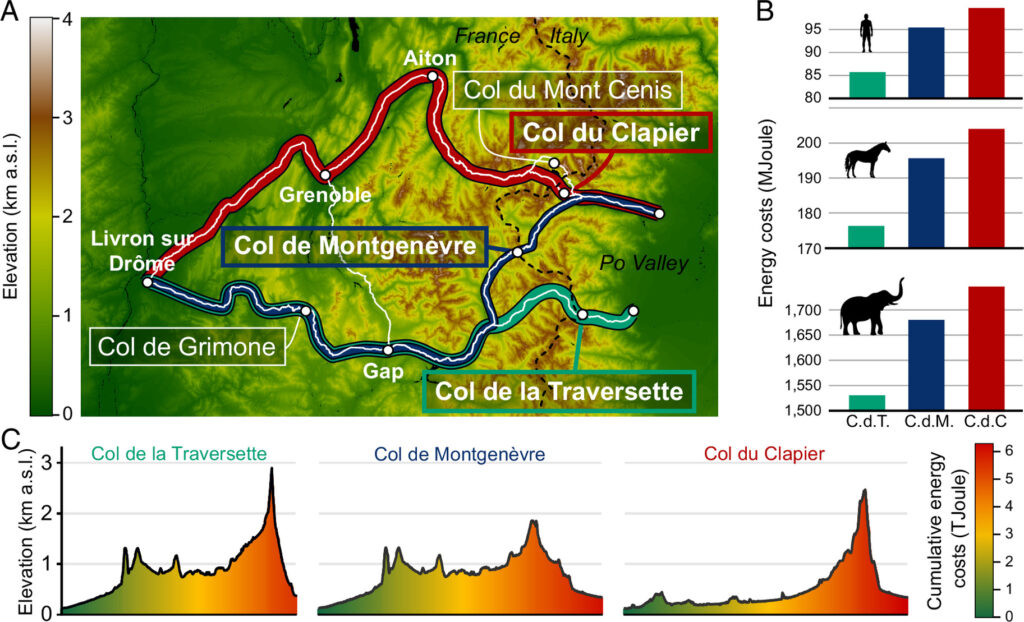
Their comparison included the long-favored Col du Clapier route and the Col de la Traversette, a nearly 3,000-meter pass that has gained support in more recent studies. The calculations favored Traversette: despite its height, it was the shortest and least costly route in direct energy terms, requiring an estimated 5.42 terajoules for the army as a whole, compared with 6.28 terajoules for the Col du Clapier route.
An Ancient March Measured in Energy
According to ancient accounts, Hannibal’s Alpine crossing took 15 days. His force had already marched from Spain before reaching the mountains, and by the time it descended into the Po Valley, it had suffered heavy losses. The expedition included 46,000 soldiers and 37 elephants, animals that were impressive on a battlefield but extremely difficult to keep alive on campaign.
The study calculated the direct energy required for men, horses, and elephants to move across four routes: Col de la Traversette, Col de Montgenèvre, Col du Clapier, and Col du Mont Cenis.
The Col de la Traversette came out lowest, with an estimated total energy cost of 5.42 terajoules for the army. The Col de Montgenèvre route required about 11 percent more energy, the Col du Clapier about 16 percent more, and the Col du Mont Cenis about 19 percent more.
In practical terms, the Traversette route would still have demanded an enormous supply effort. The researchers estimate that over 15 days, the army would have needed about 232 tons of provisions if carbohydrates were the main food source. Longer or more energy-intensive routes would have increased that burden by tens of tons.
Hannibal’s Biggest Problem Was Not the Climb, but the Food
The elephants are central to the new study because they were not just exotic military equipment. They were massive animals with massive biological demands.
A three-ton adult elephant can consume around 200 kilograms of forage per day in the wild. Even under captive conditions, the amount of feed required to meet basic metabolic needs is far beyond what could easily be carried through the Alps. In normal conditions, elephants spend much of the day feeding simply to maintain body weight.
That creates a severe problem for any proposed Alpine route. The animals could not carry enough food for themselves, and the mountain environment would not have allowed them to graze freely for long hours each day while the army kept moving.
The study estimates that crossing by the Col de la Traversette would have added about 1.53 gigajoules of energy expenditure for each elephant, on top of its basic metabolic costs during the 15-day march. To fully replace that energy while moving, the elephants would have needed an additional five to six hours of feeding every day. The authors consider that scenario highly unlikely.
Instead, the elephants probably crossed the Alps by drawing on stored body fat. On the Traversette route, the researchers estimate that elephants would have lost around four percent of their fat reserves. Horses would have lost about 11 percent, while soldiers could have lost around 19 percent.
That comparison is important. The elephants may have been physically capable of completing the crossing, but surviving the winter in Italy was another matter.
The Route Was Only the First Problem
Ancient tradition suggests that many of Hannibal’s elephants did make it across the Alps. Around 30 are believed to have fought at the Battle of the Trebia in December 218 BC, one of Hannibal’s early victories against Rome.
But after the crossing, the logistical situation changed. Hannibal’s army was in enemy territory, far from secure supply lines. Soldiers could recover body fat relatively quickly if food became available. Elephants required far greater quantities of fodder and more time to recover.
That may explain why, according to later accounts, all of Hannibal’s elephants except Surus, his personal elephant, died during the following winter.
The new study therefore shifts attention from the famous crossing itself to what came after it. Getting elephants over the Alps was possible. Keeping them alive in northern Italy may have been the real logistical failure.
A Weapon of War—and Psychology
Why bring elephants at all?
The study suggests that Hannibal may have understood the risks but still judged the animals worth the cost. Elephants could provide a tactical shock in early battles against Roman forces. They also carried psychological value. In northern Italy, Hannibal hoped to win support from Celtic groups hostile to Rome, and war elephants would have made a powerful impression.
In that sense, the elephants were not only battlefield animals. They were political theatre, intimidation, and recruitment tools moving on four legs.
Their value may have declined after the first encounters. Once Hannibal had crossed the Alps, won early battles, and drawn allies to his side, the enormous cost of feeding the elephants may have outweighed their usefulness.
A New Layer in an Old Debate
The study does not claim that ancient historians were wrong or that the Col de la Traversette is proven beyond doubt. It does something more useful: it asks what Hannibal’s choices looked like when measured against the energy needs of the army itself.
On that basis, the Traversette route becomes attractive. It was not easy, but it was shorter and required less energy than the alternatives. For a commander trying to move exhausted soldiers, horses, and elephants through hostile terrain before winter closed in, that difference may have mattered.
Hannibal’s crossing has often been remembered as a feat of daring. The new calculations make it look equally like a problem of calories, fatigue, fodder, and survival.
The legend remains. But beneath it, the numbers show how narrow the margin may have been.
E. Berti, & F. Vollrath, Energy costs of Hannibal’s alpine crossing, Proc. Natl. Acad. Sci. U.S.A. 123 (28) e2612764123, https://doi.org/10.1073/pnas.2612764123 (2026).
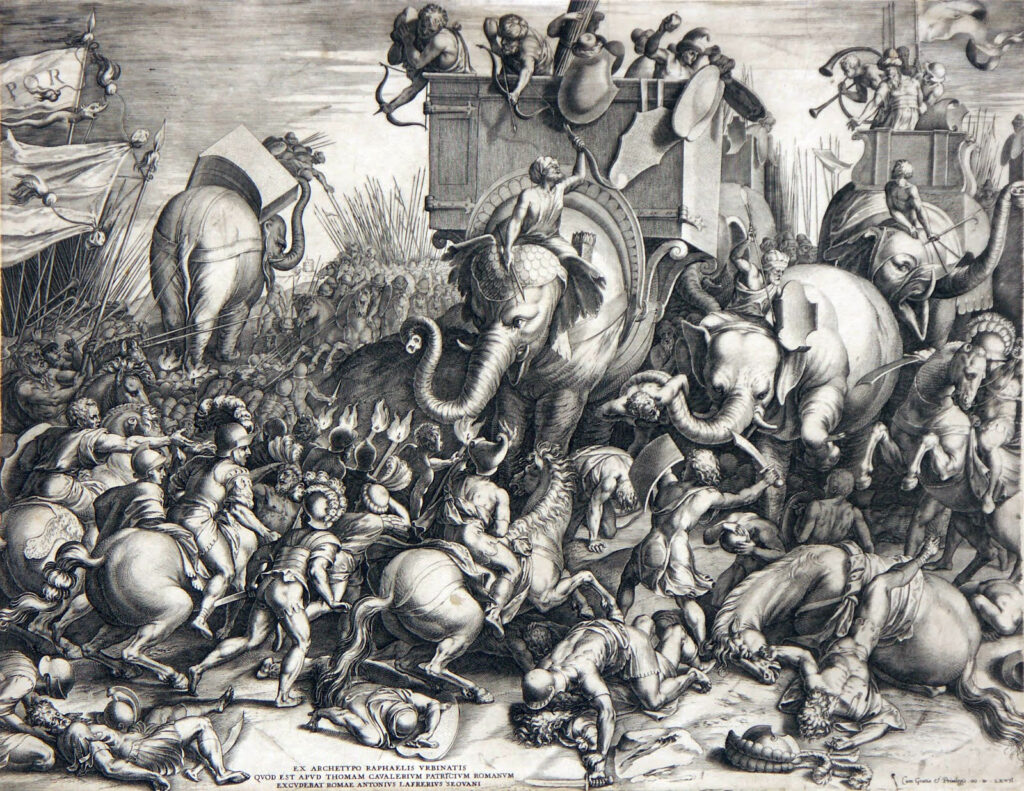
Cover Image Credit: Engraving of the Battle of Zama by Cornelis Cort, 1567. Credit: Cornelis Cort – Hunterian Museum and Art Gallery
