

The Oseberg ship burial is one of the most important Viking Age discoveries in Norway. It dates to the ninth century and was found in a burial mound near the Oslo Fjord. Inside the ship, archaeologists found many valuable objects, including carved wood, tools, household items, and textiles.
The textiles are especially important because some of them show scenes from Viking life and beliefs. The designs include people in processions, animals, and buildings decorated with dragon heads. These images give researchers clues about Viking art, stories, and rituals.
However, the textiles were badly damaged after more than a thousand years underground. Many had broken into small pieces, making it difficult to tell which fragments originally belonged together. As a result, archaeologists still cannot say with certainty how many complete textiles were placed in the burial.
Researchers at the Museum of Cultural History in Oslo have developed a computer system that uses deep learning to study the damaged Oseberg textiles.
The system compares small fabric fragments and looks for patterns, shapes, and designs that may show which pieces once belonged together.
In an early test, the AI supported ideas that experts had already made about some of the fragments. But it also went further: it identified a possible connection that researchers had not noticed before.
The challenge
Archaeologists usually try to match broken textile pieces by looking at their patterns, thread size, colors, and designs.
However this can be very difficult when the material is old and damaged. The Oseberg textiles are especially hard to study because many pieces are missing, while the remaining ones are faded, worn, and fragile.
Regular photographs cannot always show the small details that help researchers connect textile fragments. They can capture a piece’s shape and color, but they do not show its full texture, the thickness of the weave, or how light reflects off individual threads.
That is why putting the Oseberg textile fragments back together is such a difficult task.
A different approach
The researchers used a technique called Reflectance Transformation Imaging (RTI) to get more information from each textile fragment.
Instead of taking just one photograph, they photographed each piece 50 times, changing the direction of the light each time. This helped reveal details in the surface that would be difficult to see in a normal photograph, such as the texture and structure of the weave.
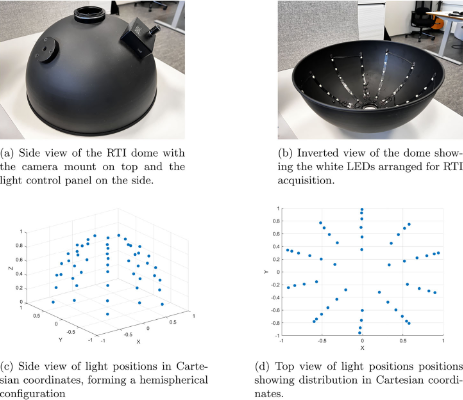
figuration. Credit: Khawaja, M. A., Gigilashvili, D., Łojewski, T., George, S., Marzani, F., Hardeberg, J. Y., & Mansouri, A., npj Heritage Science, Vol. 14, Article 95 (2026), doi.org/10.1038/s40494-026-02326-9. Open access.
The team then used this data to create a digital model of each fragment’s surface. They fed these images into ResNet-50, a deep learning model that was originally designed to recognize objects in regular photographs. In this project, it was used in a different way: to turn each textile fragment into a unique set of numbers based on its surface features.
Once every fragment had its own digital “fingerprint,” the researchers could compare the pieces using a computer rather than relying only on human observation. They used clustering methods to find fragments with similar features and then displayed the results as simple 2D charts. This allowed archaeologists to quickly see which fragments the system considered most closely related.
Testing the system
The researchers first tested the AI on a group of fragments that archaeologists had already studied closely. These pieces showed a house with a dragon’s head and a line of approaching figures. Based on their patterns, threads, and images, experts believed the fragments came from the same original textile.
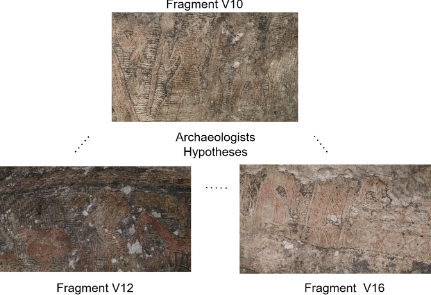
The AI reached the same conclusion. It placed these fragments together, supporting the archaeologists’ earlier work and showing that the system could identify meaningful similarities.
But the test also produced an unexpected result. The AI placed another fragment close to this group, even though researchers had not previously linked it to the others.
This does not prove that the fragment belongs to the same textile, but it gives archaeologists a new lead to examine more closely.
The advantage of RTI
The researchers also wanted to know whether RTI actually made a difference. They compared it with ordinary RGB photographs and found that RTI gave clearer results when grouping related fragments. The advantage was especially useful for old or faded textiles, where small differences in texture and weaving can be hard to see in a normal photo.
The method was then tested on a separate set of textiles from Wawel Castle in Kraków, Poland. Unlike the Oseberg pieces, these textiles came from a known complete object, which gave the researchers a reliable answer to compare with. The team digitally divided the original textile into smaller sections and tested whether the system could recognize which pieces belonged together. It successfully separated the Polish textiles from the Oseberg material and recovered the known relationships between the fragments.
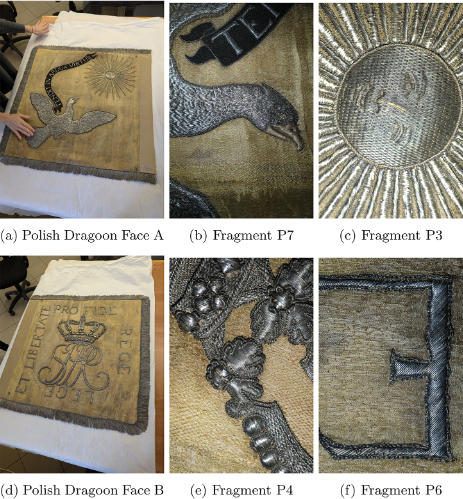
These tests suggest that the system was not simply learning the appearance of the Oseberg textiles. It could also recognize useful patterns in a different set of historical textiles.
Conclusion
By combining RTI with deep learning, researchers found a new way to study the damaged Oseberg textiles. The system confirmed some connections already identified by archaeologists and suggested another possible connection that can now be investigated further.
While the AI cannot determine with certainty which fragments belonged together, it provides archaeologists with another tool for studying the remains of these thousand-year-old textiles.
Khawaja, M. A., Gigilashvili, D., Łojewski, T., George, S., Marzani, F., Hardeberg, J. Y., & Mansouri, A. “Beyond relighting: RTI for clustering fragmented heritage textiles using deep learning.” npj Heritage Science, Vol. 14, Article 95 (2026). doi.org/10.1038/s40494-026-02326-9
