

A scientific paper that claimed satellite radar data could reveal previously unknown structures inside the Great Pyramid of Giza has been formally retracted, four years after its publication. But the decision does not overturn some of the pyramid’s most important recent discoveries, including a large void above the Grand Gallery and a hidden corridor behind its northern face.
The journal Remote Sensing retracted the 2022 study by Filippo Biondi and Corrado Malanga on August 10, 2026, after an investigation concluded that the paper contained “serious methodological flaws and statistical errors” that undermined its scientific conclusions. According to the official notice, concerns were initially raised by a reader and were subsequently investigated by the journal’s Editorial Office and Editorial Board. The authors were informed of the decision and disagreed with it.
That distinction is important. What has been withdrawn is not evidence that the Great Pyramid contains previously unknown spaces. Rather, the retraction concerns a particular method that purported to reconstruct the monument’s interior from satellite-based Synthetic Aperture Radar, or SAR, observations.
A method that claimed to make the pyramid effectively transparent
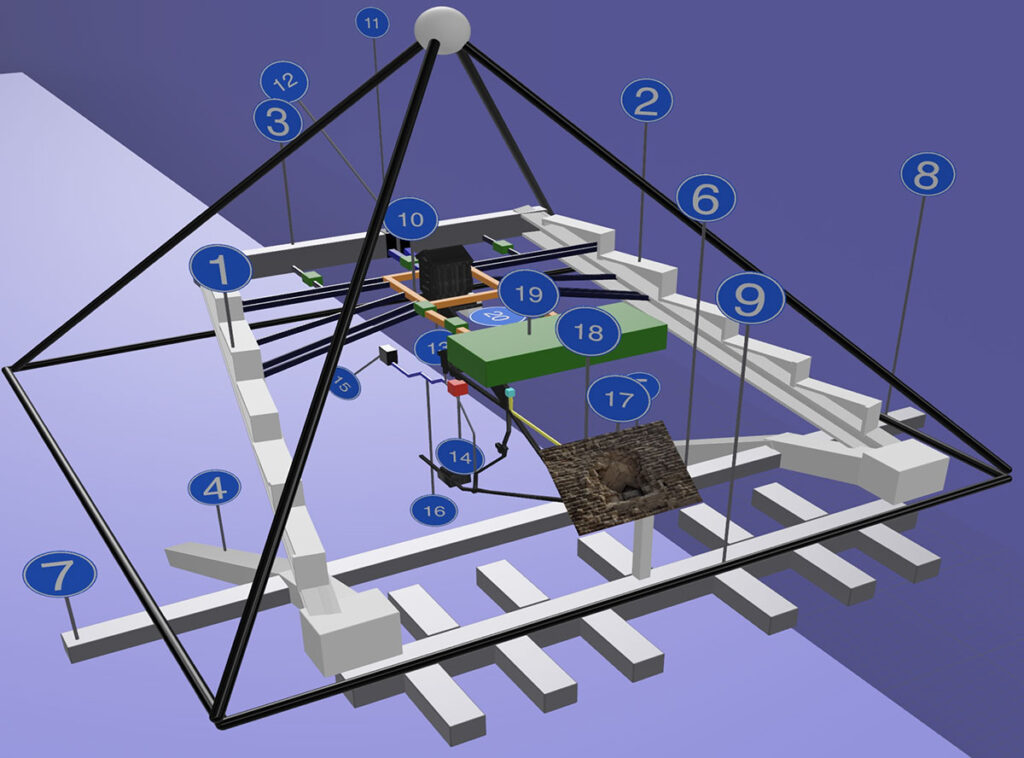
Biondi and Malanga’s original paper, published in October 2022, proposed an unconventional form of SAR Doppler tomography. Conventional radar faces severe limits when attempting to penetrate massive stone structures. The researchers instead argued that tiny movements within the pyramid, generated in part by background seismic vibrations, could be detected remotely and processed to reconstruct its internal architecture.
Using a series of images collected by Italy’s COSMO-SkyMed satellite system, the authors reported what they described as high-resolution three-dimensional tomography of both the pyramid’s interior and subsurface. They argued that their technique allowed them to reconstruct known features and identify structures that had never previously been discovered.
The journal’s 2026 retraction means those conclusions can no longer be treated as supported by the published paper. It does not, however, establish that every individual feature shown in the reconstructions is necessarily nonexistent; the journal’s notice is specifically directed at methodological and statistical problems serious enough to invalidate the paper’s scientific conclusions.
Biondi has publicly challenged the decision. In a response following the retraction, he called on Remote Sensing to specify the methodological and statistical errors behind the ruling and argued that the analytical model did not rely on statistical inference in the way implied by the notice. The formal retraction nevertheless remains in force.
Questions about validation appeared before publication
One of the more revealing aspects of the case is contained not in the retraction notice, but in Remote Sensing’s publicly available peer-review record.
During the review of the version eventually published in 2022, one reviewer explicitly wrote that validation of the results was missing and asked the authors to provide considerably more methodological information that would allow other scientists to reproduce the experiment. The reviewer also described the conclusions as weak from a validation standpoint.
The record also preserves reviews associated with an earlier submission of the manuscript, where the concerns were considerably more specific. One reviewer questioned whether features visible in the tomograms represented actual objects and cavities or artefacts created by the technique itself. Because the method was novel, the reviewer argued that it should first have been subjected to carefully controlled validation experiments using known targets and well-characterized conditions before being applied to the Great Pyramid.
The same review raised another fundamental problem: several tomographic images lacked meaningful dimensional axes, making it difficult to determine the scale of apparent structures. The reviewer also warned against subjective alignment between reconstructed radar images and diagrams of the pyramid and requested more rigorous, preferably automated comparisons with known internal architecture.
These comments do not prove that the 2026 retraction resulted directly from objections raised during peer review; the journal has not made that connection. They do show, however, that questions over experimental validation and the interpretation of apparent internal structures were already part of the paper’s review history years before its withdrawal.
What scientists have actually confirmed inside the Great Pyramid
The retraction should therefore not be confused with the separate body of evidence produced by the ScanPyramids project.
In 2017, researchers reported in Nature the discovery of the ScanPyramids Big Void, an unknown space positioned above the Grand Gallery. Instead of attempting to image through the pyramid with satellite radar, researchers used muons — high-energy particles produced when cosmic rays interact with Earth’s atmosphere and capable of passing through substantial amounts of stone.
The anomaly was not based on a single instrument. It was first observed with nuclear emulsion films inside the Queen’s Chamber, confirmed with scintillator detectors, and then independently detected again using gas detectors positioned outside the pyramid. The three muon techniques indicated a void with a minimum length of about 30 meters. Its purpose remains unknown.
Another unknown structure was subsequently identified behind the chevron-shaped masonry on the pyramid’s north face. In 2023, a study published in Nature Communications used two independent cosmic-ray muon detection systems to characterize what is now known as the ScanPyramids North Face Corridor. The measurements indicated a passage approximately nine meters long with a cross-section of roughly two by two meters.
The difference in scientific approach became even clearer afterward.
In 2025, researchers reported in Scientific Reports that the corridor had been examined using three different non-destructive methods — ground-penetrating radar, ultrasonic testing and electrical resistivity tomography. Because each technique relies on different physical principles and has different limitations, agreement between them provides an important means of testing whether an apparent anomaly corresponds to an actual feature.
A separate Scientific Reports study published in November 2025 focused specifically on electrical resistivity tomography. Measurements again detected a resistive anomaly consistent with the North Face Corridor, providing another independent line of evidence for the structure first identified through muon radiography.
The retraction does not empty the pyramid of mysteries
The scientific picture at Giza is therefore more complicated than the simple conclusion that a claim about “hidden corridors” has been disproved.
The 2022 SAR paper and the established ScanPyramids discoveries are based on fundamentally different evidence. The former attempted to infer detailed internal structures from satellite observations of microscopic movements and has now lost the scientific endorsement of the journal that published it. The Big Void and North Face Corridor, by contrast, have been detected through multiple measurements, and the corridor has subsequently been examined with entirely different physical techniques.
That distinction matters at a monument where images of supposed chambers, tunnels and underground structures can circulate internationally long before independent confirmation exists.
The retraction therefore changes what can responsibly be said about the SAR reconstructions of the Great Pyramid. It does not erase the pyramid’s confirmed hidden spaces. The Big Void and North Face Corridor have survived repeated measurements; the 2022 satellite-radar reconstruction has not survived scientific review.
Sources
This paper was retracted by Remote Sensing in August 2026: Biondi, F., & Malanga, C. (2022). Synthetic aperture radar Doppler tomography reveals details of undiscovered high-resolution internal structure of the Great Pyramid of Giza. Remote Sensing, 14(20), 5231. https://doi.org/10.3390/rs14205231
Morishima, K., et al. (2017). Discovery of a big void in Khufu’s Pyramid by observation of cosmic-ray muons. Nature, 552, 386–390. https://doi.org/10.1038/nature24647
Procureur, S., et al. (2023). Precise characterization of a corridor-shaped structure in Khufu’s Pyramid by observation of cosmic-ray muons. Nature Communications, 14, 1144. https://doi.org/10.1038/s41467-023-36351-0
