
Human remains inside a giant stone jar are reshaping an archaeological mystery
For nearly a century, the massive stone vessels scattered across the mountains of northern Laos have posed one of Southeast Asia’s most stubborn archaeological questions: what were the Plain of Jars actually used for?
A new study may have brought researchers closer than ever to an answer. Archaeologists excavating Site 75 on the Xieng Khouang Plateau have found the disarticulated remains of at least 37 people inside an exceptionally large stone vessel known as Jar 1. The discovery suggests that some of the region’s famous megalithic jars were not merely symbolic monuments, but active mortuary containers used over generations.
The research, published in Antiquity, describes Jar 1 as a collective secondary burial deposit dating roughly between AD 890 and 1160. That places the funerary activity in a period when Southeast Asia was becoming increasingly connected through trade, migration, and expanding political networks.
A rare excavation inside one of Laos’s giant jars
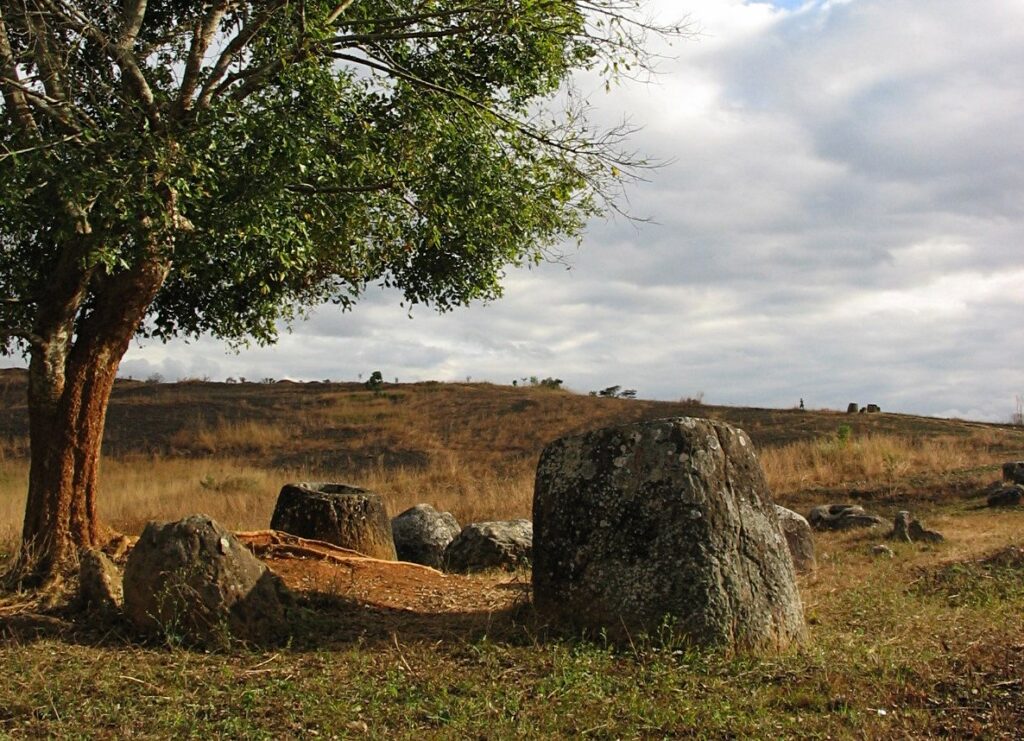
The Plain of Jars is one of the most unusual archaeological landscapes in Asia. More than 120 jar sites are known across northern Laos, with hundreds of large hollowed stone vessels spread across hillsides, forests, and open ground.
The jars have long been associated with funerary activity, but direct evidence has often been limited. Many sites were disturbed by looting, erosion or later activity. Others preserved only fragmentary traces of human bone, ceramics or burial markers.
Site 75 offered a rare opportunity. Located about 70 kilometers northeast of Phonsavan, it is the most northeastern jar site excavated so far. Its largest vessel, Jar 1, had a base diameter of 2.05 meters and a preserved height of 1.30 meters. Although damaged, the jar still retained its base and enough of its original structure to preserve material inside.
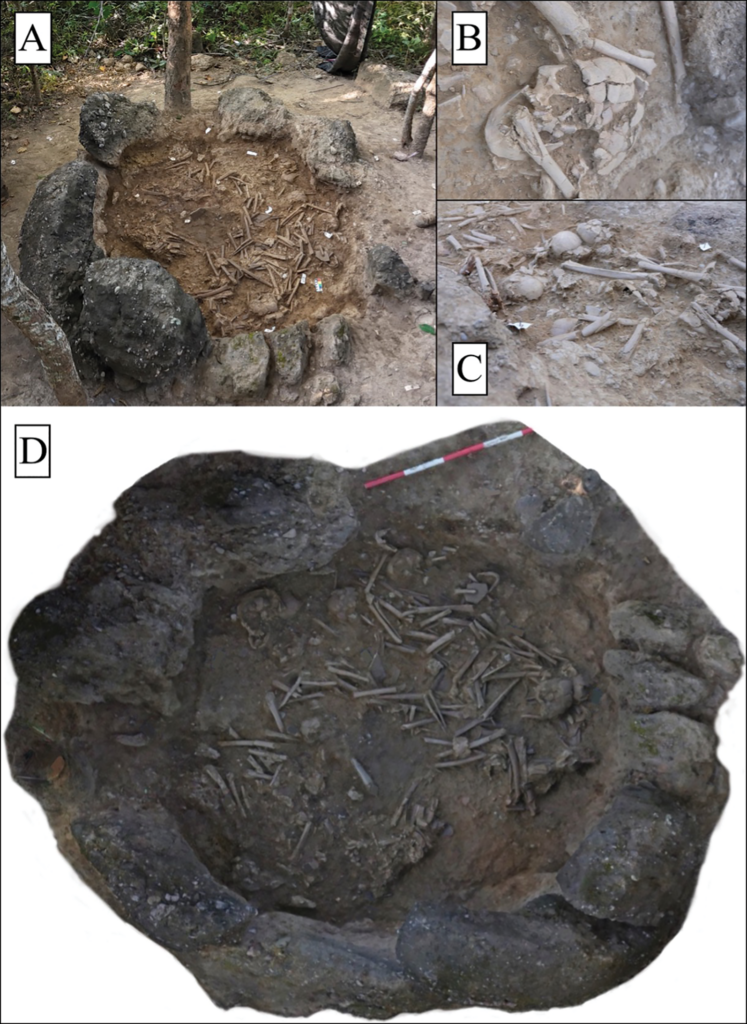
When researchers excavated the vessel, they found a dense deposit of human bones. The remains were not arranged as complete skeletons. Instead, skulls, mandibles and long bones had been placed in mixed and clustered groups, suggesting the dead had decomposed elsewhere before their bones were gathered and moved into the jar.
This practice is known as secondary burial. Rather than marking a single funeral event, Jar 1 appears to have functioned as an ossuary, a container for ancestral remains revisited over time.
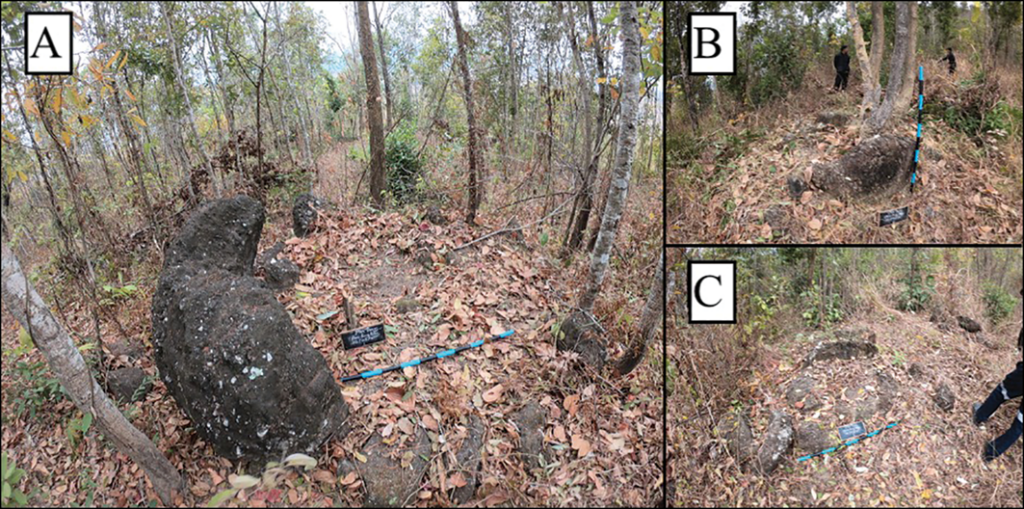
Site 75 jars prior to excavation: A) group 1, Jar 1; B) group 2, Jar 2; C) group 2, Jars 3 and 4 (figure by authors). Credit: Skopal, N., et. al., 2026, Antiquity
The remains of at least 37 individuals
The minimum number of individuals was calculated from dental remains. Researchers identified at least 37 people in the jar, including children and adults. Preliminary analysis indicates that ages ranged from about 1.5 years old to adulthood, though more detailed bioarchaeological work is still underway.
The bones were densely packed and lacked clear vertical layers. Some long bones were clustered around the jar’s edges, while cranial elements appeared in deliberate groupings. In a few cases, skulls and mandibles were still closely associated. This raises the possibility that some remains were placed in the jar before complete decomposition, or that certain skulls were deliberately arranged with special care.
Archaeologists also observed tooth ablation, a form of cultural dental modification involving the removal of selected teeth. Similar practices have been documented elsewhere in mainland Southeast Asia, making the Jar 1 community part of a wider regional tradition of bodily treatment, identity and ritual.
Offerings point to trade across Asia
The human remains were not alone. Inside Jar 1, archaeologists recovered earthenware sherds, an iron knife, a small copper-based bell, stone slabs and 20 glass beads. Nearby excavation in Trench 1 also revealed pottery vessels, including footed bowls and globular pots, along with stone tools and animal teeth.
The glass beads are especially important. Chemical analysis showed that several were made of mineral soda-high alumina glass, a composition associated with South Asian production. Others were linked to soda plant-ash glass, likely connected to Mesopotamian glass traditions. One bead may have originated in southeastern China or northern Vietnam.
This mixture of materials points to surprisingly wide connections. The people using Jar 1 were not isolated highland communities cut off from the wider world. They were part of exchange networks that linked the Lao highlands with South Asia, the Middle East, and other parts of Southeast Asia.
That matters because many early trade discussions focus on lowland centers and maritime routes. The Site 75 evidence suggests that upland communities also participated in long-distance circulation of goods, technologies, and ritual objects.
A mortuary tradition lasting generations
Radiocarbon dating of human teeth and bone from inside Jar 1 produced dates between the late ninth and mid-twelfth centuries AD. A charcoal sample from nearby pottery in Trench 1 also dated to around AD 890 to 1020.
Taken together, the results suggest the jar may have been used for several generations, possibly for as long as 270 years. This does not look like a one-time burial. It looks more like a place where a family, lineage or community returned repeatedly to deposit remains and perform ancestral rites.
The scale of the deposit makes Jar 1 unique. According to the study, it is currently the only known megalithic jar in Laos to contain a multigenerational secondary burial of this size.
Its size and unusual form may also indicate a local tradition within the wider Plain of Jars cultural sphere. The researchers caution that not all jars necessarily had the same function. Some smaller jars may have served as temporary containers for bodies during decomposition, while larger jars may have received bones later in the funerary process.
This could help explain why many stone jars across Laos are empty today. They may not have been final tombs. Instead, they could have been one stage in a longer ritual sequence involving decomposition, collection, relocation and ancestral remembrance.
Laos’s ancient jars enter a wider historical world
The dating of Jar 1 places the activity at a time of major political and economic transformation across Asia. Between the ninth and twelfth centuries, the Khmer Empire was expanding in mainland Southeast Asia, the Pagan Kingdom was rising in Myanmar, the Song Dynasty was reshaping commerce in China, and regional polities in Vietnam, Yunnan, and Thailand were increasingly connected.
In that setting, the Plain of Jars was not a remote mystery frozen outside history. It was part of a changing world of trade, movement, and cultural exchange.
The discovery at Site 75 does not solve every question. Researchers still do not know exactly who made the jars, why the tradition began, or why it eventually stopped. But Jar 1 provides unusually direct evidence that at least some of these monumental vessels were deeply tied to death, memory, and community identity.
The most striking part of the discovery is not simply that human remains were found inside a jar. It is that the jar appears to have held the dead across generations. In the highlands of Laos, a stone vessel once returned to again and again may have served as a durable place for the living to remain connected with their ancestors.
Skopal, N., Pradier, B., Bounxayhip, S., Cooper, C., Dussubieux, L., Devantier-Thomas, T. G., … Clark, G. (2026). The death jar: a new mortuary tradition at the Plain of Jars, Lao PDR. Antiquity, 1–18. doi:10.15184/aqy.2026.10352
Cover Image Credit: Public Domain
