
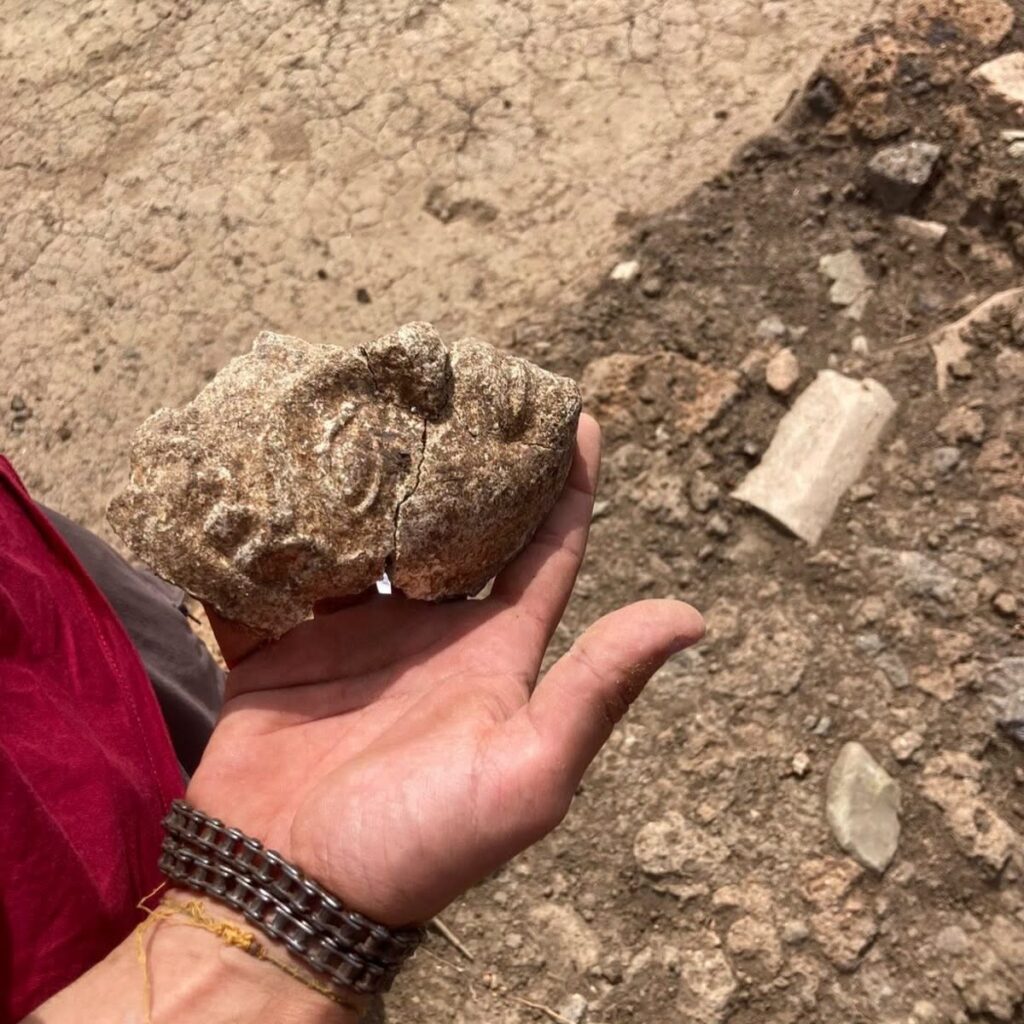
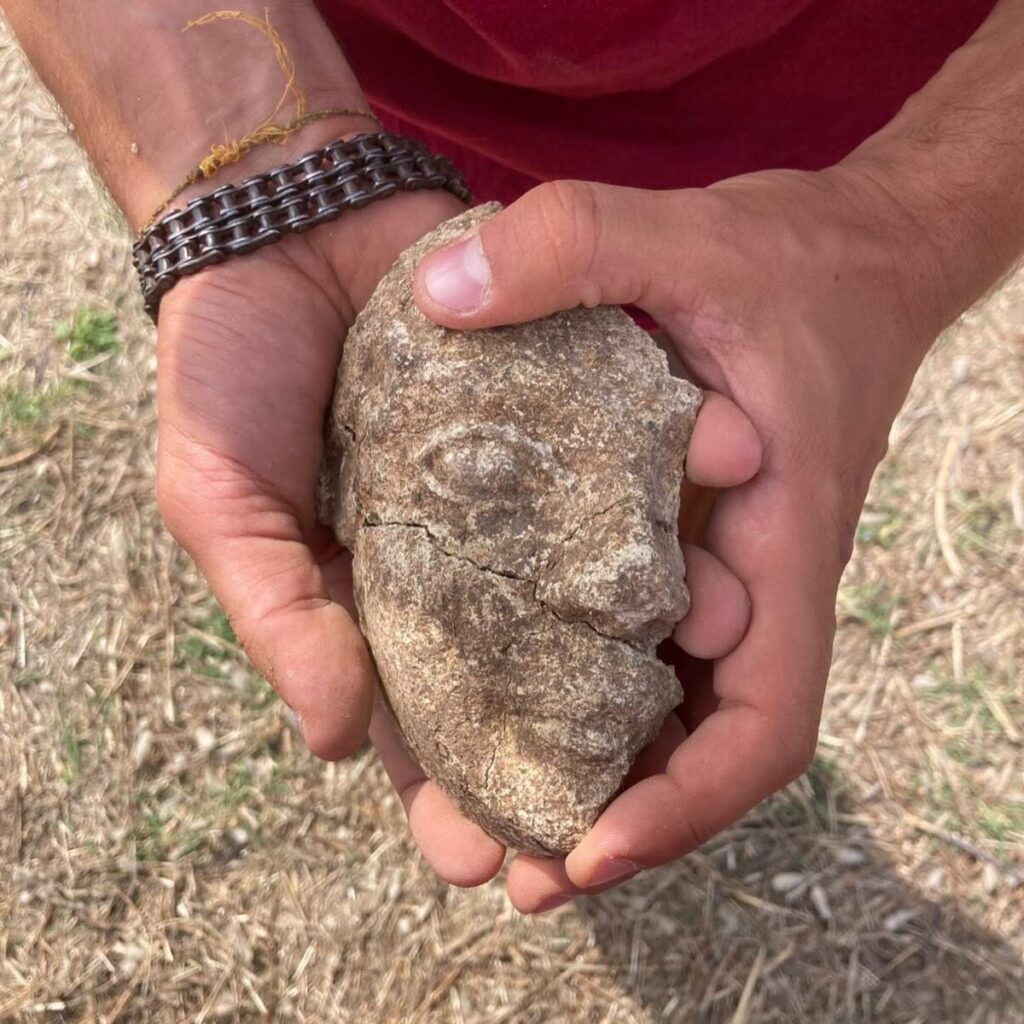
Archaeologists working at the ancient sanctuary of Pyrgi in central Italy have uncovered a new fragment of an architectural terracotta depicting the face of Uni, one of the most important goddesses of the Etruscan world.
The fragment emerged in the area of Temple B, where students and researchers from Sapienza University of Rome resumed excavations this year. The location gives the find particular significance: Temple B was dedicated to Uni more than 2,500 years ago, a connection recorded in the famous gold tablets discovered at Pyrgi in the 1960s.
Sapienza announced the discovery with a simple phrase: “This morning, at Pyrgi, Uni returned to look at us.” The university identified the object as a new fragment of an antefix bearing the goddess’s face.
Antefixes were decorative architectural elements placed along the edges of tiled roofs in Greek, Etruscan and Roman buildings. Often made of terracotta, they could carry human faces, divine figures or other protective and symbolic imagery. Female-headed antefixes from Temple B at Pyrgi were already known, making the new piece an addition to a much larger body of architectural decoration rather than the first representation of Uni found at the site.
Uni and the temple built in her honor
Uni occupied a prominent position in Etruscan religion and was later closely associated with the Roman Juno and the Greek Hera. Her sphere extended beyond marriage and women: evidence from Etruria also connects her with political authority and the protection of the community.
At Pyrgi, however, Uni acquired an especially important international dimension. The sanctuary identifies her with the Phoenician goddess Astarte, illustrating the close cultural contacts that linked Etruscans, Phoenicians and other Mediterranean communities during the Archaic period.
Temple B was constructed toward the end of the sixth century BC. The building had a single cella and a columned exterior and formed part of one of the most important religious complexes in Etruria. Later additions included the larger Temple A, built during the fifth century BC.
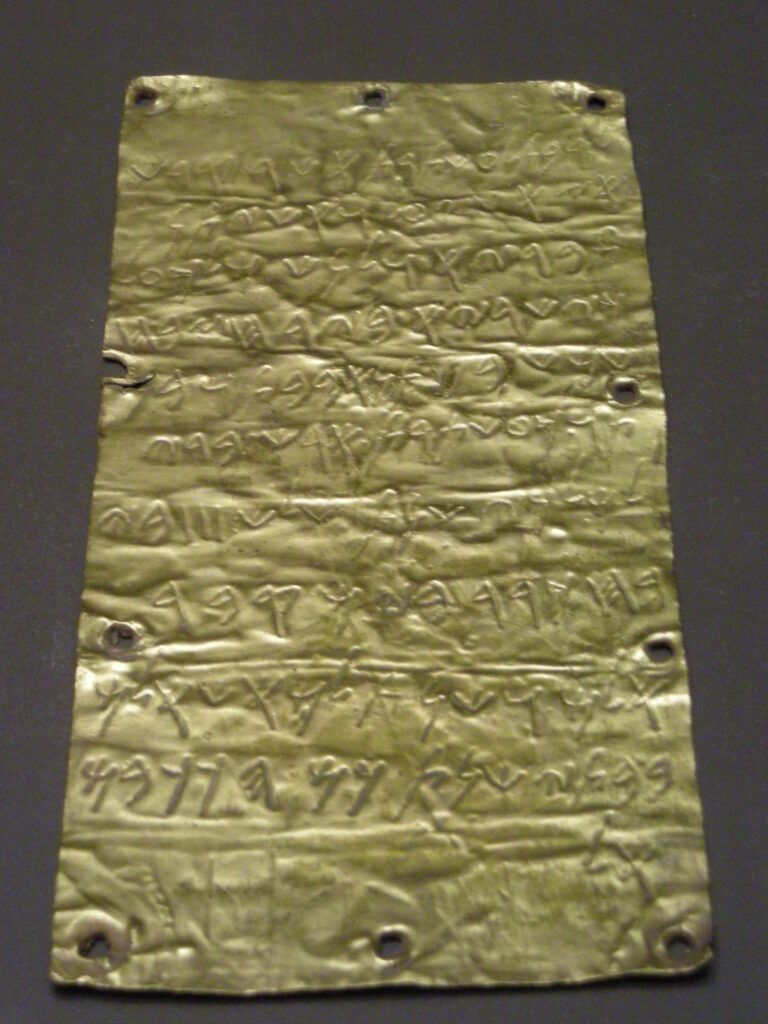
The connection between Temple B and Uni is unusually well documented because of three thin gold tablets discovered at Pyrgi in 1964. Two carry inscriptions in Etruscan and one in Phoenician, providing one of the most important bilingual records surviving from the ancient Mediterranean.
The inscriptions record a dedication made by Thefarie Velianas, the ruler or chief magistrate of Caere, the powerful Etruscan city now known as Cerveteri. They associate the sanctuary with Uni in the Etruscan text and Astarte in the Phoenician version, while Temple B itself is generally dated to around 510 BC. The original tablets are now preserved at the National Etruscan Museum of Villa Giulia in Rome.
A new fragment from one of Etruria’s major sanctuaries
Ancient Pyrgi stood on the Tyrrhenian coast near modern Santa Severa and served as one of the ports of Caere. More than half a century of excavations led by Sapienza University have revealed temples, sacred buildings and rich architectural terracottas, establishing the sanctuary as one of the key sites for understanding Etruscan religion and Mediterranean cultural exchange.
The newly recovered face is therefore a modest object with an unusually precise archaeological context. It comes from the very temple whose ancient inscriptions preserve the name of the goddess it represents.
More than 2,500 years after Uni was worshipped at Pyrgi, another part of her image has now emerged from the sanctuary dedicated to her.
