
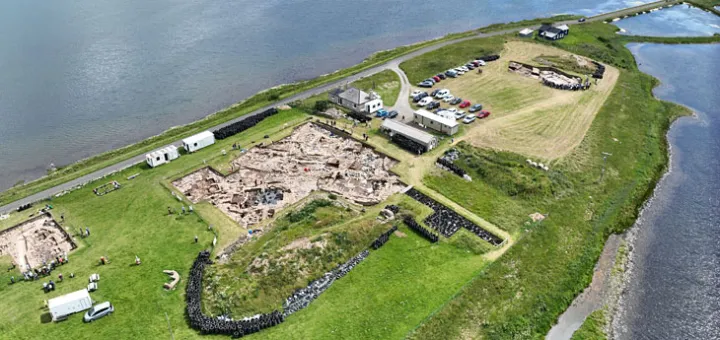
Archaeologists are preparing to resume excavations at the internationally renowned Ness of Brodgar after advanced 3D radar scans revealed what experts are calling an “extraordinary” and potentially history-changing discovery. The site, located in the heart of Orkney’s UNESCO-listed landscape, has already transformed understanding of Neolithic Britain. Now, fresh evidence beneath the surface could add an entirely new chapter to its story.
The Ness of Brodgar, a narrow strip of land between the lochs of Stenness and Harray in Orkney, lies within the Heart of Neolithic Orkney World Heritage Site. It sits just southeast of the iconic Ring of Brodgar and close to the Stones of Stenness—two monumental stone circles often compared to Stonehenge in southern England.
20 Years of Excavation
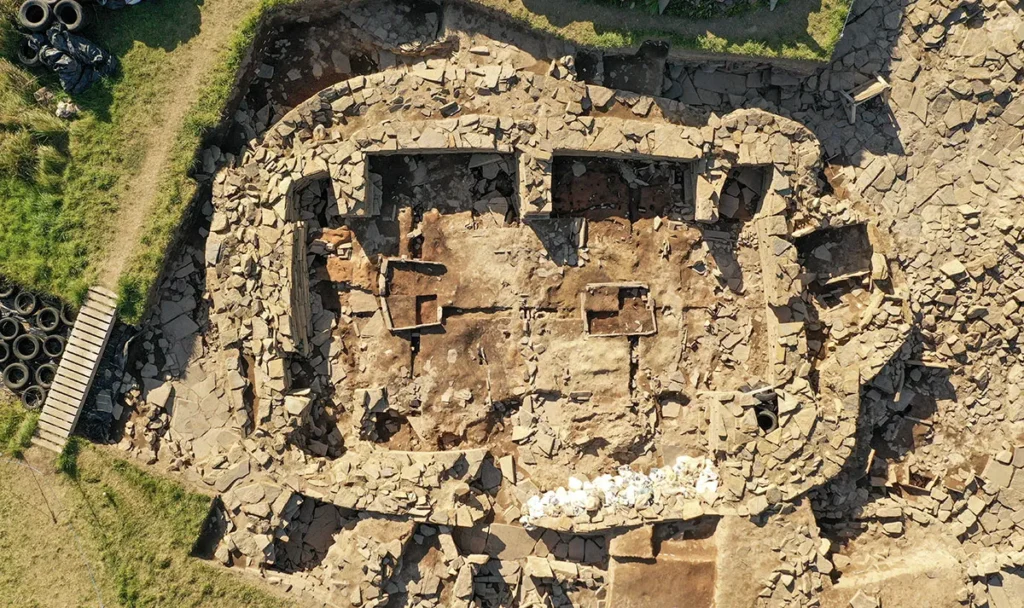
Between 2004 and 2024, archaeologists uncovered around 40 stone structures at the three-hectare site. These monumental buildings, constructed in phases between roughly 3500BC and 2400BC, featured walls up to four meters thick and finely crafted stonework. Richly decorated pottery, painted stones, and evidence of large-scale feasting suggested the Ness was not an ordinary settlement but likely a ceremonial and social hub for prehistoric communities.
The Ness of Brodgar Trust has described the site as “without parallel in Atlantic Europe,” and many experts consider it one of the most significant Neolithic discoveries in the British Isles.
When fieldwork officially ended in 2024, trenches were carefully backfilled to preserve the exposed structures. Archaeologists believed large-scale excavation had concluded for good.
3D Radar Reveals a Mystery
However, during the summer of 2025, researchers conducted a series of geophysical surveys using advanced Ground Penetrating Radar (GPR). For the first time in Scotland, this particular 3D GPR technology was deployed to create comprehensive underground images of the entire site.
According to BBC reporting, the scans revealed something “totally dissimilar to anything else we’ve uncovered” at the Ness. Archaeologist Nick Card, who has worked on the site since 2004, told the BBC that the anomaly was so unusual it “could add a new chapter to the history of the Ness.”
“We think this is so unusual that it could add a new chapter to the history of the Ness,” Card said in an interview cited by the BBC. He also noted that the area in question did not appear to contain deep archaeological deposits, meaning the upcoming work would not trigger another decades-long excavation.
Card cautioned: “Don’t expect three-dimensional Neolithic buildings. Possibly it is not Neolithic, I think probably later, but it could be contemporary.”
These statements, attributed to the BBC’s coverage of the discovery, underline just how unexpected the findings are. Unlike the rectilinear architecture that defines the Ness—known for its straight lines and rectangular forms—the new anomaly appears to differ fundamentally in character.
“Keyhole Surgery” Excavation Planned
The renewed dig, funded by the revived Time Team television programme, will follow what Nick Card has described as a “keyhole surgery” approach. Rather than reopening extensive trenches across the site, archaeologists plan to open a small, carefully targeted area to investigate the newly identified anomaly.
Card explained that the team had previously considered fieldwork at the site complete after the trenches were backfilled. However, a series of geophysical surveys carried out last summer revealed what he called an “extraordinary” subsurface feature, prompting a return to excavation under tightly controlled conditions.
The excavation is scheduled to run for four weeks in July 2026 and will be open to the public, giving visitors a rare opportunity to observe high-precision archaeological work in one of Europe’s most significant prehistoric landscapes. The monumental Neolithic structures uncovered during earlier campaigns will remain reburied to safeguard their long-term preservation.
The Role of the Ness in Britain’s Neolithic Landscape
The broader Orkney archipelago has long been recognized as a cradle of Neolithic innovation. Around 5,000 years ago, communities here were building monumental stone complexes at a time when much of Europe was still transitioning from hunter-gatherer lifestyles to settled farming.
The density and sophistication of monuments in Orkney—including chambered cairns, stone circles, and settlement complexes—suggest the islands were a powerful cultural center in prehistoric Britain. Some researchers believe Orkney may even have influenced ceremonial traditions further south.
The Ness of Brodgar, strategically positioned between major stone circles, appears to have functioned as a focal point in this sacred landscape. Excavations revealed large halls that may have hosted ritual gatherings, political assemblies, or seasonal feasts. The discovery of finely crafted artifacts indicates skilled artisans and a socially complex community.
A Discovery Beyond the Neolithic?
One of the most intriguing aspects of the newly detected anomaly is the possibility that it may not be Neolithic at all. As Card suggested in remarks reported by the BBC, it could date from a later period—or, alternatively, be contemporary but architecturally distinct.
If confirmed as post-Neolithic, the find would challenge assumptions that the site was exclusively active between 3500BC and 2400BC. It could reveal continuity of use or later reoccupation, reshaping the historical narrative of the region.
Even if the anomaly proves to be Neolithic, its apparent departure from the site’s characteristic rectangular design could signal a previously unknown phase of construction or ritual practice.
Anticipation Builds for 2026
With global interest already high, the 2026 excavation season is expected to draw archaeologists, historians, and tourists alike to Orkney. The combination of innovative technology and one of Europe’s most significant prehistoric landscapes has created a sense of anticipation rarely seen in British archaeology.
As further analysis of the radar data continues and excavation begins, experts hope to “stitch together” new 3D models of the site—again echoing comments made to the BBC—to better understand how the Ness developed over centuries.
For now, the mystery remains buried just beneath the surface. But if the early indications are correct, the next chapter in the story of the Ness of Brodgar could prove as groundbreaking as the last.
Cover Image Credit: Ness of Brodgar Project
