

Archaeologists excavating the ancient Bosporan settlement of Artezian have uncovered a remarkable ritual landscape where offerings were deliberately lowered into the earth, vessels were turned upside down for chthonic deities, and a powerful earthquake appears to have interrupted food preparation inside a nearby sacred building around 1,700 years ago.
The discoveries emerged during excavations in 2024 and 2025 on Artezian’s southern temenos, or sacred precinct, on the Kerch Peninsula in Crimea. Archaeologist Nikolai Vinokurov of Moscow Pedagogical State University details the finds in a new study published in the 2026 volume of Drevnosti Bospora, an international archaeological annual issued by the Institute of Archaeology of the Russian Academy of Sciences. The newly excavated area lies close to the remains of a sanctuary associated with Zeus Genarchos and Zeus Soter.
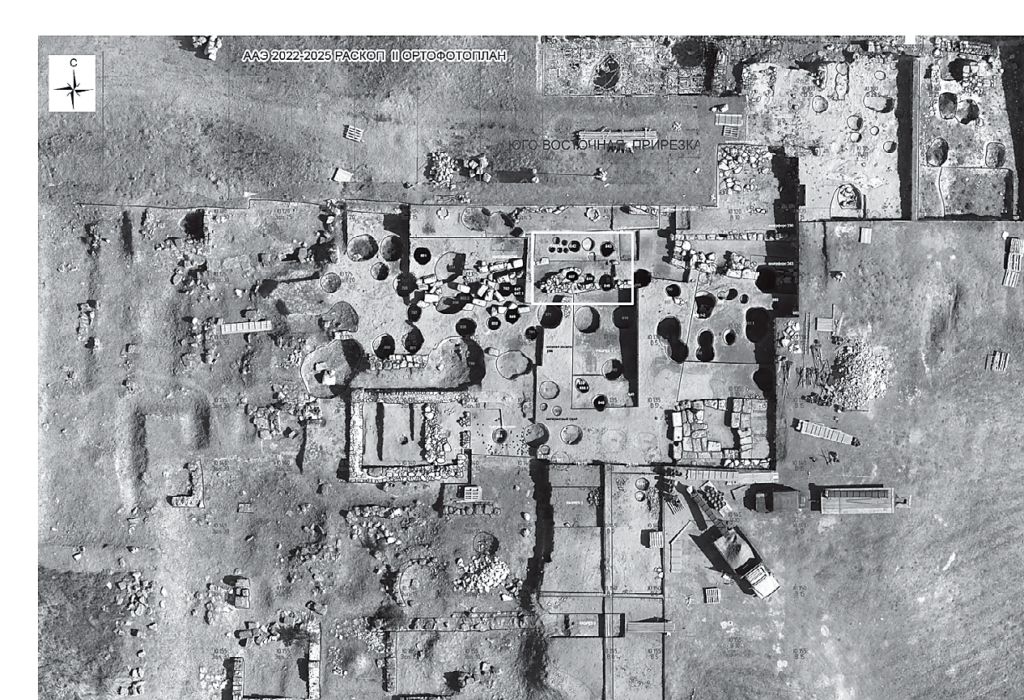
Credit: N. I. Vinokurov / Drevnosti Bospora 31 (2026)
Offerings Descended Into a Bell-Shaped Pit
One of the most striking discoveries is Pit 837, an unusual bell-shaped shaft approximately 4.12 meters deep. It appears to have begun with another function before being transformed into a bothros, a pit used for ritual deposits. Archaeologists identified several distinct levels of offerings inside it, indicating that the feature was used repeatedly rather than filled during a single ceremony.
Whole ceramic vessels had been carefully placed at different depths, many of them upside down. Vinokurov connects this repeated inversion with religious practices directed toward chthonic gods — divine powers associated with the earth and the world below. Similar ritual treatment of objects was already part of local religious practice during the first centuries CE.
The offerings were not limited to pottery. Archaeologists recovered a realistically shaped sandstone phallus measuring 72 millimeters long, eight circular counters cut from amphora walls, an iron knife, jewelry and other small objects. Sediment samples also contained carbonized wheat and barley grains as well as remains of cultivated grapes; several grape seeds were recovered directly from a large red-slipped bowl. The study cautiously raises the possibility that some of these plant remains belonged to offerings.
A neighboring ritual pit produced an even stranger object. Fashioned from a horse ankle bone, it resembles the stylized torso of an animal, perhaps a boar or pig, and carries a net-like pattern with two rounded “eyes” painted in bright blue pigment. Vinokurov suggests that it may have served as an offering and notes that no comparable painted object had previously been found at Artezian.
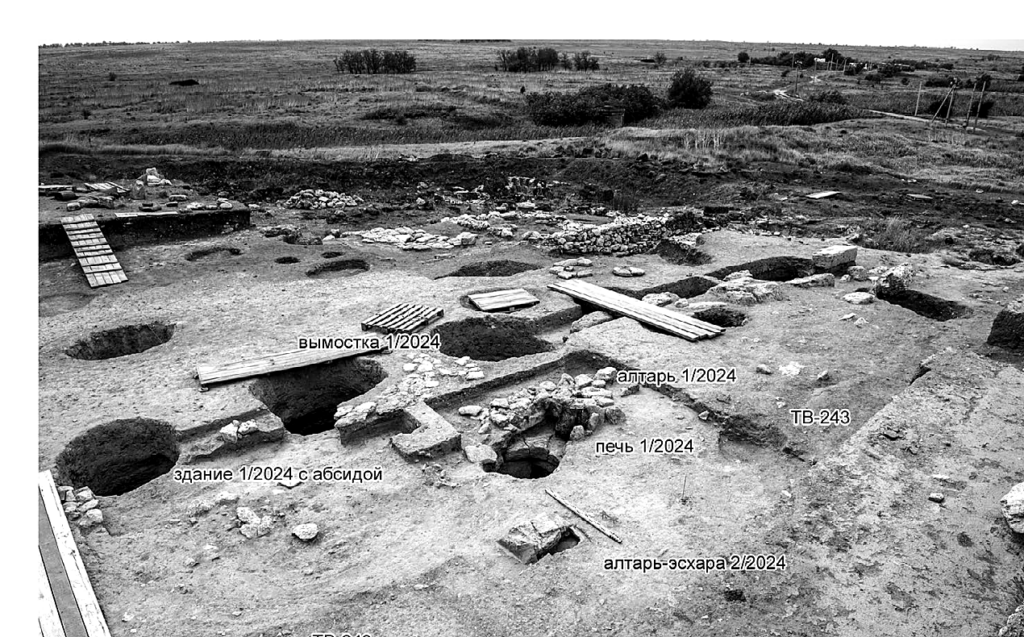
Credit: N. I. Vinokurov / Drevnosti Bospora 31 (2026)
An Earthquake Interrupted the Meal
Above and around the earlier ritual pits, archaeologists identified another phase of activity centered on a small building equipped with two altars and an unusual two-level oven. Vinokurov considers it possible that this building functioned as a sanctuary, with the oven used to prepare food for attendants or participants in sacred dining ceremonies.
The oven itself had an unusual construction. Instead of the more common vertical supports beneath its upper surface, part of the cooking platform rested on a hollow, tapering clay cone. The study notes that no close architectural parallel for this feature has yet been identified.
Then came the earthquake.
A strong seismic event, dated broadly to 255–269/275 CE, damaged the building, its altars and the oven. Part of the cooking structure collapsed into the older ritual pit below, carrying vessels with it. Several pots still preserved blackened organic material on their inner surfaces, probably the remains of burned porridge or another prepared food. Vinokurov concludes that the earthquake struck while a meal was being prepared, most likely during daylight hours.
The catastrophe also left its mark on the ritual installations. A limestone altar used for libations was split by a seismic crack, while another altar built from mudbrick preserved evidence of repeated ceremonies. Its limestone cover had been coated with clay at least seven times, and each successive surface showed traces of burning. Rather than assigning a fixed symbolic meaning to the number seven, the study suggests that the layers may represent successive episodes of ritual use.
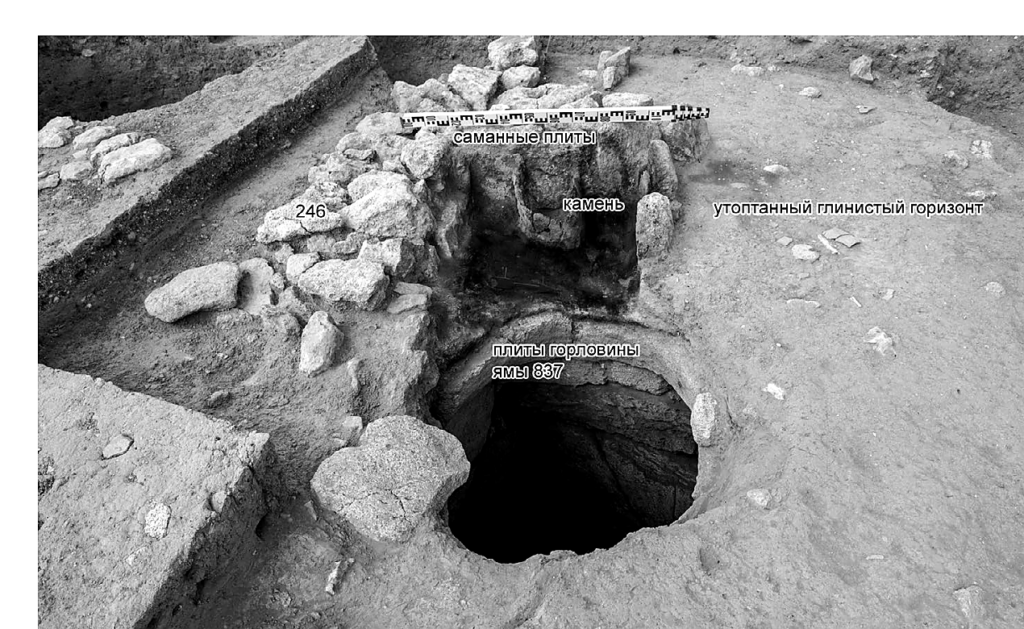
Credit: N. I. Vinokurov / Drevnosti Bospora 31 (2026)
The Sacred Landscape Outlived the Temple of Zeus
The newly discovered features belonged to a much older sacred landscape. Artezian’s southern temenos had previously contained a Doric temple dedicated to Zeus Genarchos and Soter, with building phases associated with the periods of Mithridates VI Eupator and his son Pharnakes. The sanctuary went through repeated destruction and rebuilding, and its precise later history remains complex.
What the new excavations show more clearly is that the sacred significance of this part of Artezian survived major architectural change. Later sacrificial pits contained fragments of a large marble statue of Zeus, including parts of its torso and head, along with the heads of horses, goats, pigs and sheep. Terracotta figurines, lamps, coins, magical graffiti and other objects were also deposited in ritual contexts.
Even after the Temple of Zeus Genarchos and Soter had been destroyed, altars, bothroi, votive deposits and evidence of fire rituals continued to mark the southern zone as sacred. The researchers therefore see the 2024–2025 discoveries not as an isolated ritual installation, but as another chapter in the long religious life of the site.
The earthquake preserved an unusually vivid moment within that history: vessels falling from an oven while food was still being prepared. Yet the deeper story at Artezian lies beneath the ruined building, in a four-meter-deep pit where generations of offerings had already been directed toward the world below.
Vinokurov, N. I. (2026). “Late 3rd century CE altars of the southern temenos of the Artezian settlement.” Drevnosti Bospora, 31, 50–73. DOI: 10.25681/IARAS.2026.978-5-94375-501-9.50-73.
