
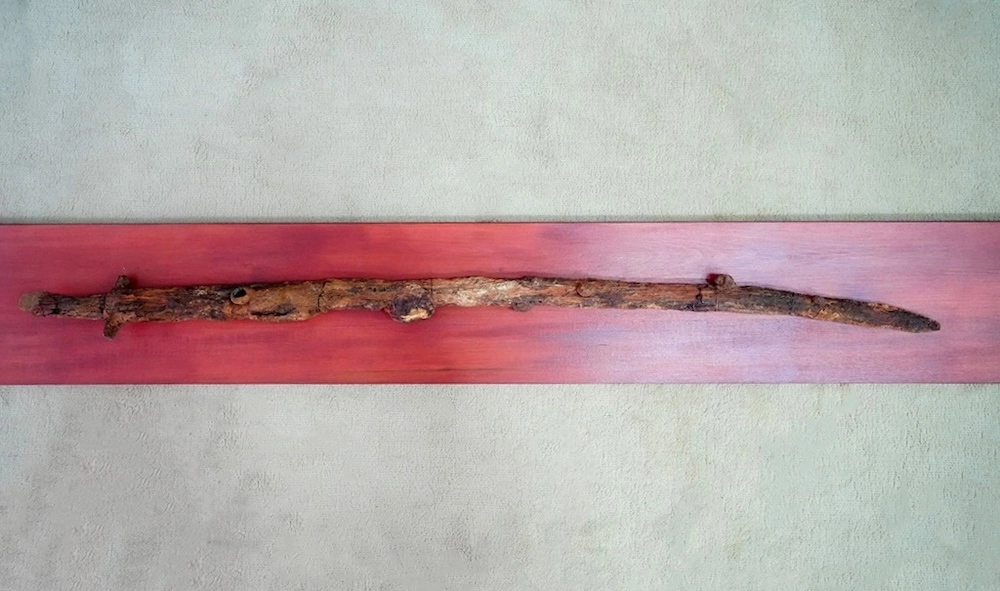
Archaeologists in Russia’s Astrakhan region have uncovered an unusually long medieval saber in a 13th-century male burial, a discovery now being described as one of the most striking recent additions to the Astrakhan Museum-Reserve.
The weapon, found at the archaeological site known as the “Orlinoye Gnezdo” settlement and ground burial cemetery in Krasnoyarsky District, measures 112 centimeters while still in its wooden scabbard. Its blade alone is close to one meter long, far exceeding the more typical medieval saber length of about 70 centimeters.
Museum specialists believe the saber was not a standard weapon. Its size, preservation, and construction suggest it may have been made to order for a specific owner, possibly a high-status warrior connected to the turbulent world of the lower Volga in the second half of the 13th century.
Two unusual graves among dozens of Muslim burials
The discovery was made during last year’s field season by specialists from the scientific and production institution “Nasledie” in Astrakhan Oblast. Archaeologists examined a 50-square-meter area on a small rise at the Orlinoye Gnezdo site, where they identified more than 50 Muslim burials, most of them without grave goods.
In the final days of excavation, however, two graves stood apart from the rest.
The upper burial, labeled No. 52, contained the remains of a man placed in a rectangular grave pit with his head to the west. According to archaeologist Tatyana Grechkina, the body position was highly unusual. The man appears to have been laid face down, with signs that his hands had been bound before burial. The position of the skull also suggested severe trauma to the neck.
Yet the grave does not fit easily into a simple execution scenario. About 20 centimeters north of the body, archaeologists found the leg bones of a horse, along with a stirrup and a buckle from horse harness equipment. These items point to a burial practice with symbolic or status-related meaning rather than a hurried disposal.
Just 20 centimeters below this grave, archaeologists found an earlier burial, No. 53, dated to around the middle of the 13th century. It contained another male skeleton, placed in an oval pit with the head to the east. When the remains were cleared, archaeologists noticed a dark coating over the head and upper torso. One hypothesis is that these traces may come from decayed leather armor and perhaps a helmet.
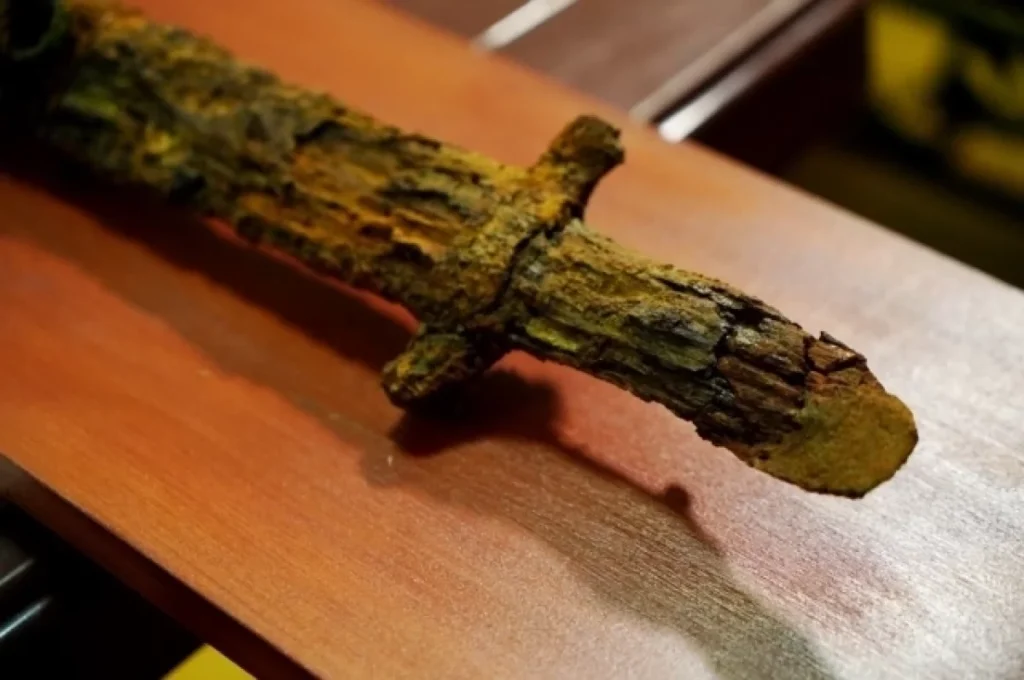
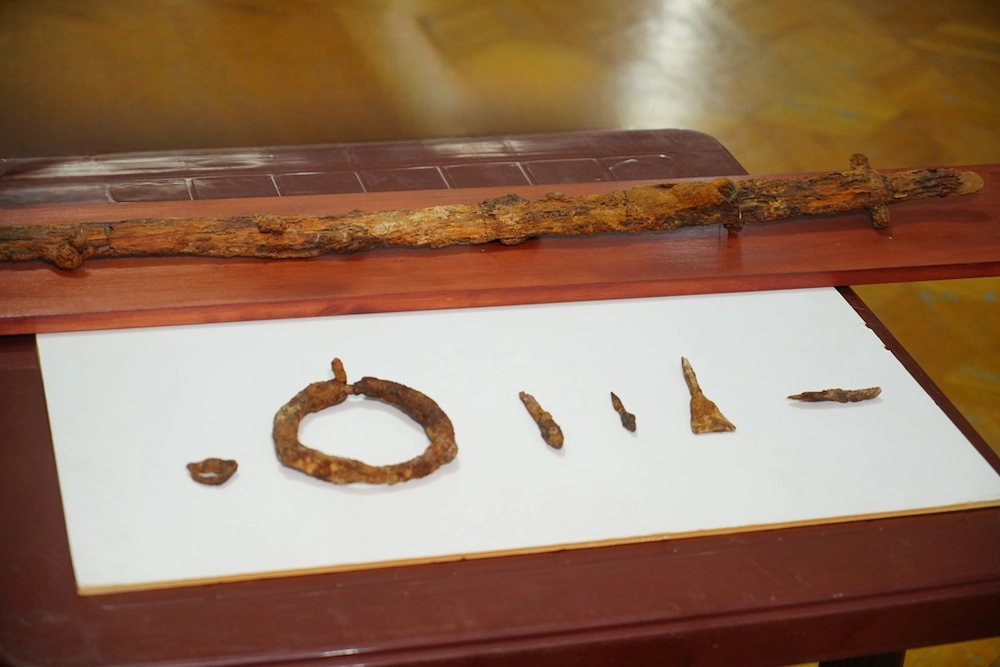
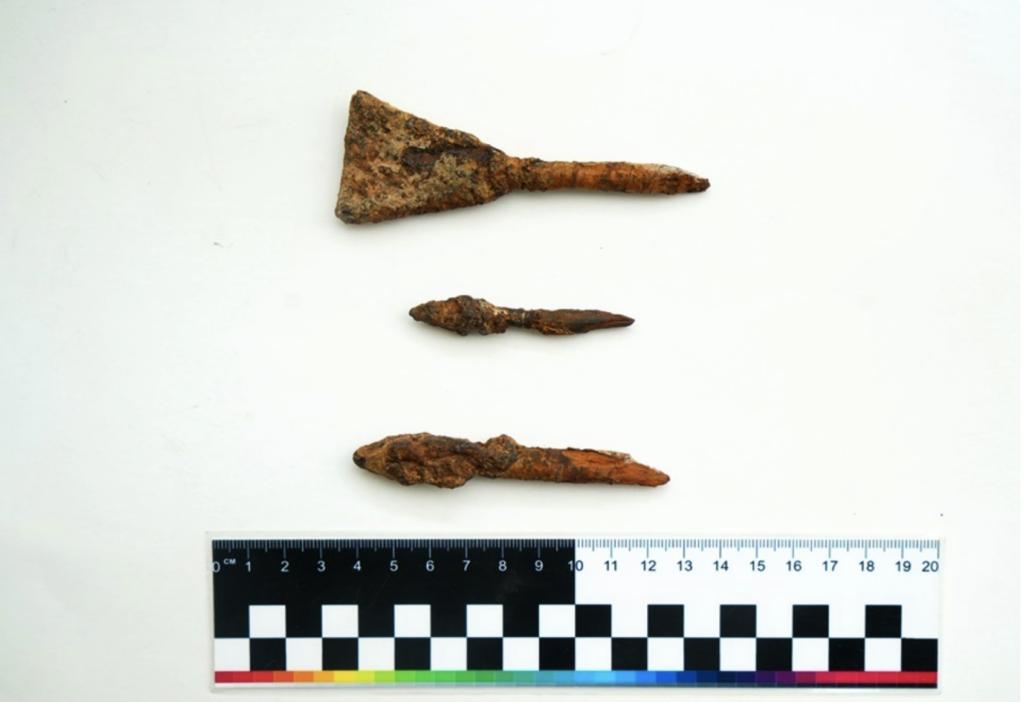
The grave also held arrowheads and the remarkable saber in its wooden scabbard.
A weapon preserved by its own scabbard
The saber was not lifted from the soil as a loose object. Archaeologists removed it as a block together with the surrounding earth. The block weighed about 15 kilograms, and restoration later took four months.
Restorer Mikhail Golovachev said the preservation was exceptional. The iron blade had remained inside the wooden scabbard, and iron oxides appear to have helped preserve the wood. This unusual chemical process allowed parts of the weapon and its fittings to survive in a condition rarely seen in medieval iron objects.
The saber’s size is what makes it especially puzzling. Golovachev noted that ordinary medieval blades of this type were much shorter and widely available through arms trade networks. This example, by contrast, seems too long for mass production.
He suggested it may have been made for a particularly tall individual, perhaps someone around two meters in height, since drawing such a long blade from its scabbard would require a broad reach. Yet the skeleton in the grave measured about 175 centimeters. That discrepancy leaves open questions about whether the saber was symbolic, ceremonial, inherited, or simply designed for a fighting style that is not yet fully understood.
Beneath the saber, archaeologists also found about 50 square centimeters of birch bark. The remains may belong to a birch-bark quiver. A preserved suspension element from the weapon also offers clues about how the saber was worn.
Astrakhan’s medieval archaeology gains a major find
Along with the saber, seven objects were transferred to the Astrakhan Museum-Reserve. These include a stirrup, a belt buckle, arrowheads, the saber itself, and a knife fragment found near the right arm and sternum of one of the burials. Whether the knife was connected to the man’s death or placed there as part of the burial remains uncertain.
Dmitry Vasilyev, senior researcher at the Astrakhan Museum-Reserve, said the region is experiencing an especially productive period in archaeological research. New sites are helping scholars examine a historically complex period in the Volga delta, where Islamic burial traditions, steppe warfare, horse culture, and long-distance connections intersected during the medieval era.
The 13th century was a time of major political and military transformation across the Eurasian steppe. In the lower Volga, communities lived within a landscape shaped by trade, conflict, migration and the rise of powerful steppe polities. A weapon of this quality, found with arrowheads and possible armor traces, gives archaeologists a rare physical link to that world.
The artifacts are now being formally registered into the museum collection. According to museum officials, they are expected to go on display at the Local History Museum closer to August.
For now, the 112-centimeter saber stands as more than an impressive weapon. It is a clue from a layered burial ground near Astrakhan, where one grave suggests violence, another hints at warrior identity, and a blade preserved in wood has reopened questions about status, warfare, and burial customs in the medieval lower Volga.
Cover Image Credit: Astrakhan Museum-Reserve
