

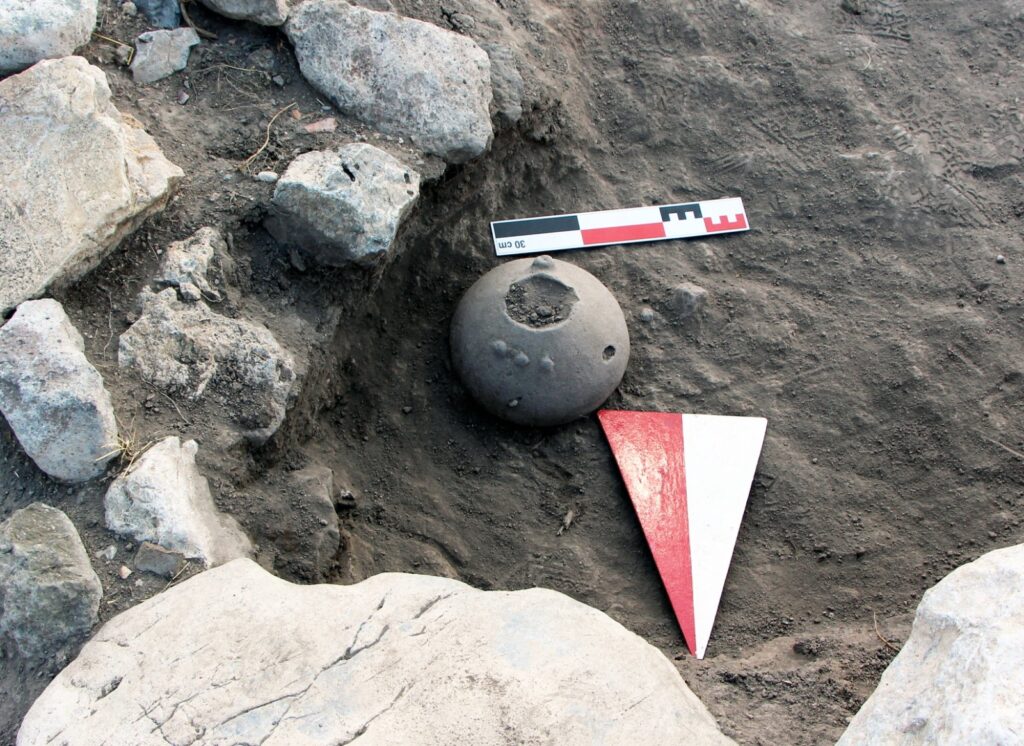
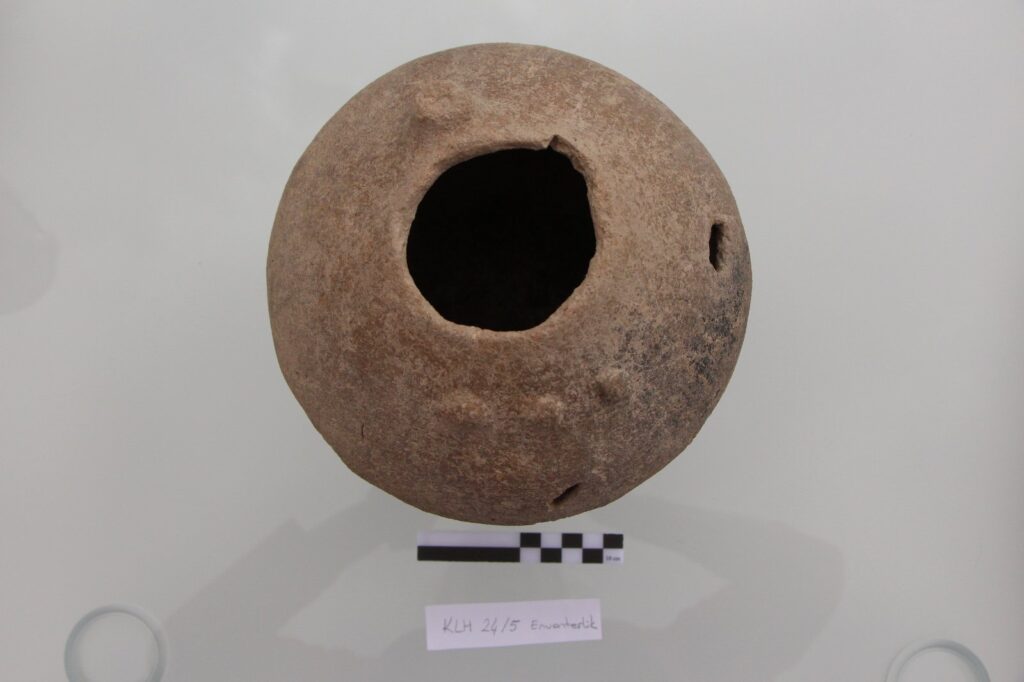
A 4,000-year-old vessel unearthed at the Hittite settlement of Külhöyük in central Türkiye has produced an unusually delicate discovery: ancient seed remains identified as belonging to Sevgi Çiçeği, an endemic flower that still grows in Ankara’s Gölbaşı district today.
Türkiye’s Minister of Culture and Tourism Mehmet Nuri Ersoy announced the find, describing the remains as the world’s oldest known seed traces of the plant. Known scientifically as Centaurea tchihatcheffii, the flower now survives within a remarkably restricted landscape around Gölbaşı — the same district where Külhöyük has preserved thousands of years of human occupation.
What makes the discovery striking is therefore not simply the age of the seeds. A plant now regarded as one of Ankara’s most distinctive and vulnerable endemic species appears to have been growing in the landscape inhabited by communities at Külhöyük roughly four millennia ago.
A Hittite city on an important route
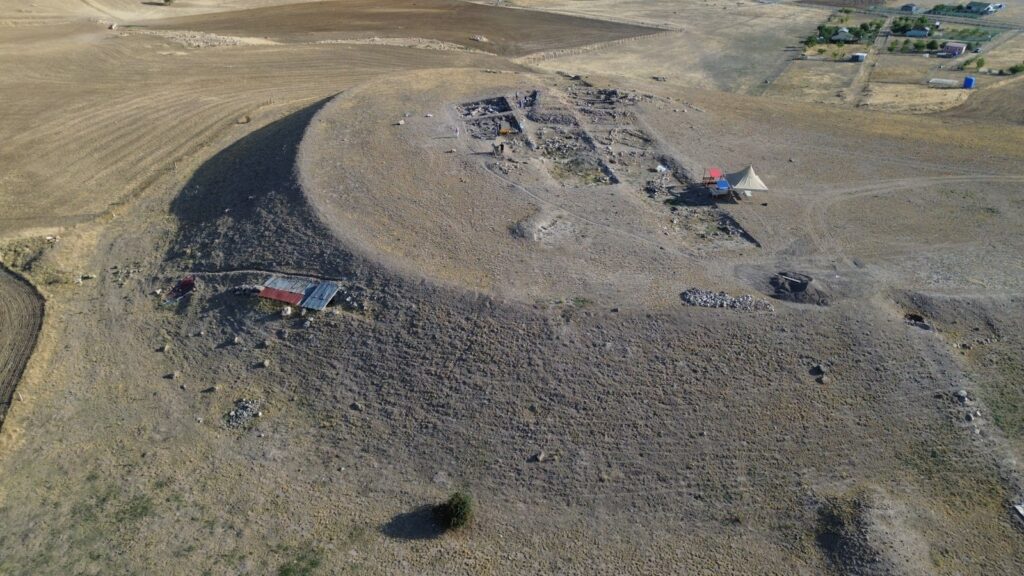
Külhöyük rises near the modern village of Oyaca in Ankara’s Gölbaşı district, about eight kilometers from the Hittite monument of Gavurkale. The mound measures roughly 250 by 150 meters and reaches about 22 meters in height, preserving occupation that began around 5,000 years ago during the third millennium BCE.
The settlement began in the Hattian period and later developed into a significant Hittite center during the second millennium BCE. Its location was particularly important: Külhöyük stood on a network of military and commercial routes leading south from Central Anatolia toward the Cilician Gates and onward to Syria and Mesopotamia.
Archaeologists have uncovered massive cyclopean fortification walls, three postern structures and part of a monumental building at the site. A Mitanni-style cylinder seal and a clay sealing carrying Hittite hieroglyphic signs also point to the connections Külhöyük maintained with the wider political and cultural world of Late Bronze Age Anatolia.
The site first came to archaeological attention after illegal digging in 1978. The Museum of Anatolian Civilizations conducted rescue excavations for 14 seasons between 1992 and 2006, while a new excavation program began in 2021 under Associate Professor Derya Yılmaz Tekin of Ankara University.
Now, the seeds found inside a Hittite vessel are revealing another side of Külhöyük — not its walls, administration or trade routes, but the plants that formed part of the landscape around its inhabitants.
A flower that survived in the same landscape
Sevgi Çiçeği is an annual plant belonging to the Asteraceae family. Its flowers can display striking shades of red, pink, and purple, giving rise to local names including yanardöner, gelin düğmesi, and peygamber çiçeği. Official environmental records describe it as an extremely localized endemic species whose surviving natural distribution is centered on the Gölbaşı area around Ankara.
Today its habitat is closely monitored. Conservation projects around Mogan Lake have included population counts, seed collection, and attempts to protect the remaining areas in which the species can reproduce naturally. The flower also received geographical indication status as the “Gölbaşı Sevgi Çiçeği” in 2019.
But the Külhöyük discovery pushes the story far beyond modern conservation.
Seeds preserved inside a Bronze Age vessel potentially place the flower within the same Central Anatolian environment thousands of years before Ankara existed as a modern city. Archaeobotanical remains of this kind can reveal details easily missed by monumental archaeology: what grew around settlements, what people collected, and how ancient communities interacted with the seasonal landscape around them.
Flowers and spring were part of the Hittite ritual world
That relationship between people, plants, and the changing seasons also appears in Hittite written traditions.
One of the Hittite kingdom’s major religious celebrations was the AN.TAḪ.ŠUM festival, a spring festival whose very name came from a plant. The celebrations could last as long as 38 days and involved the king and royal court traveling between important cult centers including Hattusa, Arinna, Katapa and Ankuwa, while offerings, music and ceremonies honored numerous gods.
The precise botanical identity of the AN.TAḪ.ŠUM plant remains debated. Earlier scholarship proposed crocus or saffron among the possibilities, but no identification has gained complete certainty. What is clearer is the significance of the plant itself: the emergence of vegetation in spring was important enough to give its name to one of the most elaborate festivals in the Hittite religious calendar.
There is currently no evidence that the Sevgi Çiçeği seeds from Külhöyük belonged to such a ceremony, and their presence inside the vessel may have had an entirely practical explanation. Yet the broader Hittite context makes the discovery particularly evocative. Plants were not merely background scenery to Bronze Age life; they formed part of agriculture, food, medicine, seasonal rhythms and religious practice.
A small find with a long history
Külhöyük has so far been defined largely through architecture: fortifications, passageways, monumental structures and objects reflecting contacts across Anatolia and beyond. The latest discovery changes the scale.
A handful of seeds preserved inside a vessel brings the surrounding landscape into the archaeological record. While walls tell us how a Hittite settlement was defended, and seals reveal networks of power and communication, plant remains can tell a quieter story about the environment in which those people actually lived.
Four thousand years later, Sevgi Çiçeği still blooms in Gölbaşı.
That continuity may ultimately prove to be the most remarkable part of the discovery: an endemic flower now confined to a small part of Ankara appears to have roots in the same landscape stretching back to the age of the Hittites.
