
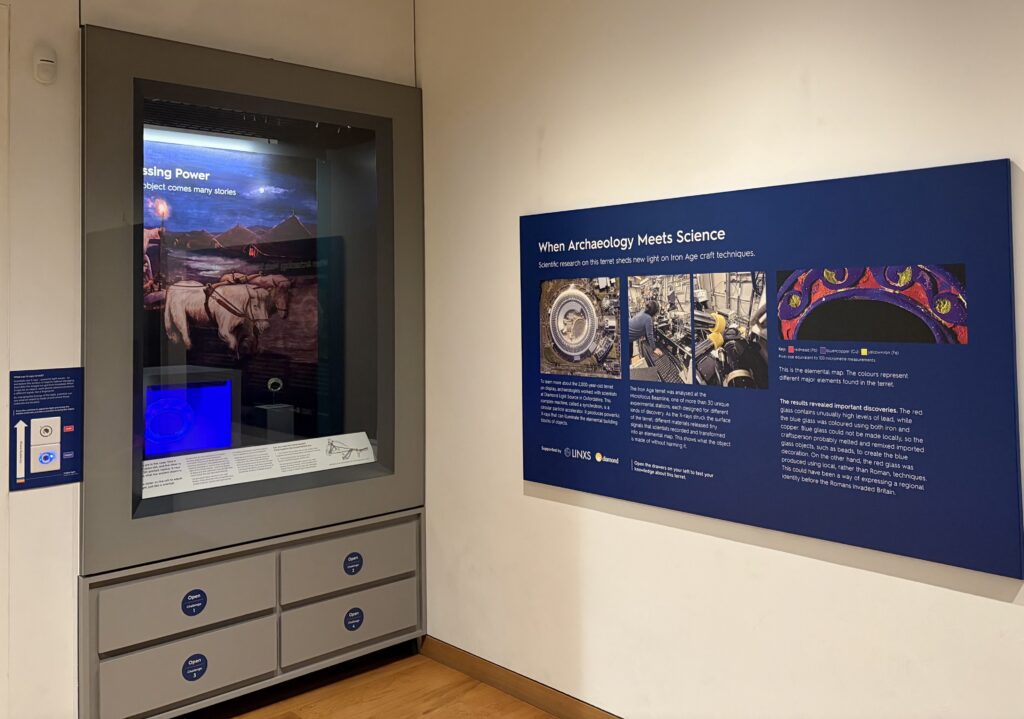
A small piece of horse equipment preserved at Oxford’s Ashmolean Museum has revealed a surprising connection to ancient Egypt. Hidden among the red and blue decorations of a 2,000-year-old bronze fitting was glass that appears to have travelled thousands of miles before reaching Britain.
The discovery emerged when museum curators turned to scientists at Diamond Light Source, the UK’s national synchrotron facility. Powerful X-rays revealed that the two colours decorating the object had very different origins, offering a glimpse of how foreign materials found their way into the hands of Iron Age British craftspeople.
An Egyptian Secret Hidden in Blue Glass
The artifact is a terret, a bronze ring used to guide the reins of a horse-drawn chariot. Although designed for a practical purpose, this particular example was carefully decorated with red and blue glass inlays, making it more elaborate than a simple piece of harness equipment.
Its small size concealed a question that could not be answered by looking at the object: where had the glass come from?
In late 2025, Ashmolean curators brought the fitting to Diamond Light Source, where scientists examined it using the I18 microfocus beamline. The resulting elemental map revealed the composition of its metal and decorative glass without requiring researchers to damage the artifact.
The bronze surface was primarily copper, with significant amounts of lead. The red glass also contained an unusually high concentration of lead, while the blue glass showed a different chemical signature, with iron and smaller amounts of copper.
That difference proved important. According to the researchers, the blue glass could not have been manufactured in Britain. Its composition instead points to Egypt, suggesting that it originally arrived as imported glass beads before being worked into the chariot fitting.
The red glass, however, belonged to a type already familiar to British Iron Age communities. One small object had brought together a material from the eastern Mediterranean and a decorative tradition rooted in Britain.

How Did Egyptian Glass Reach Britain?
The fitting dates to approximately 50 BC–AD 75, a period spanning the Roman invasion of Britain in AD 43. Its decoration offers a glimpse of the exchange networks operating during a time when local traditions were increasingly encountering influences from the wider Mediterranean world.
But the discovery does not mean that an Egyptian merchant travelled to Britain carrying the glass. The material could have passed through several communities and trading centres before reaching the craftsperson who incorporated it into the bronze ring.
Nor can the object yet be placed firmly before the Roman conquest. Its estimated date extends into the early decades of Roman rule, leaving open the question of precisely when it was made.
What the analysis does reveal is that British craftspeople had access to materials originating far beyond their own shores. Rather than simply copying foreign objects, they could incorporate imported glass into equipment that remained recognisably part of local craft traditions.
A Museum Object Reveals a New Story
The fitting was not recovered during a recent excavation. It was already part of the Ashmolean Museum’s prehistoric collection when the scientific investigation began.
Its Egyptian connection came to light through modern analytical techniques, demonstrating that familiar museum objects can still hold important evidence about the ancient world.
Visitors can now see the terret in the museum’s Harnessing Power display in the Conservation Gallery. The blue glass that once decorated a horse’s harness offers a tangible reminder of how widely materials could circulate some 2,000 years ago.
