
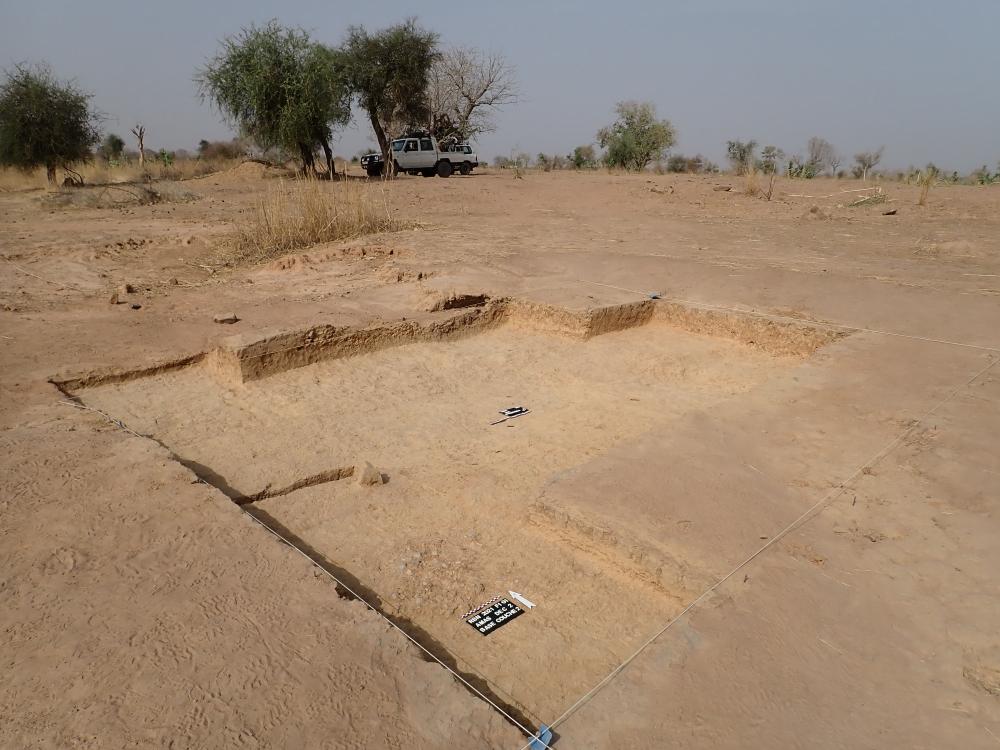
Senegal’s Falémé Valley has revealed one of West Africa’s best-preserved prehistoric sites, offering unprecedented insight into the last hunter-gatherers of the region.
Archaeologists from the University of Geneva (UNIGE), in collaboration with international partners, have uncovered a 9,000-year-old Later Stone Age quartz knapping workshop and fireplace at the Ravin Blanc X (RBX) site in eastern Senegal. This discovery, recently published in PLOS One, is helping to fill a critical gap in the understanding of West Africa’s early Holocene hunter-gatherers — populations that remain far less documented compared to their counterparts in Europe, Asia, or eastern Africa.
A rare window into West Africa’s early Holocene
For decades, archaeologists have struggled to reconstruct West Africa’s prehistoric past. Unlike Europe, where caves preserved layers of artifacts, West Africa’s climatic and geological conditions have often erased stratified archaeological remains, leaving researchers with only fragmented clues.
The Ravin Blanc X site, discovered in 2017 and excavated between 2020 and 2023, provides a rare exception. Beneath later Neolithic deposits, researchers uncovered an exceptionally well-preserved Early Holocene occupation layer dated between 9,397 and 8,988 years before present.
“Finding a stratified Later Stone Age site of this preservation quality in West Africa is extraordinary,” explains Dr. Anne Mayor, senior lecturer at UNIGE’s Global Studies Institute. “It gives us direct evidence of the technical skills and cultural practices of hunter-gatherers living during a key transitional period marked by climatic and environmental changes.”
The quartz workshop: reconstructing ancient craftsmanship
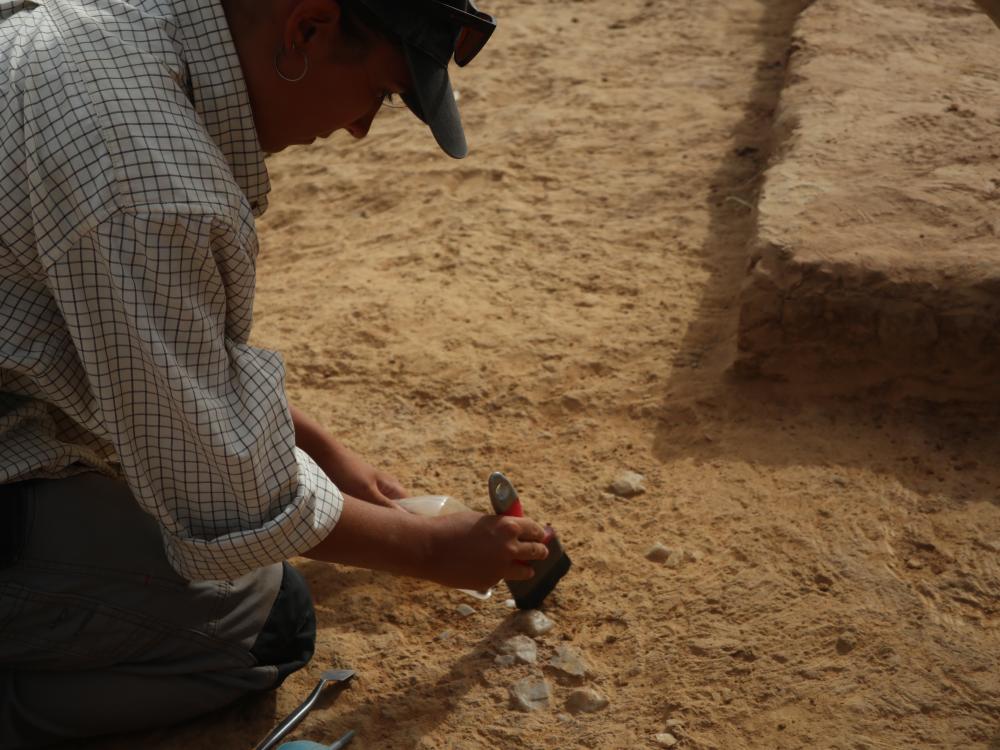
At the heart of the site lies a quartz knapping workshop, where prehistoric toolmakers produced microliths — tiny, standardized stone tools likely hafted onto wood or bone to create arrows and spears.
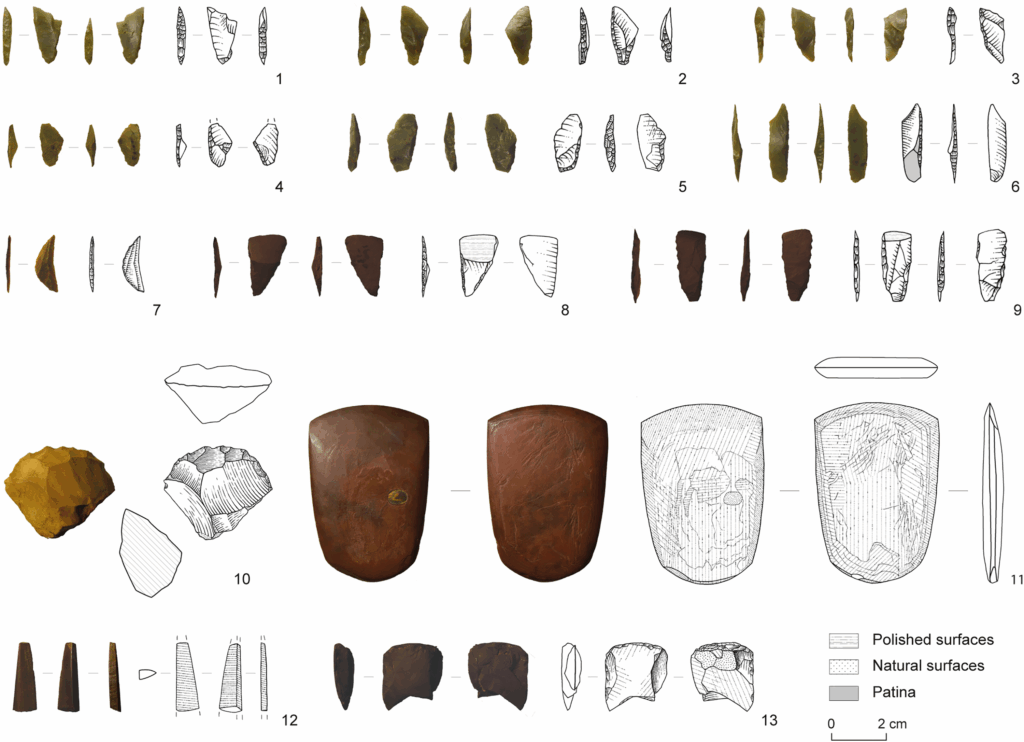
Although no finished tools were left behind (as the hunter-gatherers carried them away), the excavation yielded over 1,400 lithic fragments, including cores, flakes, and bladelets. By carefully refitting these pieces like a puzzle, archaeologists were able to reconstruct the reduction sequences and identify the knappers’ methods.
Two distinct production strategies emerged:
Broad, rectilinear blanks, thick and robust.
Thin, elongated blanks with asymmetric points, well-suited for precision hunting tools.
The high degree of standardization suggests that these communities valued efficiency and skill in tool production. “The meticulous selection of quartz and the sophisticated techniques demonstrate advanced craftsmanship that rivals contemporary traditions in other parts of the world,” notes lead researcher Charlotte Pruvost.
Evidence of daily life: the fireplace and environmental clues
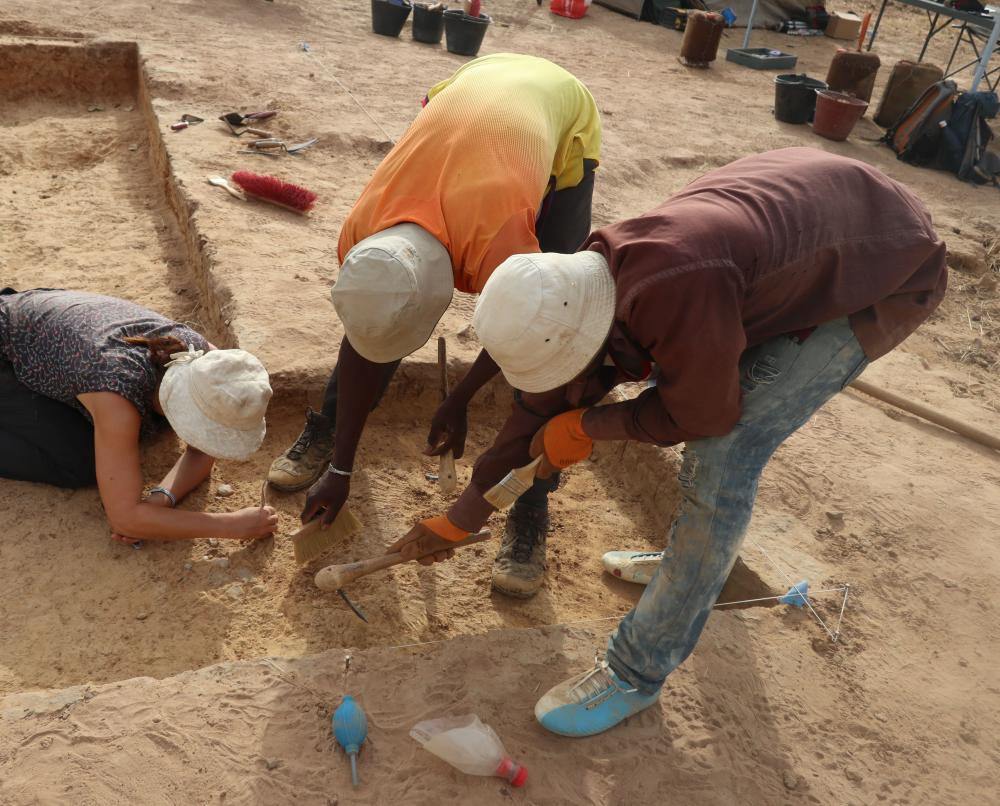
Just meters from the workshop, archaeologists uncovered a 65 cm-wide circular fireplace, still containing charcoal remains. Analysis identified the wood as Detarium microcarpum, a species typical of Sudanian savannas. Radiocarbon dating of the charcoal provided consistent Early Holocene dates, confirming the site’s age.
Further phytolith analysis (microscopic plant remains) revealed that the landscape was an open savanna dotted with trees and palms, reflecting the wetter conditions of the African Humid Period. This ecological context would have supported a mobile lifestyle of hunting, gathering, and fishing.
Distinct cultural traditions across West Africa
Comparisons with other Later Stone Age sites in Senegal and Mali suggest that Ravin Blanc X was part of a broader Sahelo-Sudanian cultural facies, characterized by standardized microlith production.
By contrast, sites in tropical forest environments of southern West Africa display less standardized, opportunistic tool-making traditions. This divergence highlights the cultural and ecological diversity of prehistoric populations and suggests that regional groups adapted differently to their environments, even within the same broad time frame.
Bridging the prehistoric knowledge gap
The discovery of Ravin Blanc X not only enriches the archaeological record of Senegal but also bridges a crucial gap in West Africa’s prehistory, where few stratified sites exist. The interdisciplinary research — combining archaeology, geology, palaeobotany, and radiocarbon dating — underscores how collaborative science can shed light on periods once thought invisible.
“This site helps us understand how human groups responded to environmental shifts at the dawn of the Holocene,” says Eric Huysecom, honorary professor at UNIGE and director of the Human Population and Paleoenvironment in Africa project. “It also challenges the outdated notion that West Africa was marginal in prehistory. In fact, it was home to vibrant, innovative communities.”
Amilestone for African archaeology
With funding from the Swiss National Science Foundation and in partnership with institutions across Senegal, France, Germany, and Switzerland, the excavation at Ravin Blanc X represents a milestone for African archaeology. The findings highlight the need for further research in understudied regions, where each new discovery has the potential to reshape global narratives of human history.
As Pruvost and her colleagues emphasize, the site’s exceptional preservation offers an invaluable time capsule. It captures a fleeting yet crucial moment when West Africa’s last hunter-gatherers mastered the art of quartz knapping — a testament to their ingenuity, resilience, and cultural distinctiveness.
Pruvost C, Huysecom E, Garnier A, Hajdas I, Höhn A, Lespez L, et al. (2025) A Later Stone Age quartz knapping workshop and fireplace dated to the Early Holocene in Senegal: The Ravin Blanc X site (RBX). PLoS One 20(9): e0329824. https://doi.org/10.1371/journal.pone.0329824
Cover Image Credit: The Ravin Blanc X archaeological site (25 m²), discovered in 2017 in the Falémé Valley in eastern Senegal, is one of the few sites in West Africa dating to the early Holocene. Credit: © UNIGE-ARCAN
