

A small but striking object has emerged from the soil at Roman Vindolanda, the celebrated frontier fort just south of Hadrian’s Wall in northern England.
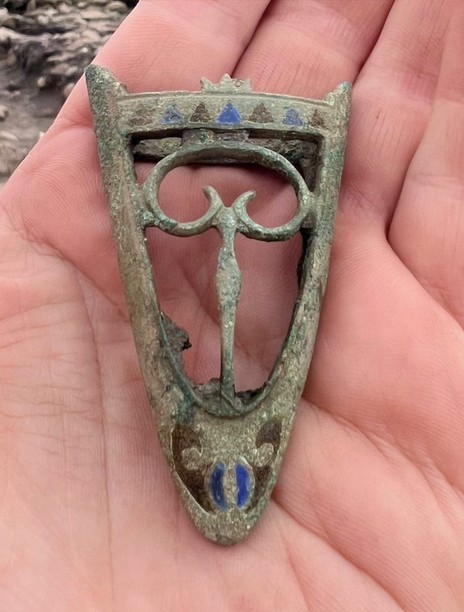
Archaeologists working at the site have uncovered a copper-alloy scabbard chape decorated with enamel, found within a 2nd-century archaeological context. The discovery was announced by the Vindolanda Trust as a “Friday Find” after the object was recovered by the excavation’s Period 10 Team.
A scabbard chape was fitted to the lower end of a sword sheath, helping protect the tip while also offering an opportunity for decoration. The newly discovered example retains enamelled ornamentation, giving the small military fitting an unusually vivid character despite having spent roughly 1,800 years underground.
Vindolanda was established around AD 85 and developed through a succession of timber and stone forts as Rome consolidated its northern frontier in Britain. The site lies along the Stanegate, the military road that predated the construction of Hadrian’s Wall, and remained occupied for centuries.
Thousands of objects recovered from Vindolanda have provided unusually detailed evidence for everyday life on the Roman frontier, from shoes and writing tablets to weapons, tools and personal possessions. Small finds such as the newly uncovered chape can offer another glimpse into the equipment carried and used by soldiers stationed at the fort.
For now, the Vindolanda Trust has released only limited information about the object. Its precise date, typological classification and decorative parallels have not yet been published, and no connection with a particular soldier or military unit has been proposed.
The discovery therefore remains, for the moment, exactly what makes archaeology compelling: a finely decorated object emerging unexpectedly from a well-dated Roman context, with its fuller story still waiting to be studied.
