

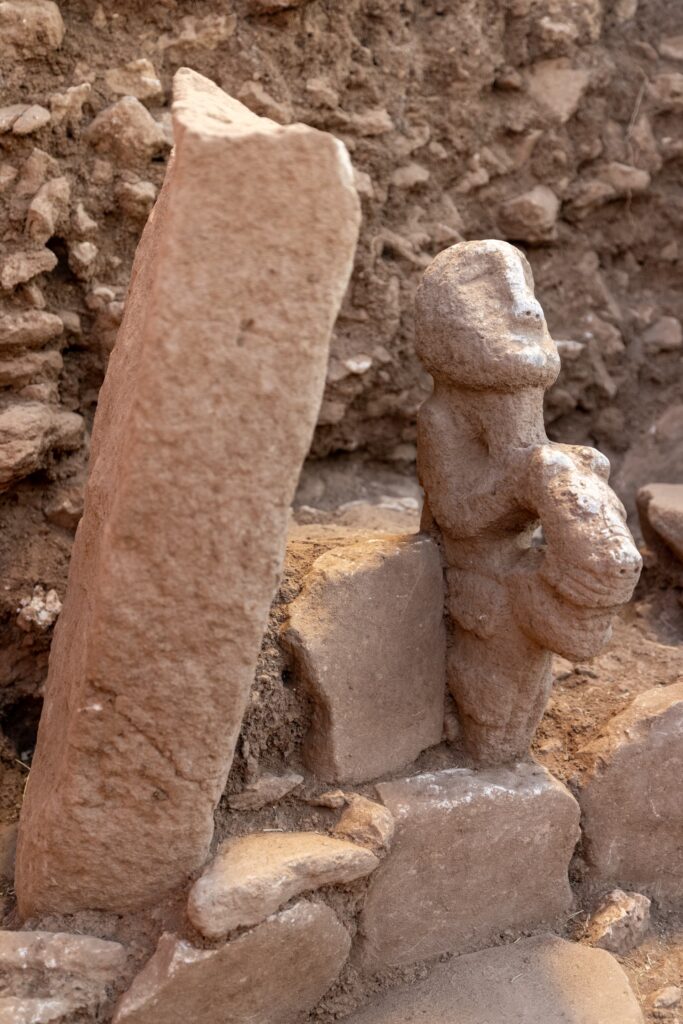
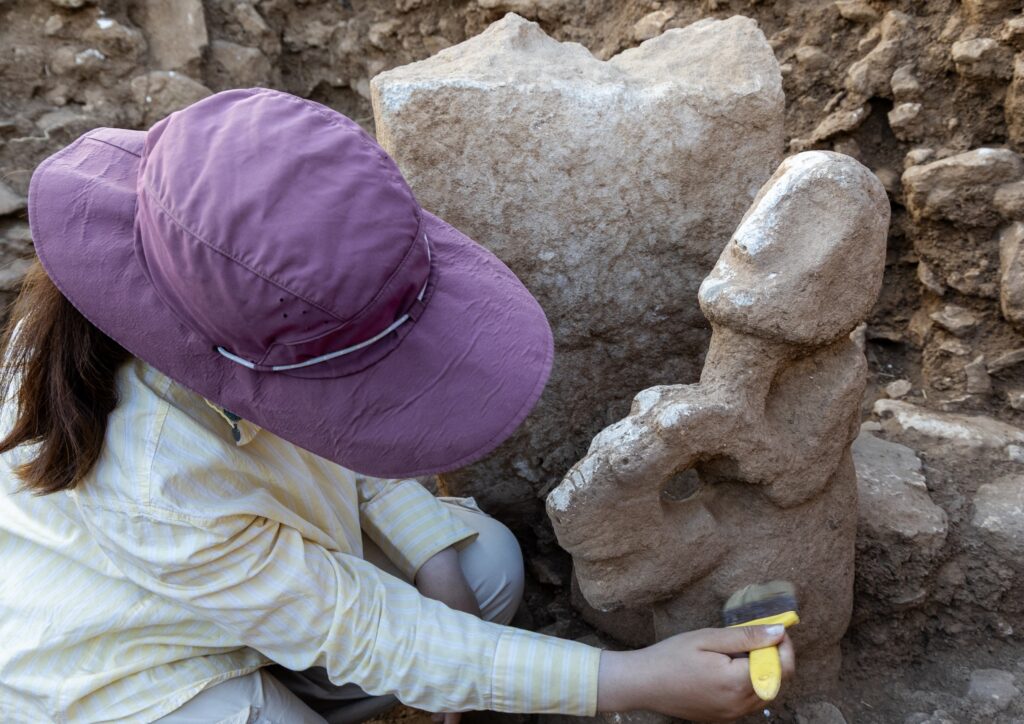
Archaeologists excavating Karahantepe in southeastern Türkiye have uncovered an approximately 11,000-year-old composite statue depicting a human figure seated on the back of a leopard, adding an unexpected new variation to the site’s already remarkable repertoire of human-animal imagery.
The 70-centimeter-tall sculpture was discovered during the 2026 excavation season and announced on August 25 by Türkiye’s Minister of Culture and Tourism Mehmet Nuri Ersoy. According to the announcement, the statue was found where it had apparently been left in antiquity, resting on a bench running along the wall of a structure measuring about three meters in diameter. The building had a floor paved with flat stones.
Ersoy described the sculpture as displaying a style not previously encountered at Karahantepe. No detailed archaeological publication explaining the object’s chronology, manufacturing technique or precise interpretation has yet accompanied the announcement, leaving its meaning open for further study.
A familiar animal appears in an unfamiliar position
The leopard is not a new presence at Karahantepe. What makes the latest discovery particularly intriguing is the relationship between the animal and the human figure.
Earlier excavations produced several composite sculptures showing the opposite arrangement: a human carrying a leopard on their back. Karahantepe excavation director Prof. Dr. Necmi Karul has previously said that three such sculptures were discovered at the site. Importantly, the leopards were not represented as dead prey. They were carved as living animals, appearing alert and aggressive.
The newly announced sculpture appears to reverse that visual formula. Instead of the human carrying the leopard, the human is seated on the animal. Whether that reversal conveyed a different narrative, status or symbolic relationship cannot yet be determined, but the composition gives archaeologists another piece of evidence for examining how Karahantepe’s inhabitants imagined the boundary between humans and powerful wild animals.
Leopards also occur independently at the site. The Şanlıurfa Museum’s Neolithic collection includes leopard heads and a 45-centimeter limestone leopard figurine from Karahantepe, while carved leopard motifs have been recorded on standing stones within its monumental buildings.

What did the leopard mean to Neolithic communities?
Assigning a single meaning to the leopard would go beyond the available evidence. There are no written texts from these communities explaining what individual animals represented, and interpretations based on later mythologies can easily become speculative.
There is, however, a clear archaeological pattern.
Karul has described the leopard as the animal motif encountered most frequently at Karahantepe. Leopards appear both as reliefs and incised images on the pillars of Structure AD, as well as in three-dimensional sculptures. His interpretation places these images within a broader relationship between early settled communities and the natural world rather than treating the leopard simply as hunted game.
Karul has argued that people living at the beginning of settled life may have understood themselves as part of the animal world to a greater degree than later societies did. The human figures carrying living leopards, in his view, reflect a relationship whose exact nature remains difficult to reconstruct but in which animals occupied a very different cultural position from that of ordinary prey.
The wider Neolithic imagery of the Şanlıurfa region points in the same direction. At nearby Sayburç, an approximately 11,000-year-old narrative relief places human figures alongside two leopards and a bull. Researchers studying the relief have noted that Neolithic artists repeatedly emphasized the threatening characteristics of wild animals, particularly exposed teeth and horns.
Some scholars have proposed more specific roles for the leopard, including interpretations involving guardianship or transformation, but such readings remain hypotheses rather than established explanations. The safest conclusion is that the repeated pairing of humans and powerful predators was deliberate and carried meanings that extended well beyond subsistence.
Karahantepe’s growing world of stone images
Systematic excavations at Karahantepe began in 2019. The settlement covers roughly 14 hectares, making it one of the largest known early Neolithic sites in the region, and more than 250 T-shaped standing stones have been identified there. Excavations have revealed domestic areas alongside larger structures containing stone benches, pillars, carved human figures and animal imagery.
The site has repeatedly produced unusual combinations of the human and animal worlds. In 2023, archaeologists uncovered a monumental male statue measuring around 2.3 meters high, positioned on a stone bench decorated with a leopard and accompanied by a vulture. More recently, Karahantepe has yielded small animal figures arranged as a deliberate composition, suggesting that images could have been used to construct narratives shared by the community.
The new leopard sculpture now adds another configuration to that visual vocabulary.
Its significance may ultimately depend less on identifying the leopard with a single deity, ritual or myth than on understanding why Karahantepe’s artists repeatedly chose to place humans in such intimate and sometimes unsettling relationships with predators.
For the moment, the figure of a person sitting on the back of a leopard raises precisely the kind of question for which Karahantepe has become known: not simply what its inhabitants carved in stone, but what stories those images were meant to tell.
Source: Türkiye’s Minister of Culture and Tourism Mehmet Nuri Ersoy
