
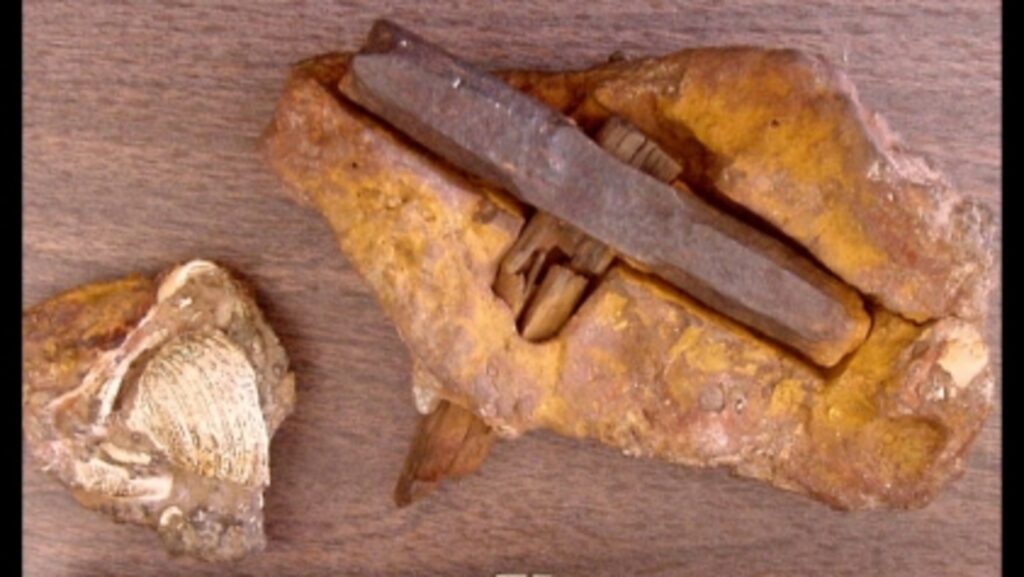
A Texas family found something they could hardly have expected: an iron hammer trapped inside a lump of rock. The discovery would eventually inspire claims of a forgotten civilization, advanced ancient metallurgy, and even humans living alongside dinosaurs.
The object became known as the London Hammer. Its unusual metal composition and rocky casing continue to attract curiosity, although neither has established that the tool is prehistoric.
An Ordinary Hammer with an Extraordinary Story
Max and Emma Hahn reportedly discovered the object in the mid-1930s near Red Creek, outside London, Texas. A wooden handle protruded from the stone, but the iron hammerhead remained concealed until their son broke open the rock roughly a decade later.
In 1983, creationist Carl Baugh acquired the hammer and promoted it as evidence of an alternative human history. Supporters argued that it might be as old as the nearby Cretaceous formations, dating back approximately 110 million years. If true, the discovery would place human toolmaking in the age of dinosaurs.
Paleo
+1
Yet the stone was only part of the fascination. Reports about the hammer’s metal composition soon added another dimension to the mystery.
The 96.6% Iron That Fueled the Mystery
A widely circulated analysis described the hammerhead as containing 96.6% iron, 2.6% chlorine, and 0.74% sulfur, with reportedly no carbon. Its apparent resistance to corrosion also attracted attention, leading some enthusiasts to suggest that its makers possessed unusually advanced metallurgical knowledge.
But the original laboratory documentation remains unverified, and the figures are frequently attributed to Battelle Laboratories without substantiation. Even if the reported composition is accurate, its iron content is not unprecedented: ordinary steel can contain a higher proportion of iron. The chemical figures alone cannot establish the tool’s age.
A 19th-Century Tool Trapped in Stone?
Researcher Glen J. Kuban examined the hammer in 1986 and again in 2006. He noted that its design resembles American tools from the historical period, while an earlier assessment by researcher John R. Cole identified it as probably a 19th-century miner’s hammer.
Its rocky casing also has a possible geological explanation. Mineral-rich water can deposit calcium carbonate around an abandoned object, gradually forming a hardened concretion. Such formations can develop within decades under suitable conditions.
Crucially, the hammer was reportedly discovered inside a loose rock, not excavated from an undisturbed prehistoric layer. There is therefore no demonstrated connection between the tool and the ancient geological formations nearby.
The London Hammer’s precise manufacturing date remains uncertain, but its resemblance to 19th-century tools offers a plausible historical explanation. The object returned to the spotlight in January 2026, when a replica sold for $330 at an online auction. The original remains at the Creation Evidence Museum in Texas, while the claim that it dates back to the age of dinosaurs remains unsupported.
Sources
Creation Evidence Museum – The London Artifact
Glen J. Kuban – The London Hammer: An Alleged Out-of-Place Artifact
Jason Colavito – 2026 London Hammer auction
Cover Image Credit: S. J. Miba / Wikimedia Commons / CC BY-SA 4.0
