
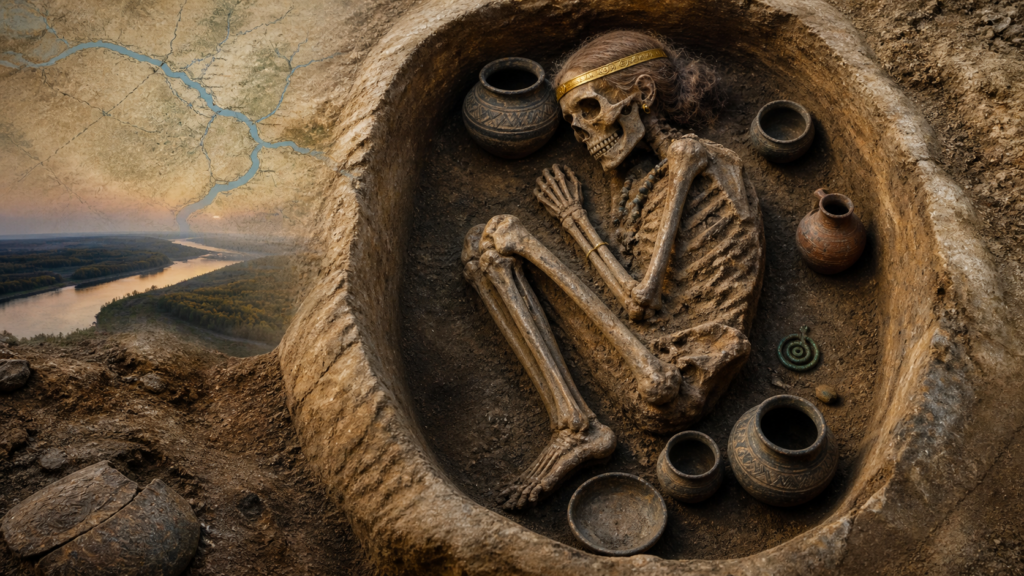
A woman buried near the Danube with a thin gold diadem around her skull has become one of the clearest clues to a wider Bronze Age network linking present-day Serbia, the Carpathian Basin, and the Central Balkans.
A new study by archaeologists Ognjen Mladenović and Aleksandar Bulatović presents fresh radiocarbon dates for three Early and Middle Bronze Age burials from the Serbian Danube region: Vajuga-Pesak, Šljunkara-Zemun, and Golokut-Vizić. For decades, these graves were understood mainly through the style of their pottery, metal objects, and burial customs. Now, dates taken from human teeth provide a firmer timeline for communities that lived, exchanged objects, and shared funerary traditions more than 4,000 years ago.
A Bronze Age woman buried with a gold diadem
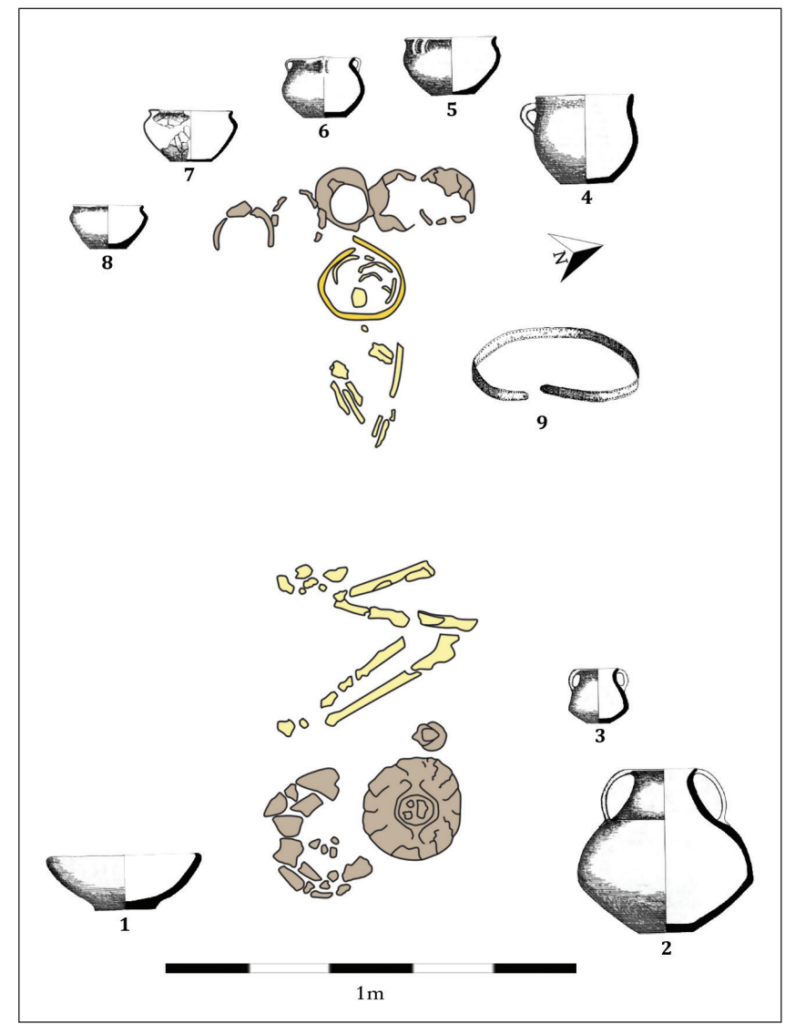
The most visually striking of the three graves comes from Šljunkara in Zemun, today part of Belgrade. The burial contained the remains of an adult woman, probably between 25 and 30 years old. She had been placed in a crouched position, oriented west-east, with her face turned toward the northeast.
Around her body, archaeologists documented a carefully arranged set of grave goods. Some vessels were placed below her feet, while a larger group was positioned above her head. These included bowls, beakers, and a small jug or cup. But the object that gives the burial its unusual power is a diadem made from a thin gold plate.
The gold diadem was found around the skull, at the level of the forehead. Small perforations at its ends suggest it was once attached to another material, perhaps textile or leather, while punctured decoration along its edges gave the object a deliberate visual rhythm. It was not simply a loose ornament placed in the grave. It appears to have formed part of the way the woman was presented in death.
A tooth sample from the burial dated the grave to between 2268 and 2039 cal BCE. That places the woman in a critical phase of the Early Bronze Age, when several cultural traditions met and overlapped across the southern Carpathian Basin and the Central Balkans.
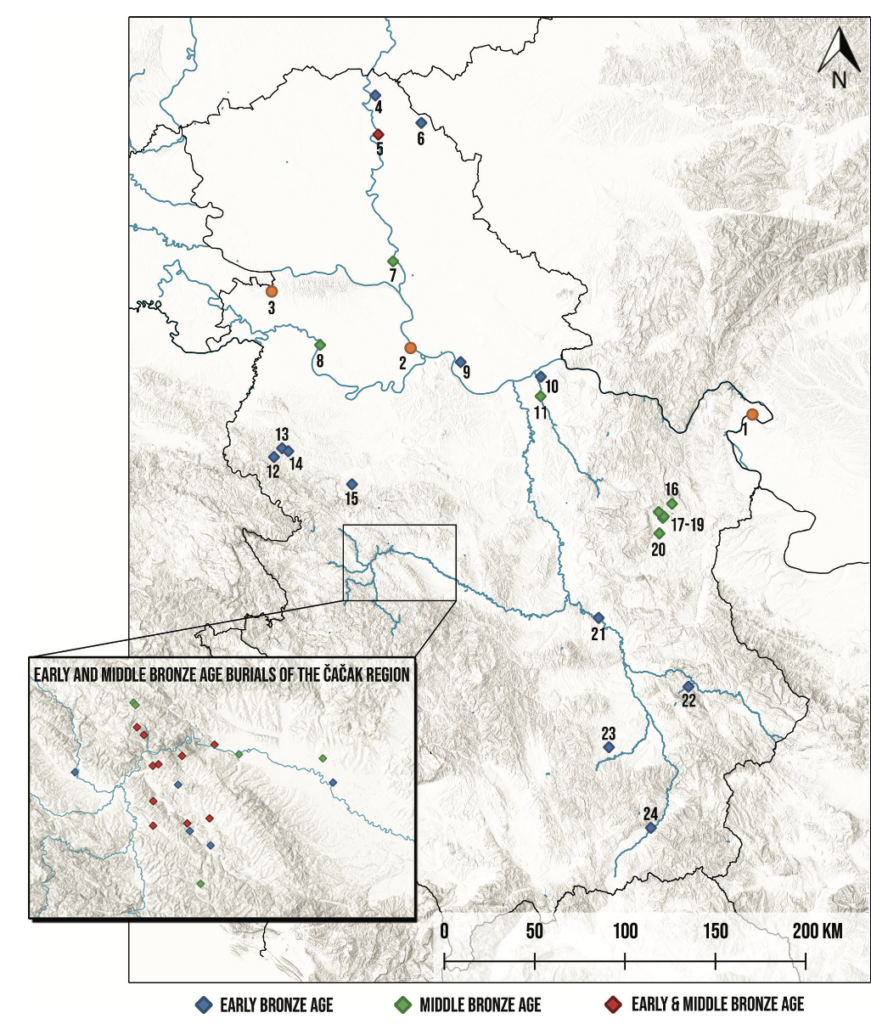
13. Cerik-Bandera, Bela Crkva; 14. Šumar, Belotić; 15. Žabari; 16. Kriveljski Kamen; 17. Borsko Jezero; 18. Trnjane; 19. Hajdučka Česma;
20. Šoka Lu Patran; 21. Utrina, Rutevac; 22. Polje, Glogovac; 23. Svinjarička Čuka; 24. Meanište, Ranutovac (Base map: EsriTopoMap, QGIS version 3.34.15-Prizren; graphics: O. Mladenović). Credit: Mladenović & Bulatović, 2026
Three graves, three ancient teeth
The Šljunkara-Zemun burial is not an isolated discovery in the study. The researchers also dated two other graves, each adding a different piece to the Bronze Age picture.
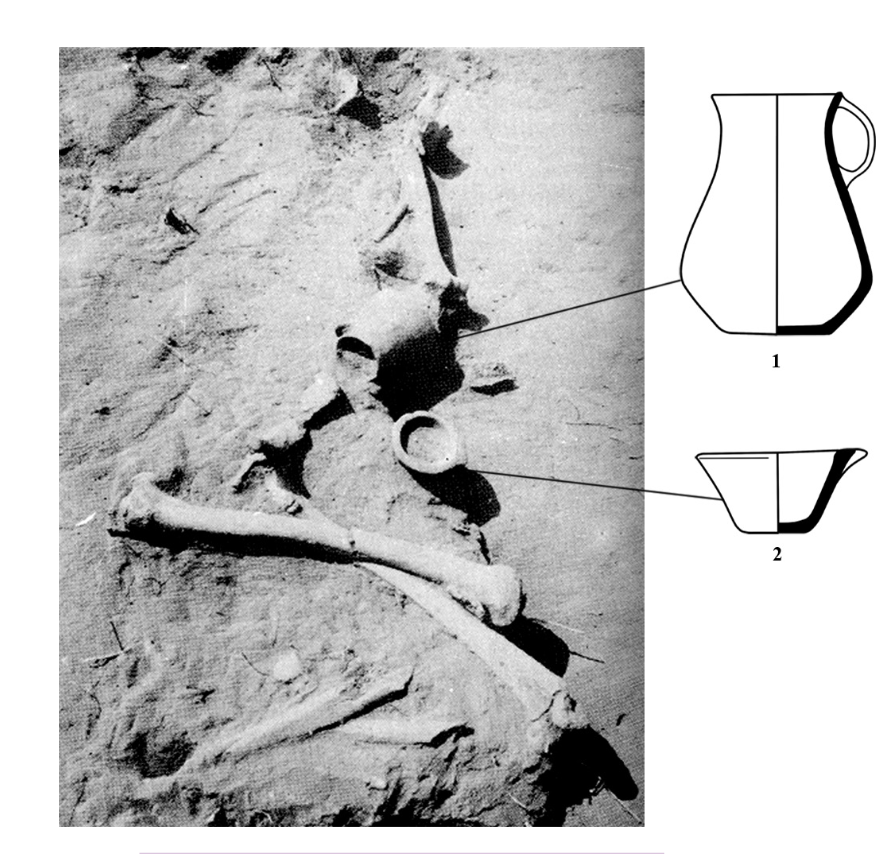
At Vajuga-Pesak, on the right bank of the Danube, archaeologists examined the burial of an adult woman aged between 30 and 40. She had also been placed in a crouched position. Her grave goods were simpler than those from Zemun: a bowl and a one-handled jug. Yet the date from this burial may be the most surprising of all.
A human tooth from Vajuga-Pesak produced a date between 2663 and 2474 cal BCE, or more narrowly between 2622 and 2496 cal BCE. This is slightly earlier than expected from the grave goods, which connect the burial with the Somogyvár-Vinkovci cultural horizon.
That matters for the chronology of the region. If the date is confirmed by future research, Vajuga-Pesak may suggest that cultural contacts linked to the Somogyvár-Vinkovci world reached farther east along the Danube earlier than previously assumed.
The third burial, from Golokut-Vizić, belongs to the Middle Bronze Age. It was found within an Early Neolithic Starčevo layer, but the grave itself is much later. The deceased was placed on the left side in a slightly crouched position, with several possible grave goods nearby. These included ceramic vessels, a miniature vessel with deep carvings for encrustation, and a bronze Lockenring, a type of spiral ornament associated with Bronze Age dress and display.
A tooth from Golokut-Vizić dated the burial to between 1880 and 1699 cal BCE. This confirms its place within the chronological range of the Vatin Group, one of the important Middle Bronze Age cultural formations in the region.
The Danube graves and a shifting Bronze Age map
Together, the three graves show that the Serbian Danube region was not a marginal zone. It was part of a larger corridor where burial customs, ceramic forms, metal objects, and symbolic practices moved across cultural frontiers.
The crouched body position seen in all three graves connects them with wider funerary traditions known from the southern Carpathian Basin. The grave goods point in the same direction. At Šljunkara-Zemun, the ceramic vessels and gold diadem suggest links with the Somogyvár-Vinkovci and Maros cultural spheres. The location of the site, near the border of Syrmia and Banat, makes it especially valuable for understanding contact zones between neighboring Bronze Age groups.
The date from Šljunkara-Zemun also strengthens the discussion around the Novačka Ćuprija-Pančevo Group, a cultural manifestation recently identified in connection with the Great Morava Valley, Peripannonia, and the southern Carpathian Basin. Rather than showing one fixed cultural identity, the grave appears to stand at a meeting point of traditions.
Golokut-Vizić adds another layer. Its date supports the position of the Vatin Group in the first half of the 2nd millennium BCE, while the encrusted miniature vessel links the burial to the Transdanubian Encrusted Pottery Culture. The bronze Lockenring also points to wider networks of ornament use across the Carpathian Basin.
A gold diadem in a world of movement
The gold diadem from Šljunkara-Zemun remains the strongest image in the study. It gives the story a human center: a young woman buried with visible care, surrounded by vessels, and marked by a rare ornament placed at her forehead.
But the diadem’s importance goes beyond beauty or status. Its presence in a grave dated by human remains allows archaeologists to anchor a rare object within a precise chronological frame. It also helps show how ideas of identity, display, and ritual moved through Bronze Age communities along the Danube.
The new dates do not close the debate. They sharpen it. Vajuga-Pesak may push part of the timeline earlier. Šljunkara-Zemun helps define a cultural borderland where several traditions met. Golokut-Vizić confirms the importance of regional variants within the Vatin world.
A thin sheet of gold, three ancient teeth, and a handful of ceramic vessels now make the Serbian Danube region look less like an edge of the Bronze Age world and more like one of its active corridors.
Mladenović, O., & Bulatović, A. (2026). New absolute dates for three Early and Middle Bronze Age burials in the Serbian Danube region. Archaeologia Austriaca, 110, I–XIV.
Cover Image Credit: AI-generated reconstruction created by the author, based on the Bronze Age burial context discussed in Mladenović and Bulatović (2026). The image is an interpretive illustration and does not represent an original excavation photograph.
