

What began with gold coins appearing in a field in northern Luxembourg developed into a years-long archaeological investigation involving Roman ruins, unexploded wartime munitions and one of the country’s most remarkable ancient coin hoards. A detailed study of the Luxembourg Roman gold hoard has now added another twist to the story: an unusually large group of its coins came from Nicomedia in ancient Anatolia.
Researchers recovered 141 late Roman gold solidi from the site known as Um Rank at Holzthum, in the commune of Parc Hosingen. The coins span the turbulent final decades of the fourth century, but their geographical origins suggest that at least part of the wealth had travelled an extraordinary distance before reaching what is now Luxembourg.
It began with 38 gold coins in a field
The story started in September 2019, when two amateur fieldwalkers and metal-detector users surveyed Um Rank following earlier investigations of the area and advice from Luxembourg’s National Institute for Archaeological Research, or INRA.
They found 38 gold coins and immediately reported the discovery. Archaeologists then launched three further field campaigns, eventually uncovering the remains of a multi-phase Late Roman fortified structure known as a burgus, together with its ditch system.
The excavation was anything but routine. The region still contained munitions and explosives left from the Second World War, forcing archaeologists to work alongside the Luxembourg Army’s Explosive Ordnance Disposal Service, SEDAL. The site had also suffered during the Ardennes fighting of 1944–45 and from later agricultural activity.
Work continued between 2020 and 2024 before Luxembourg authorities publicly announced the discovery. INRA said the excavation required exceptional care because of both the archaeological importance of the deposit and the danger posed by wartime explosives.
By the end of the investigation, archaeologists had recovered 141 solidi. Even that figure may not represent the original size of the hoard: the researchers caution that wartime disturbance and farming could have displaced or removed coins before archaeological work began.
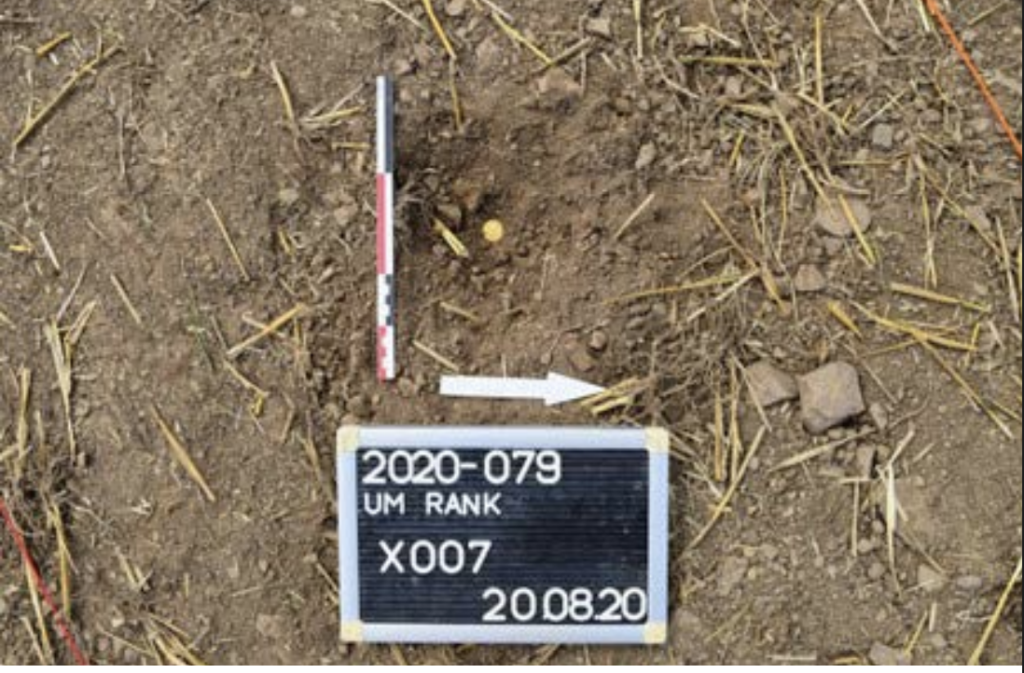
A late Roman gold solidus photographed in situ at the Um Rank site in Holzthum, Luxembourg. The excavation label identifies the find as X007; the study catalogs it as a solidus of Valentinian II struck at Constantinople between AD 383 and 388. Credit: INRA.
Seventeen coins point directly to ancient Anatolia
The most striking result emerged when numismatists compared the hoard with other late Roman gold deposits from Belgium, Luxembourg, the Netherlands and western Germany.
Seventeen of the Holzthum coins were struck between AD 364 and 367 at Nicomedia, the major Roman mint on the Sea of Marmara in northwestern Anatolia. They account for 12.2 percent of the 139 regular coins included in the study’s mint-distribution table; the remaining two pieces are fragmentary plated coins.
That concentration is unusual. According to David Wigg-Wolf, David Weis, and Lynn Stoffel, who published the analysis in Schweizer Münzblätter, the Coin Hoards of the Roman Empire database contains no comparable regional hoard with such a strong representation from Nicomedia.
The coins may also preserve traces of imperial troop movements across the Roman world.
Emperor Valentinian I was proclaimed Augustus at Ancyra, modern Ankara, in AD 364. The researchers suggest that eastern solidi could have travelled west with Valentinian and his army as they moved first toward Italy and later into Gaul. The Holzthum coins therefore offer a possible material trace of money moving thousands of kilometres with the machinery of the Roman state.
Gold that travelled with Roman armies
Other coins appear to record later movements between the eastern and western halves of the empire.
The hoard contains coins struck at Constantinople between AD 383 and 388 as well as two Honorius solidi produced at Sirmium in AD 394–395. The researchers propose that some of these coins may have reached the region with troops returning west after Theodosius I defeated the usurper Eugenius in AD 394.
Yet the study deliberately stops short of turning the hoard into evidence for one dramatic historical event. The authors find no specific war, invasion, or political crisis that can securely explain why someone buried the gold and never returned for it. Their numismatic analysis places the closing date around AD 395 or shortly afterward.
That is significant because it provides a more cautious chronology than simply dating the treasure from the reigns represented on the coins.
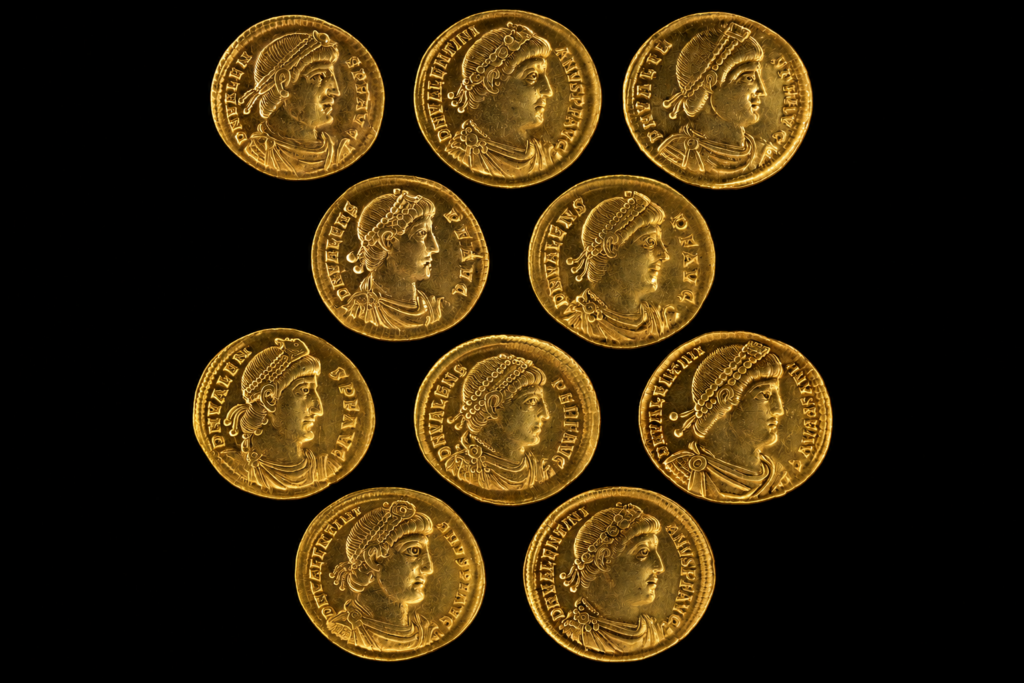
A selection of late Roman gold solidi from the Holzthum “Um Rank” hoard in Hosingen, Luxembourg. Credit: C. Nosbusch / INRA
Not every coin was what it seemed
A few pieces also complicate the idea of a perfectly uniform pile of Roman gold.
The researchers identified two fragmentary plated coins of the RESTITVTOR REIPVBLICAE type. Based on the portrait style, one was probably an ancient imitation. Another coin has an unusually dark surface and may contain substantial quantities of silver or tin rather than fine gold, although researchers have not yet carried out the metal analysis required to confirm its composition.
A further solidus has a bent edge that exposes what appears to be a flan formed from two bonded layers. The team plans more detailed analysis to understand how it was produced and whether later damage caused those layers to separate.
The discovery also has substantial monetary value. Luxembourg compensated the legal rights holders €308,600 after an independent numismatic assessment that considered the coins’ preservation and rarity, including several scarce issues of Eugenius.
But the Holzthum hoard’s scientific value lies elsewhere. A cache once hidden beside a Roman fort in Luxembourg contains gold struck from Trier and Rome to Constantinople, Antioch and Nicomedia. More than 1,600 years later, those coins are beginning to reveal how imperial money, armies and political power moved across enormous distances within the late Roman world.
Luxembourg’s National Institute for Archaeological Research (INRA)
Wigg-Wolf, D., Weis, D., & Stoffel, L. (2025). The Holzthum ‘Um Rank’ solidus hoard. Schweizer Münzblätter, 75(300), 120–129. https://doi.org/10.5169/seals-1099430
