
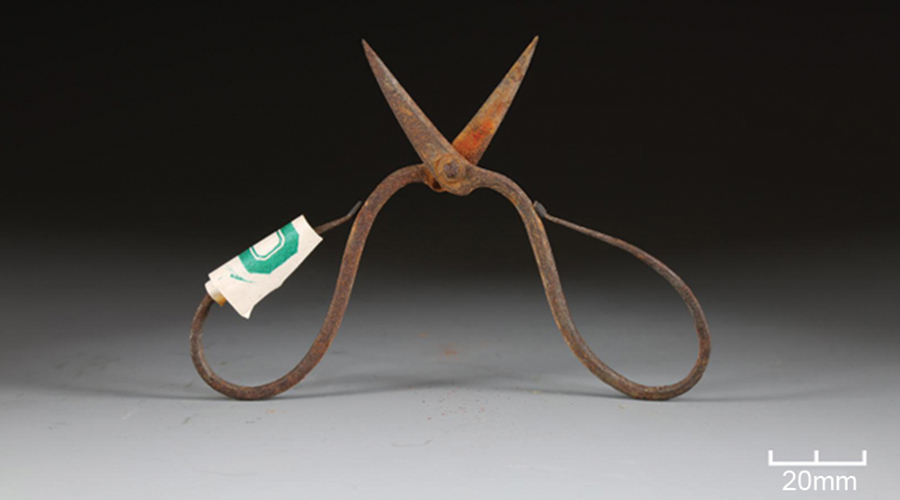
The oldest direct evidence of surgical anesthesia may have been hiding in traces of red corrosion on two small medical tools from a Ming Dynasty tomb in eastern China.
A new study published in Antiquity reports that researchers identified probable residues of aconitine, a powerful and highly toxic compound derived from aconite plants, on a pair of metal scissors and tweezers linked to the early Ming physician Xia Quan. The discovery suggests that Chinese doctors may have used carefully prepared plant toxins to reduce pain during surgery in the 14th or early 15th century.
The finding does not describe anesthesia in the modern sense. It was not ether, chloroform, or a controlled hospital procedure. But it may represent something just as important for medical history: direct chemical evidence that physicians in medieval China were applying pharmacological substances to manage surgical pain centuries before the first public demonstration of modern inhalation anesthesia in Boston in 1846.
A physician’s tomb preserves a medical clue
The instruments were unearthed in 1974 from a Ming Dynasty tomb in Jiangyin, Jiangsu Province. The tomb belonged to Xia Quan, who lived from 1348 to 1411 and appears to have been a respected physician. Unlike many archaeological medical tools, these objects can be linked to a named individual, giving researchers a rare opportunity to connect material evidence with a specific medical life.
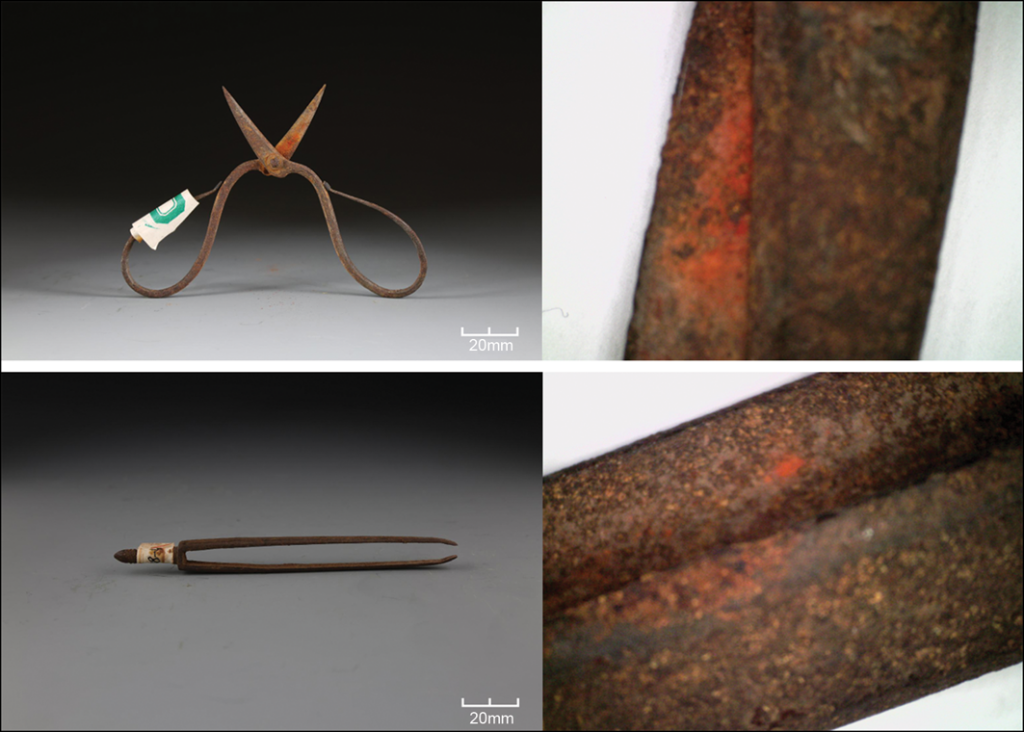
At first glance, the objects are modest. The scissors and tweezers are both about 12.3 centimeters long. Yet their form tells a more advanced story. The scissors resemble straight operating scissors used for precise cutting, while the tweezers have features comparable to tissue forceps, suggesting they were designed for gripping soft tissue.
Their metal composition also matters. The tools are made mainly of iron, with an average iron content of about 97 percent. That points to mature Ming-period ironworking and a practical understanding of tool strength, durability, and surgical function.
But the most revealing evidence was not the metal itself. It was the residue.
Microscopic traces of a dangerous anesthetic
Researchers sampled tiny red rust particles from areas where residue would be difficult to clean, including parts of the scissors and tweezers likely to have come into contact with tissue or medicine. Using micro-Raman spectroscopy and stimulated Raman scattering microscopy, they detected organic compounds on the tools.
The key signal was consistent with aconitine-related residues. Aconitine comes from plants of the Aconitum genus, including Aconitum carmichaelii and Aconitum kusnezoffii. These plants have long been used in traditional Chinese medicine, but they are also dangerous. Even small doses can affect the heart, nervous system, and breathing.
That danger is exactly what makes the discovery so striking. Aconite was not a casual herbal remedy. It was a substance that demanded knowledge, preparation, and control. Historical Chinese medical texts record formulas using aconite for numbing pain, including preparations known as Caowu San and other anesthetic powders. The new chemical evidence suggests that these written traditions were not merely theoretical. They may have been applied in real surgical practice.
The researchers argue that the residues were unlikely to be accidental contamination. They were concentrated in functional areas of the tools, and their chemical profile fits known medicinal compounds rather than ordinary blood or soil contamination.
Pain, poison, and surgical skill
Before modern anesthesia, surgery was often a race against pain. In many cultures, patients were restrained, given alcohol, or treated with plant-based sedatives and analgesics. Operations could be brief, brutal, and risky.
The Ming evidence presents a more nuanced picture. It suggests that some physicians were not simply enduring pain as an unavoidable part of treatment. They were trying to control it chemically.
The probable use was topical rather than a full-body general anesthetic. In other words, the aconite preparation may have been applied directly to the affected area before cutting, trimming, or treating tissue. This would fit Ming medical texts that describe applying a numbing agent before using scissors on skin or wounds.
Such a method would also reduce systemic danger. Aconitine is too toxic to use carelessly. Topical application, compound prescriptions, and strict preparation methods may have helped physicians balance its anesthetic power against its lethal potential.
A global history of anesthesia becomes older and wider
The discovery challenges a simple story in which effective anesthesia begins only with 19th-century Western medicine. Modern anesthesia as a safe, standardized medical system did emerge in that period. But the desire to reduce surgical pain is much older, and it developed in many places.
Ancient Indian medical texts describe surgical knowledge. Archaeology has revealed trepanation in prehistoric Europe and the Americas. Across the world, healers experimented with plants, minerals, alcohol, and other substances to ease suffering. What has often been missing is direct chemical proof from medical tools themselves.
That is why the Xia Quan instruments are important. They do not just show that aconite was mentioned in texts. They show that residues consistent with aconite compounds survived on actual surgical instruments from a Ming medical context.
The finding also strengthens the role of archaeochemistry in rewriting medical history. Written sources can tell us what physicians claimed to do. Residue analysis can show what their tools actually touched.
Questions still remain
The evidence is powerful, but not complete. Researchers cannot yet say which exact procedure the tools were used for. They also cannot prove whether the aconitine functioned as a surgical anesthetic in every instance, or whether it was part of a broader medicinal treatment that included pain relief, wound care, or tissue management.
The discovery should therefore be understood carefully. It is not proof that Ming doctors practiced modern anesthesia. It is evidence that they may have used a toxic plant compound as a controlled numbing agent in surgical treatment.
That distinction makes the story more credible, not less remarkable.
A small pair of scissors and tweezers from a Chinese tomb now point to a larger human story: long before operating rooms, oxygen monitors, and anesthetic gases, physicians were already searching for ways to make the knife less unbearable.
Ling, X., Li, J., Zhao, G., Cao, X., Weng, X., Zhang, H., … Zhao, C. (2026). Surgical anaesthesia in Ming China: scientific analysis of aconitine residues on medical instruments. Antiquity, 1–19. doi:10.15184/aqy.2026.10347
Cover Image Credit: Congzang Zhao et al., Antiquity 2026
