
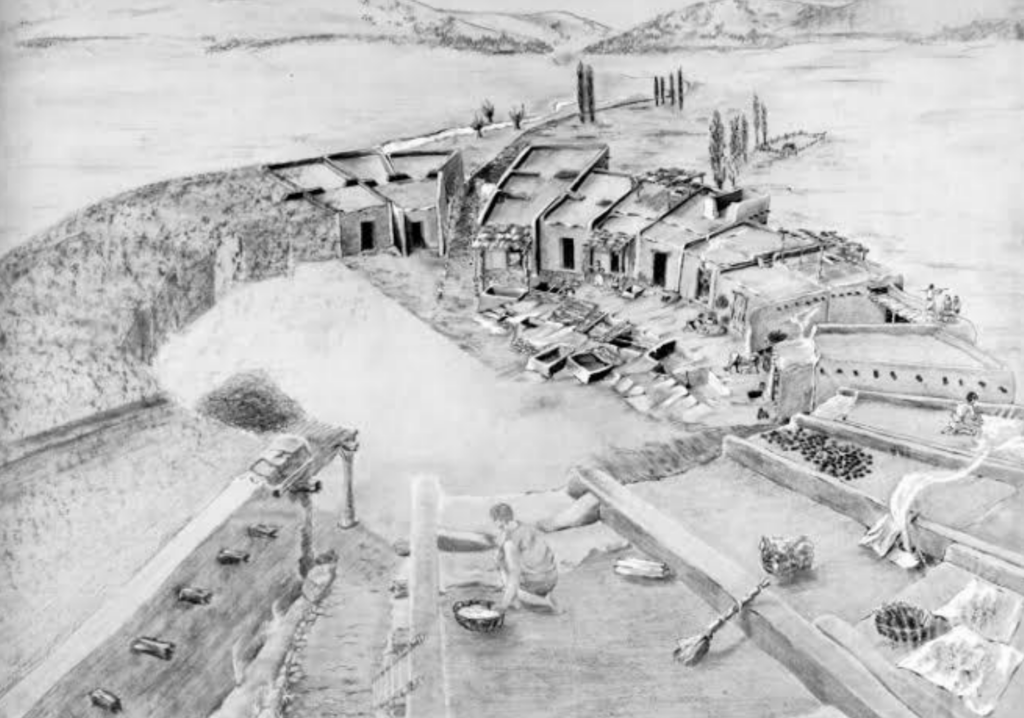
A new study proposes bringing part of Demircihöyük, one of western Anatolia’s distinctive Early Bronze Age settlements, back into view through experimental archaeology.
The proposal, developed by Deniz Sarı of Bilecik Şeyh Edebali University and architect Funda Didem Mean, does not treat archaeology as something to be protected behind glass. Instead, it asks a more direct question: what can be learned if an ancient building system is reconstructed, tested, and experienced again?
At the center of the study is Demircihöyük’s unusual settlement plan. Unlike many prehistoric settlements where houses appear in looser arrangements, Demircihöyük was organized in a striking circular layout. Its stone-founded, mudbrick-walled buildings were arranged around a central open space, forming a planned settlement pattern that still feels surprisingly deliberate nearly 4,500 years later.
A Bronze Age settlement planned around a shared center
Demircihöyük, located in Bilecik province in northwestern Türkiye, belongs to the second half of the third millennium BC, a formative period in western Anatolian Bronze Age culture. The settlement’s layout has long attracted attention because of the way its buildings were grouped in a ring-like order.
The houses were not simply placed side by side. They formed a spatial system. Many of the buildings had single-room or entrance-room plans, stone foundations, and mudbrick walls. Their arrangement around a common courtyard suggests a community in which domestic life, production, access, and movement were carefully structured.
That shared central space is one of the most important elements of the story. In archaeological terms, it may point to daily activities such as cooking, storage, craft production, and controlled circulation. For modern readers, it also makes Demircihöyük easier to imagine: a Bronze Age community built not as a scattered village, but as a compact social world facing inward.
This is where the settlement differs most clearly from a generic prehistoric village. Its form suggests planning, repetition, and collective spatial logic. Sarı and Mean’s study uses that difference as the basis for a new experimental reconstruction model.
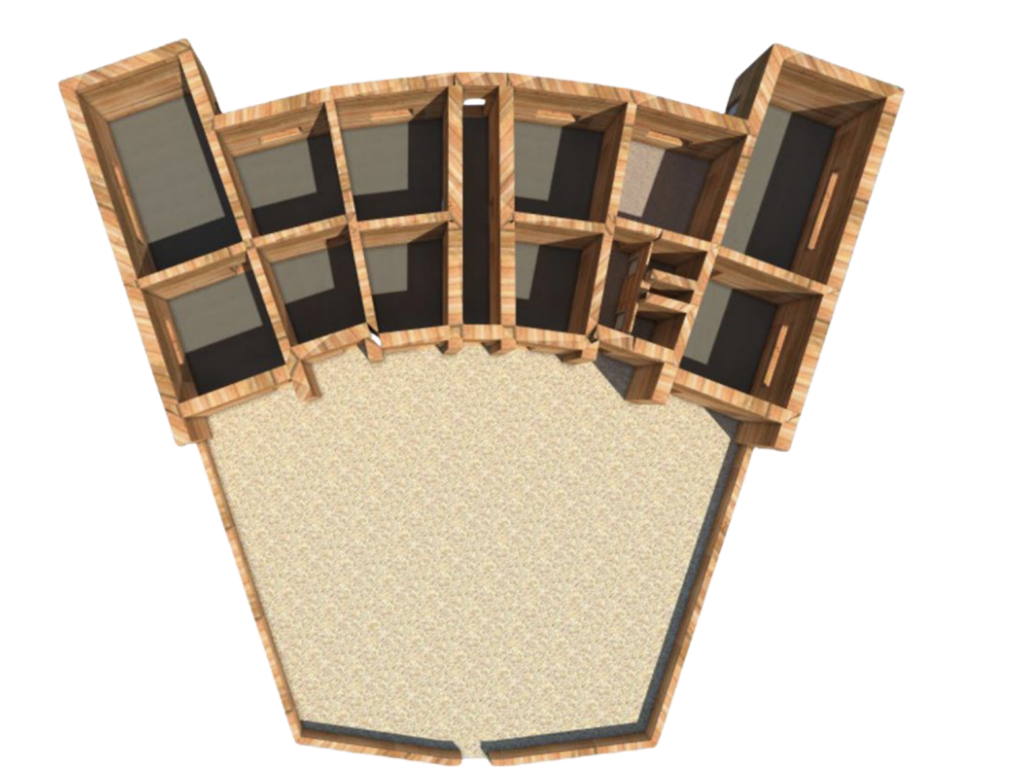
Six buildings, one ancient plan
The proposed reconstruction would not recreate the entire site. Instead, it focuses on a controlled and readable section of Demircihöyük’s settlement pattern.
According to the study, the project would reproduce about 15 percent of the original settlement layout through six megaron-like buildings arranged in a circular plan. These structures would follow the archaeological evidence as closely as possible in orientation, scale, and material logic.
The construction system is equally important. The model would use stone foundations, mudbrick walls, compacted earth floors, wooden elements, and flat earthen roofs. Every stage of construction would be documented through video, photography, and drawings, turning the project into a testable archaeological experiment rather than a decorative replica.
That distinction matters. Experimental archaeology is not the same as making a visual reconstruction for visitors. Its value comes from the process. How long does the material take to prepare? How does the wall behave? What kind of labor is needed? How do heat, moisture, and structural load affect the building? These are questions that cannot be answered fully from a plan drawing alone.
From kerpiç to alker
The most contemporary part of the project lies in its treatment of building material. Demircihöyük was built with kerpiç, or traditional mudbrick, one of Anatolia’s oldest construction materials. Sarı and Mean place this ancient technology beside alker, a modern stabilized earthen material whose name combines the Turkish words alçı and kerpiç, meaning gypsum and adobe.
Alker is made by adding gypsum, lime, and water to clay-rich soil. Unlike fired brick, it does not require baking, which reduces energy consumption. The material hardens quickly, has thermal mass, allows walls to breathe, and helps regulate indoor temperature and moisture. These properties give the Demircihöyük model a relevance beyond archaeology.
In other words, the project is not only about reconstructing the past. It also reopens a discussion about local, low-energy, and climate-sensitive building traditions. Ancient mudbrick was not primitive in the simplistic sense. It was a practical, locally sourced material shaped by environmental knowledge. Alker represents an attempt to carry that knowledge into a more durable and measurable modern form.
Demircihöyük therefore speaks to more than Early Bronze Age archaeology. Its mudbrick tradition and the proposed use of alker place the settlement within a wider conversation about sustainable, low-energy building systems.
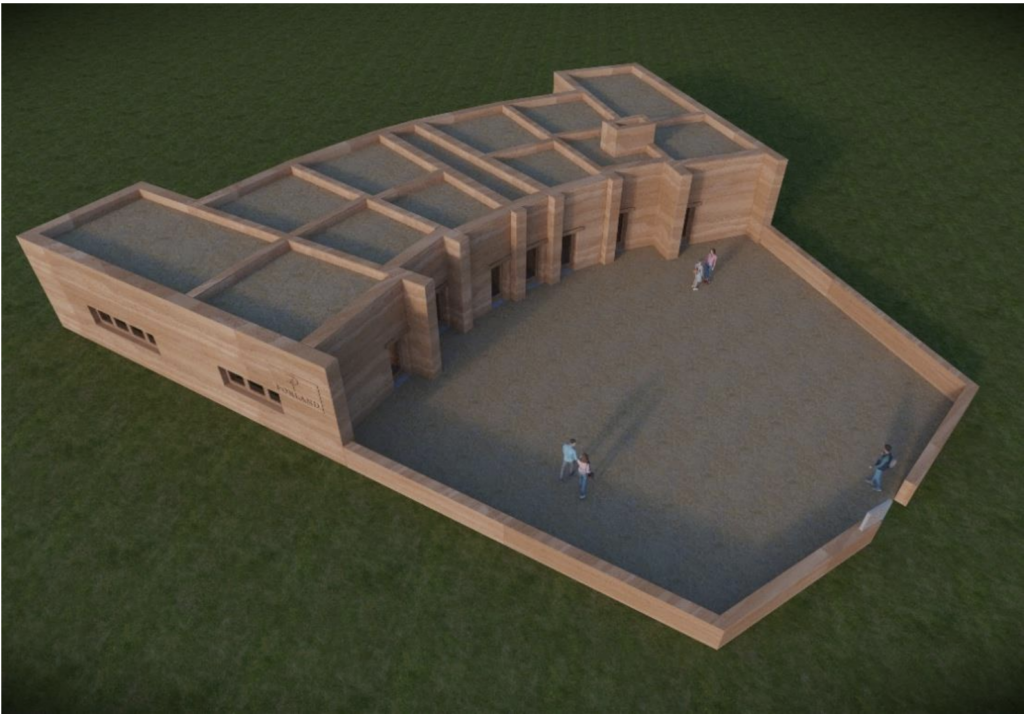
Three-dimensional model of the structure. Architect F. D. Mean, 2025. Credit: Sarı, D., & Mean, F. D. (2026)
More than a reconstruction
The study is also tied to the Research Center for Experimental Archaeology at Bilecik Şeyh Edebali University, described as one of Türkiye’s first institutional frameworks for experimental archaeology. The proposed Demircihöyük model would extend that work from excavation training into architecture, public education, and urban memory.
For students, such a reconstruction would offer more than a model to look at. It would create a working field where stratigraphy, material analysis, construction technique, and spatial interpretation can be learned through direct experience. For local communities, it could make a prehistoric settlement visible as part of Bilecik’s broader cultural identity.
That is the larger claim of Sarı and Mean’s research. Archaeological heritage does not have to remain distant from contemporary life. When handled carefully, it can become part of how a city understands itself.
Demircihöyük’s ring-shaped plan is already unusual enough to attract attention. But the proposed reconstruction adds another layer. It turns a Bronze Age settlement into a living question about how people built, organized space, and used earth as architecture thousands of years before modern sustainability became a global concern.
The result is not nostalgia. It is a serious experiment in reading the past through material, labor, and space. And in Demircihöyük’s case, that past begins with a simple but powerful image: a community built in a circle, around a shared center.
Sarı, D., & Mean, F. D. (2026). Arkeolojik Mirasın Kentle Buluşması: Demircihöyük Yerleşiminin Çağdaş Kent Kimliğine Kazandırılması. Kent Akademisi, 19(5), 1-23. https://doi.org/10.35674/kent.1759196
Cover Image Credit: Reconstruction of the Demircihöyük settlement plan revealed through archaeological excavations. Korfmann, 1983. Sarı, D., & Mean, F. D. (2026)
