
For centuries, Indigenous hunters returned to a small bison kill site in central Montana, a region of the northern United States shaped by the vast grasslands of the Great Plains. Then, around 1,100 years ago, the place fell out of visible use. The strange part is that the bison had not disappeared.
A new study published in Frontiers in Conservation Science suggests that the abandonment of the Bergstrom site was not caused by a collapse in bison numbers. Instead, the answer may lie in a more practical problem: drought made the site less useful for large-scale hunting and processing, just as bison hunting on the Northern Great Plains was becoming more organized and demanding.
A long-used hunting place in Judith Gap
The Bergstrom site lies near Red Bluff Creek in Judith Gap, a natural passage between the Little Belt Mountains and the Big Snowy Mountains in central Montana. Its position made sense for hunters. Open grasslands, sloping terrain, a nearby spring-fed creek, and a natural landscape constriction could have helped people intercept moving bison.
Archaeological evidence shows that the site was used intermittently for roughly seven centuries. Excavations uncovered bison bone, charcoal, and projectile points, including Besant and Avonlea types, in cultural layers dated between about 1,800 and 1,100 years before present.
That long pattern of return is what makes the site’s abandonment important. If the place had worked for generations, why stop using it?
The bison were still there
One obvious explanation would be prey scarcity. If bison had left the region, hunters would have had little reason to return. But the study found little support for that idea.
The researchers combined archaeological excavation with radiocarbon dating, pollen analysis, charcoal records, dung-fungal spores, and regional bison occurrence data. The results point in the same direction: the local environment did not undergo a major collapse after the site was abandoned.
Pollen from the nearby Red Bluff Creek sediment cores indicates that grassland and riparian vegetation remained relatively stable. Charcoal levels do not show a major fire-related disruption. Indicators of large herbivores also continued after the last visible occupation of the site.
In other words, Bergstrom did not become an ecological dead zone. Bison were still present in the wider region, and hunting continued elsewhere. The problem was not simply that the animals had gone.
Drought changed the value of the site
The study instead highlights severe, repeated droughts between roughly 1,700 and 700 years ago. These droughts overlapped with the period when Bergstrom was still being used and continued after its final visible occupation.
For a bison kill site, water mattered. It was not only useful for people and animals. It was also needed during the demanding work that followed a successful hunt: butchering, processing, cleaning, and preparing meat and hides.
A small creek could buffer normal dry periods. But during severe and repeated droughts, a hydrologically marginal place could become less reliable. That would not necessarily drive bison out of the whole region. It could simply make this particular site less practical.
This is the key point of the study: hunters may not have abandoned Bergstrom because there were no bison. They may have abandoned it because the site no longer fit the scale and logistics of the hunting systems developing around it.
Hunting was becoming more organized
During the late Holocene, bison hunting across the Northern Great Plains changed. Smaller, mobile hunting groups had long used flexible intercept strategies. Over time, larger communal hunts became more important. These operations could involve drive lines, jumps, corrals, and coordinated labor, allowing groups to take and process many animals.
That shift brought advantages. Large hunts could produce winter stores, surplus resources, and materials for wider exchange. But they also required more from the landscape. Reliable water, enough space, fuel, forage, and useful topography became critical.
The Bergstrom site appears to have been better suited to smaller-scale, opportunistic use. The study notes low lithic density and no preserved evidence of major drive infrastructure. Compared with large communal hunting complexes, Bergstrom may have become too limited.
As hunting systems grew more coordinated, hunters may have shifted their efforts toward larger and better-watered places with stronger natural advantages.
A local abandonment, not a regional collapse
One of the strongest findings is the contrast between Bergstrom and the wider region. Regional data show that archaeological bison frequencies increased through the Holocene, while paleontological bison frequencies stayed more stable. Around the period of Bergstrom’s abandonment, bison hunting intensity in the region was still high.
That makes the site’s story more interesting. It was not part of a simple decline. It was part of a reorganization.
Bergstrom was left behind while other locations continued to be used. The abandonment reflects a choice within a changing hunting landscape, not the end of bison hunting in Montana.
Ancient adaptation under climate stress
The study also carries a modern message. Bison management today is shaped by conservation agencies, private production, nonprofit groups, and Tribal nations, all operating under different constraints. Climate variability is once again a central issue.
The Bergstrom case suggests that long-term resilience depended on flexibility. Past hunting communities adjusted where and how they worked when environmental conditions changed. They did not simply follow bison herds in a mechanical way. They responded to water, terrain, labor demands and the scale of their social organization.
The authors caution that not every abandoned bison kill site should be explained the same way. Some may have been left for different environmental, social or cultural reasons. They also note that rare later visits to Bergstrom may have occurred without leaving clear archaeological traces.
Still, the evidence from Bergstrom offers a sharp lesson from the Northern Great Plains. Climate pressure did not always erase resources. Sometimes it changed which places remained useful.
About 1,100 years ago, bison still moved through the region. Hunters still hunted them. But at Bergstrom, drought and changing hunting strategies may have made an old place no longer worth returning to.
Wendt JAF, Neeley M, Alt M, Ewing SA, Fischer GS, and McWethy DB (2026) American bison kill site use and abandonment amid drought and cultural shifts in late Holocene Montana. Front. Conserv. Sci. 6:1688950. doi: 10.3389/fcosc.2025.1688950
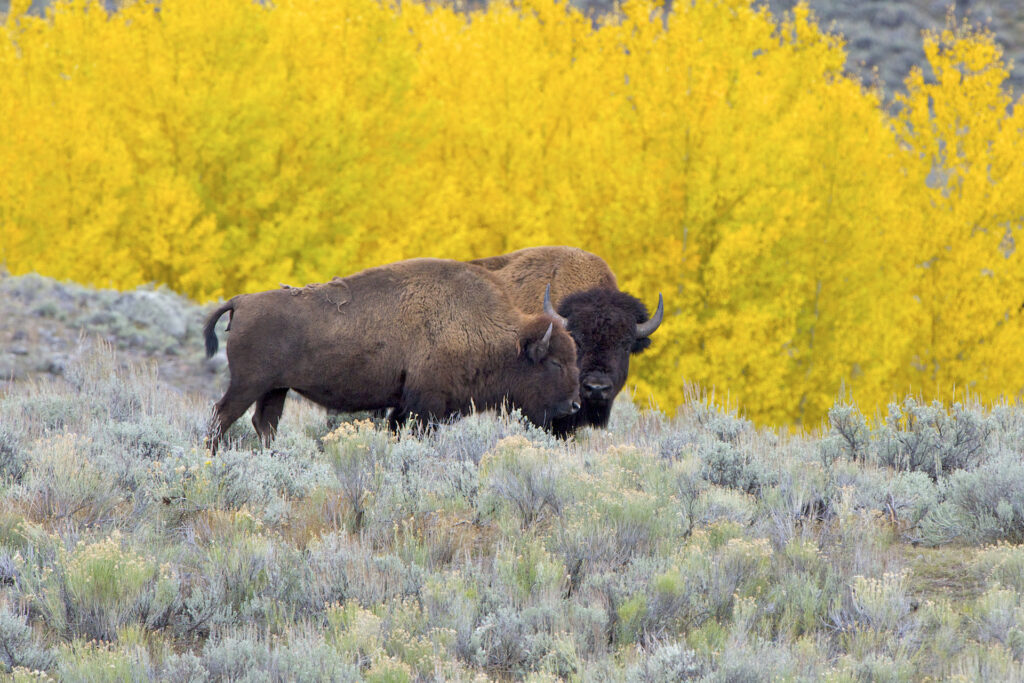
Cover Image Credit: Adult male (behind) and adult female (in front), in Yellowstone National Park. Arturo de Frias Marques – Public Domain
