27 January 2026 The Future is the Product of the Past

Researchers Discovered Wreckage of a Schooner that Sank in Lake Michigan in Late 1800s

Maritime historians from the Wisconsin Underwater Archeology Association discovered the wreckage of a schooner that sank in Lake Michigan in the late 1800s.

The Margaret A. Muir – a 130-foot, three-masted ship built in 1872 – was found under about 50 feet (15 meters) of Lake Michigan water off Algoma, Wisconsin, according to a Wisconsin Underwater Archaeology Association (WUAA) news release.

The Muir was built at Manitowoc, Wisconsin by the Hanson & Scove shipyard for Captain David Muir.  It was intended primarily for the Great Lakes grain trade, although it carried many diverse cargoes, frequenting all five Great Lakes over her 21-year career.

The ship was en route from Bay City, Michigan, to South Chicago, Illinois, with a cargo of bulk salt. It had almost reached Ahnapee, which is now known as Algoma, when it sank during a storm on the morning of Sept. 30, 1893.

According to the Wisconsin Underwater Archeology Association, the six-member crew and Captain David Clow made it to shore in a lifeboat, but Clow’s dog went down with the ship. Captain Clow, a 71-year-old Lake veteran, had seen many wrecks in his day, but exclaimed “I have quit sailing, for water no longer seems to have any liking for me.”  The Captain was particularly grieved at the loss of his dog, described as “an intelligent and faithful animal, and a great favorite with the captain and crew.”  The Captain remarked, “I would rather lose any sum of money than to have the brute perish as he did.”


📣 Our WhatsApp channel is now LIVE! Stay up-to-date with the latest news and updates, just click here to follow us on WhatsApp and never miss a thing!!
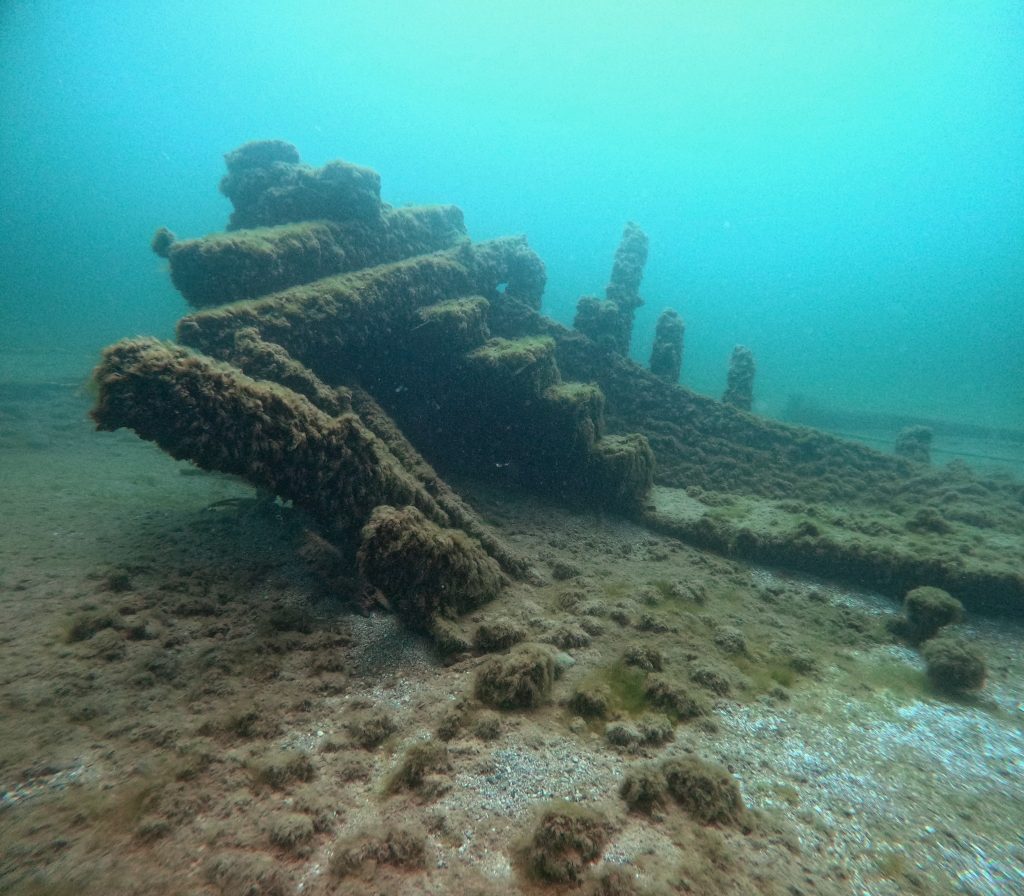


More than a century after sinking, the Margaret A. Muir was found in about 50 feet of water in Lake Michigan in May 2024. Shown here is a rare internal view of her unusual stepped sternpost construction. Photo: Tamara Thomsen, State Historical Society of Wisconsin

The team, including Brendon Baillod, Robert Jaeck and Kevin Cullen used historical records as well as a high resolution side scanning sonar to locate the vessel, finding its remains on May 12th, 2024.

The Margaret A. Muir was lost to history until Baillod began compiling a database of Wisconsin’s missing ships around twenty years ago.  The Muir stood out as being particularly findable.  In 2023, Baillod approached the Wisconsin Underwater Archeology Association to undertake a search for the vessel, narrowing the search grid to about five square miles, using historical sources. 

Baillod, Jaeck and Cullen were on their final pass of the day and in the process of retrieving the sonar when they ran over the wreck in approximately fifty feet of water only a few miles off the Algoma Harbor entrance.  It had lay undetected for over a century, despite hundreds of fishing boats passing over each season.

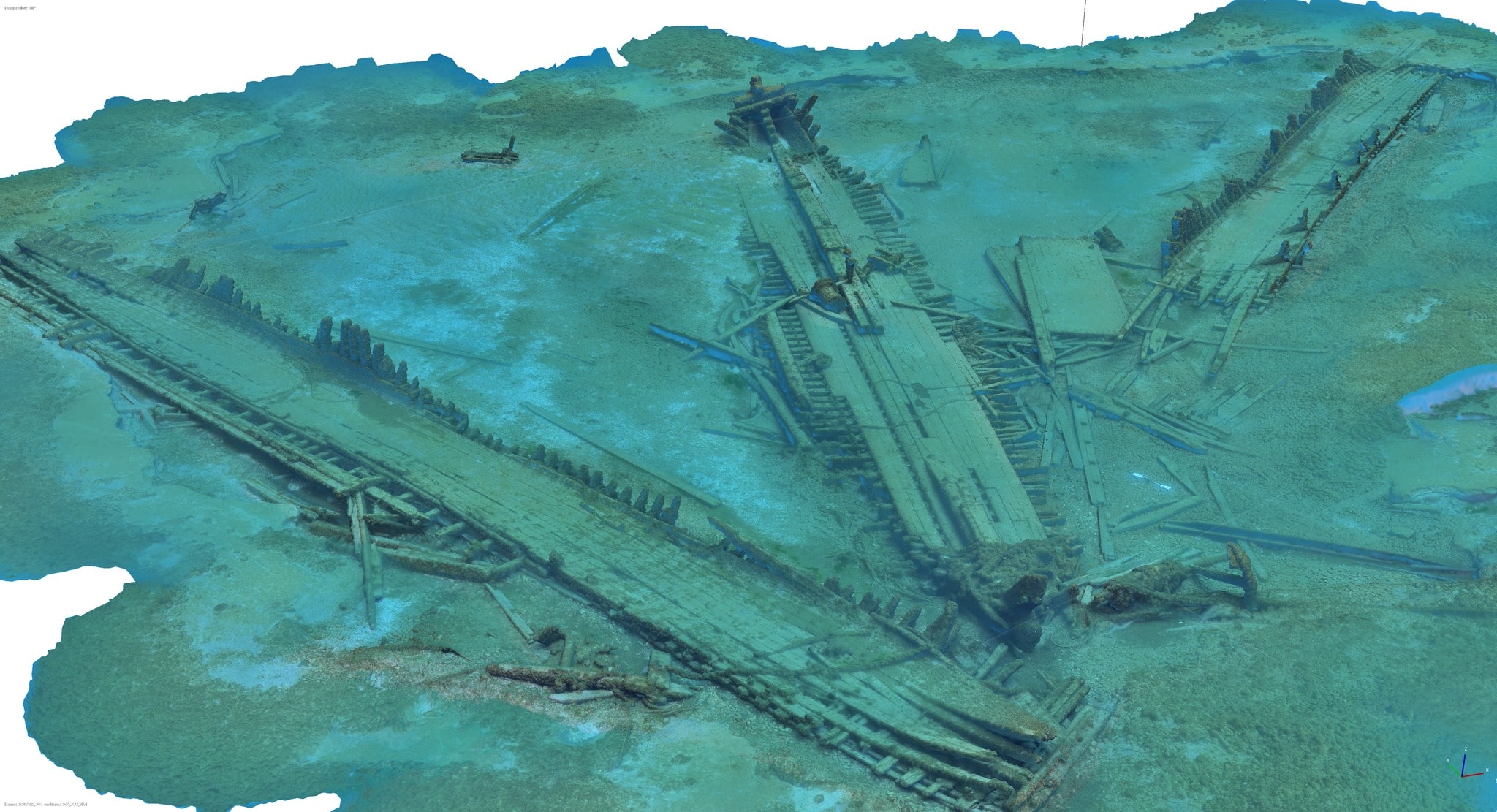
3D Photogrammetry Flyover. Zach Whitrock

After informing Wisconsin State Maritime Archeologist Tamara Thomsen of the discovery, the team worked for weeks to gather thousands of high-resolution photos of the location. Zach Whitrock then used these photos to create a 3D photogrammetry model of the wreck site, which enables virtual site exploration. 

The vessel is no longer intact, its sides having fallen outward after deck collapsed, but all its deck gear remains, including two giant anchors, hand pumps, its bow windlass and its capstan.

The Wisconsin Underwater Archeology Association now plans to work with the Wisconsin Historical Society’s Maritime Archeology Program to nominate the site to the National Register of Historic Places.  If accepted, it will join the schooner Trinidad, which the team located in deep water off Algoma in June of 2023.

Wisconsin Underwater Archeology Association

Cover Image: Wisconsin Underwater Archeology Association
Related Articles

Hand disease known as Viking disease may have its origins in Neanderthal genes

14 June 2023

14 June 2023

A recent study in the Oxford University Press journal Molecular Biology and Evolution demonstrates that a condition known as Dupuytren’s...

World’s Largest Geoglyphs Found in the Thar Desert

29 May 2021

29 May 2021

A massive spiral encompassing 100,000 square meters unearthed in the Indian desert may be the greatest drawing ever drawn. The...

8th-Century Tang Dynasty Tomb Unearthed in China Reveals Vivid Murals — and a Blond Foreigner

15 October 2025

15 October 2025

Archaeologists in northern China have uncovered an exceptionally preserved 8th-century Tang dynasty tomb whose breathtaking murals offer a window into...

A cave painting found in Egyptian Sahara depicts a nativity scene 3,000 years before Jesus’ Birth

21 December 2023

21 December 2023

5,000-year-old rock art depicting the oldest nativity scene ever found has been found in Egypt’s Sahara Desert: A newborn between...

An unexpected shipwreck was unearthed at the Tallinn construction site

18 April 2022

18 April 2022

During the construction of the office building on Lootsi Street in Tallinn, Estonia’s capital on the Baltic Sea, a shipwreck...

Poseidon Temple in Greece Larger than Previously Assumed

27 January 2024

27 January 2024

New excavations at Kleidi-Samikon in Greece’s Western Peloponnese show that the temple, discovered in 2022, is more monumental than previously...

3,000-Year-Old Rare Carved Stone Unearthed at Prehistoric Cult Site in Norway

20 August 2025

20 August 2025

Archaeologists in Norway have uncovered a rare 3,000-year-old carved stone at a prehistoric cult site buried beneath clay after a...

The world’s northernmost Palaeolithic settlement has been discovered on Kotelny Island in the Arctic

20 August 2021

20 August 2021

During the Paleolithic period, hominins lived in tiny groups and subsisted by collecting plants, fishing, and killing or scavenging wild...

A prehistoric monument consisting of three round enclosures, one of which resembles a horseshoe, was discovered in France

7 April 2024

7 April 2024

Archaeologists from the French National Institute for Preventive Archaeological Research (INRAP) unearthed an unusual, prehistoric monument in the shape of...

The rich-poor distinction draws attention in the nutrition of the inhabitants of the Ancient City of Pergamon

27 November 2021

27 November 2021

The hegemony of wealth to the poor, arising from the ruler, elite structure, property ownership, unjust acquisition, and distribution of...

Archaeologists Uncover the World’s Longest Dinosaur Footprints in a British Quarry -166-Million-Year-Old

14 October 2025

14 October 2025

Archaeologists have uncovered one of the world’s longest and most extraordinary sets of dinosaur footprints in a British quarry, shedding...

1300-year-old stone sculpture from the ancient Turkish era found in Kazakhstan

3 August 2021

3 August 2021

A 1,300-year-old stone sculpture from the early Turkish period was discovered in Kazakhstan’s south, around 250 kilometers (155 miles) from...

Ark of the Covenant Discovery? Biblical Ruins Unearthed in Israel May Be Key to Ancient Mystery

6 August 2025

6 August 2025

Archaeologists at Tel Shiloh Claim Structure Matches Biblical Tabernacle Where the Ark of the Covenant Was Housed In a monumental...

Celtic Traditions Endured Long After Roman Conquest: Archaeological Research in Saarland Reveals a Hybrid Past

20 September 2025

20 September 2025

Excavations in Oberlöstern uncover burial mounds, villas, and monuments that blend Celtic and Roman traditions—tracing the roots of European identity....

A Roman sarcophagus bearing the title of “Emperor’s Protector” was found for the first time in Anatolia

29 April 2022

29 April 2022

A sarcophagus carrying the title of “Emperor’s protector” was discovered in the province of Kocaeli in western Turkey. With the...