1 December 2025 The Future is the Product of the Past

Archaeologists Discovered 8th-century BC Settlement in Uzbekistan

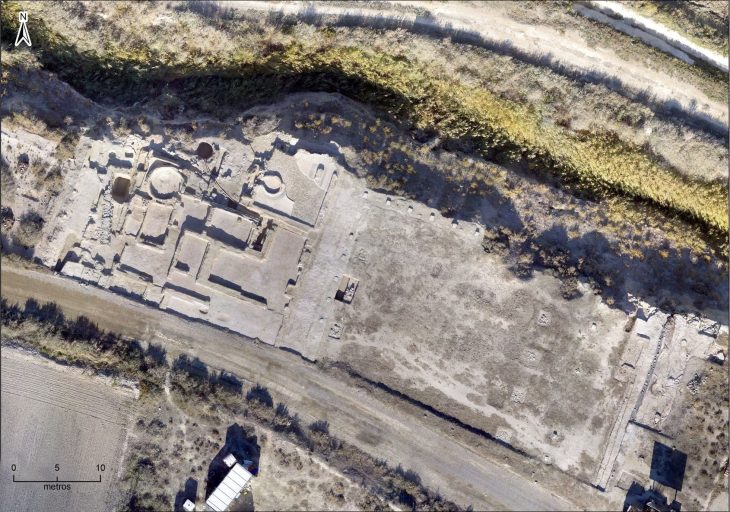
A team of Chinese and Uzbek archaeologists discovered an ancient settlement dating back to the 8th century BC in Uzbekistan, near the country’s Surxondaryo River, also known as Surkhandarya.

A square-shaped architectural structure with several rooms, including a kiln and waste pits, is present at the recently excavated site, offering insight into the ancient civilization that once flourished there. Numerous smaller square rooms within the ruins were discovered; based on the abundance of pottery wares discovered nearby, archaeologists believe these rooms served as living quarters or kitchens.

Utensils made of stone such as millstone, mortars, and pestles were discovered, revealing the “food processing history of ancient people in the region,” Archaeologist He Jierao told the Global Times.

“It reveals the evolution of ancient people’s community lifestyles and how they developed more civilized lifestyles,” He emphasized.

Beginning in April, the excavation project was led by Northwest University archaeologist Ma Jian and his team in Xi’an, Shaanxi Province, China. Three major discoveries were made in Uzbekistan between April and June by experts from China and Uzbekistan.


📣 Our WhatsApp channel is now LIVE! Stay up-to-date with the latest news and updates, just click here to follow us on WhatsApp and never miss a thing!!


In addition to the 8th-century BC settlement, another major project involved the investigation of the ancient Kushan Empire.  Twenty-five old tombs and six buildings from the Kushan Empire were found as a result of the combined efforts. The Kushan Empire was a powerful political system that ruled over what is now Uzbekistan, Afghanistan, and Pakistan. It was founded in the first century AD by the nomadic Yuezhi people.
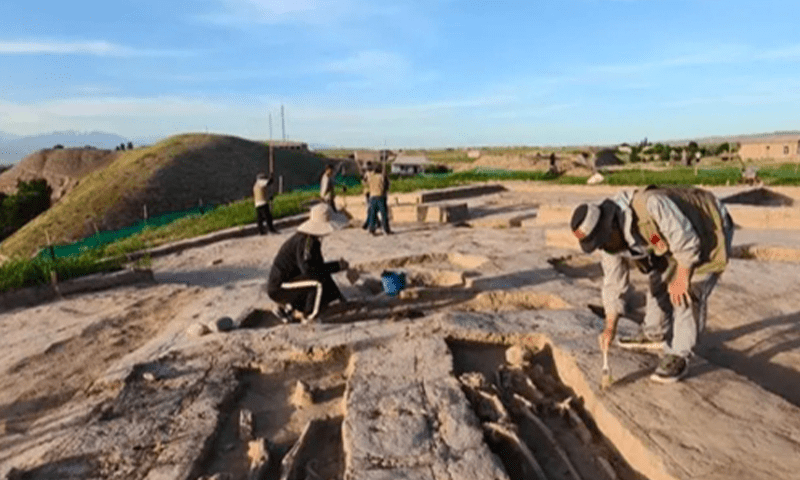
Archaeologists uncover 8th-century BC ruins near Surkhandarya river
Photo: Northwest University - Global Times
Archaeologists uncover 8th-century BC ruins near Surkhandarya river Photo: Northwest University – Global Times

Archaeologist Wang Meng noted that such discoveries are crucial for establishing a chronological timeline of the Kushan culture in the region, helping to trace the development of civilization around the Surkhandarya area.

In the third project, archaeologists focused on the Fergana Valley in eastern Uzbekistan, where they explored and reviewed 84 ruins between April and May.  A precious cliff painting was also discovered during the research, which helped paint a picture of the ancient culture of the Namangan Region of Uzbekistan.

These discoveries mark the latest milestones in a longstanding archaeological partnership between Northwest University and Uzbekistan, which began in 2009. By 2024, more than 70 joint projects had been conducted in Central Asia, aiming to study the historical exchanges along the ancient Silk Road.

Wang Jianxin, a pioneering archaeologist who began working in Uzbekistan 15 years ago, highlighted that these collaborations have challenged Western-centric interpretations of Silk Road history and enhanced global understanding of China’s contributions to ancient Silk Road civilization.

Cover Photo: Aniq
Related Articles

The first and largest astronomical observatory of the 6th century BC discovered in Egypt’s Kafr El-Sheikh

24 August 2024

24 August 2024

Archaeologists in Egypt unveiled the first and largest astronomical observatory from the 6th century BCE in the Buto Temple at...

Radar Detects Long-lost River in Egypt and Could Explain How The Pyramids Were Built

22 May 2024

22 May 2024

More than 30 pyramids in Egypt are located in an unremarkable strip of barren desert far from the shores of...

A 5,000-year-old large house has been discovered in China’s Yangshao Village

7 December 2022

7 December 2022

Henan Provincial Institute of Cultural Heritage and Archaeology archaeologists have excavated the ruins of house foundations dating back more than...

Neanderthals used glue to make stone tools 40,000 years ago, a new study suggests “Earliest evidence of a multi-component adhesive in Europe”

22 February 2024

22 February 2024

More than 40,000 years ago, Neanderthals in what is now France used a multi-component adhesive to make handles for stone...

Roman girl adorned with 1800-year-old jewelry found in a lead coffin on Mount Scopus

9 April 2023

9 April 2023

“After the destruction of the Jerusalem Temple and the exodus of the Jewish population, late Roman Jerusalem—renamed Aelia Capitolina—had a...

Ancient tomb with prayer-related murals found in China’s Shanxi

25 December 2021

25 December 2021

Archaeologists in north China’s Shanxi Province have found an ancient tomb dating back to the Jin Dynasty (1115-1234) with murals...

Egypt’s Tanis bronze figurines shed light on ancient commerce

19 July 2021

19 July 2021

A research team told that the newly discovered 3,000-year-old bronze figurines recently unearthed in Tanis, Egypt, can answer questions about...

An inscription with the name of the ancient city was found at the excavation site in Gordion, the capital of the Phrygians

8 August 2022

8 August 2022

An inscription bearing the name of the ancient city was found at the excavation site in Gordion, the capital of...

Kurt Tepesi: The Silent Sentinel in the Shadows of Göbeklitepe and Karahan Tepe – Unearthing the Forgotten Sister

31 May 2025

31 May 2025

In the arid plains of southeastern Anatolia, a quiet giant slumbers. While Göbekli Tepe has dazzled archaeologists and the global...

Archaeologists Discovered Over 500 Ancient Coins and A Gold Template for Making jewelry in Bulgaria

17 August 2024

17 August 2024

In Plovdiv, in southern Bulgaria, archaeologists have discovered over 500 ancient coins and a gold template for making jewelry from...

3,500-Year-Old Rice Discovery Marks Longest Early Ocean Journey

24 July 2025

24 July 2025

Breakthrough research reveals ancient rice remains in Guam, offering insight into early Austronesian culture and a remarkable 2,300-kilometer early ocean...

Newly discovered inscribed brick may reveal Elamite water supply system in Western Iran

15 January 2024

15 January 2024

Archaeologists discovered a brick inscribed with Akkadian script, marking the Elamite water supply system, alongside some intricately patterned bricks in...

The Discovery of a Historic Wooden Shipwreck in the North Sea

27 January 2025

27 January 2025

A section of a wooden shipwreck was uncovered near Rantum, a coastal village located on the island of Sylt in...

Tombs of Queens of Commagene Detected

23 September 2021

23 September 2021

The graves built by Commagene King Mithritades II (36-21 BC) for his mother Isias, his sister Antiokhis, and Antiochis’s daughter...

Exploring the life story of a high-status woman from isotope data in Hungary’s largest Bronze Age cemetery

29 July 2021

29 July 2021

Researchers examined 29 tombs from Szigetszentmiklós-Ürgehegy, one of Hungary’s largest Middle Bronze Age cemeteries, and one of them, a high-status...