
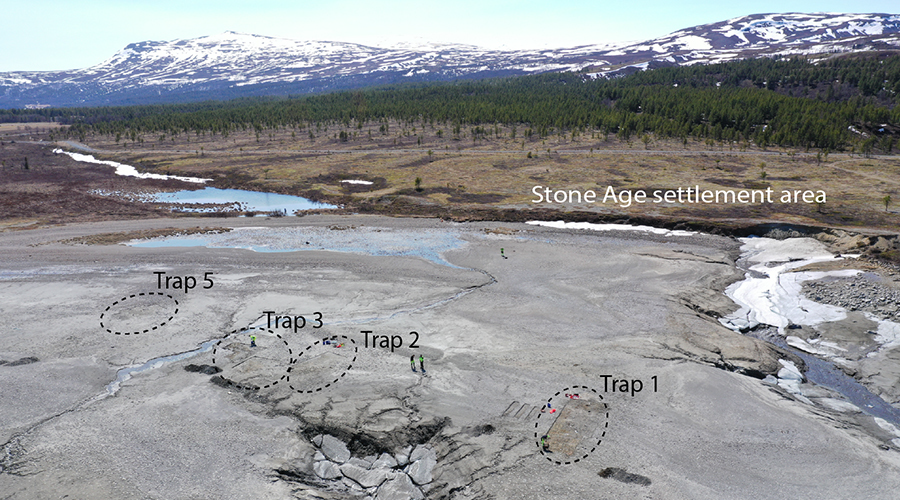
Wooden fish traps discovered in a high-altitude Norwegian lake suggest that Stone Age hunter-gatherers deliberately introduced brown trout into waters the fish could not have reached naturally.
The earliest traps, found in the exposed bed of Lake Tesse in the Jotunheimen mountains, date to around 5000 BC. Researchers argue that the structures provide evidence of a carefully planned ecological intervention—one that transformed previously fishless mountain lakes into reliable sources of food thousands of years before farming became established in the region.
Published in the journal Antiquity, the study challenges the traditional idea that prehistoric hunter-gatherers simply moved through landscapes in search of naturally available resources. Instead, the evidence from Lake Tesse indicates that these communities actively reshaped their environment and invested in food supplies that would benefit them years, and perhaps generations, later.
A lake fish could not reach on their own
Lake Tesse lies 854 metres above sea level in central southern Norway. After the Fennoscandian Ice Sheet retreated, the surrounding mountains became accessible to people, but waterfalls and steep river gradients prevented freshwater fish from naturally reaching many upland lakes.
The lake drains through the steep Tessa River toward lower waterways connected to the Oslofjord. While the lower river system historically contained around 25 fish species, only brown trout were recorded in its upper reaches. This sharp difference is central to the researchers’ argument that trout were carried into the mountains by people rather than arriving through natural migration.
The annual lowering of Lake Tesse’s water level, now managed as part of a hydroelectric reservoir, exposes sections of the former lakebed each spring. In 2022, this process revealed an area containing several stationary wooden fish traps near Stone Age settlement remains.
Archaeologists subsequently excavated four traps and collected more than 100 wooden samples for radiocarbon and tree-ring analysis.
Four traps spanning more than two millennia
The dating results show that fishing installations were built at Lake Tesse over an exceptionally long period.
Two of the traps date to around 5000 BC, including one placed at approximately 4950 BC. Another dates to around 3850 BC, while the youngest was constructed around 2700 BC. Together, they show that people returned to the lake and rebuilt fishing structures for at least 2,300 years.
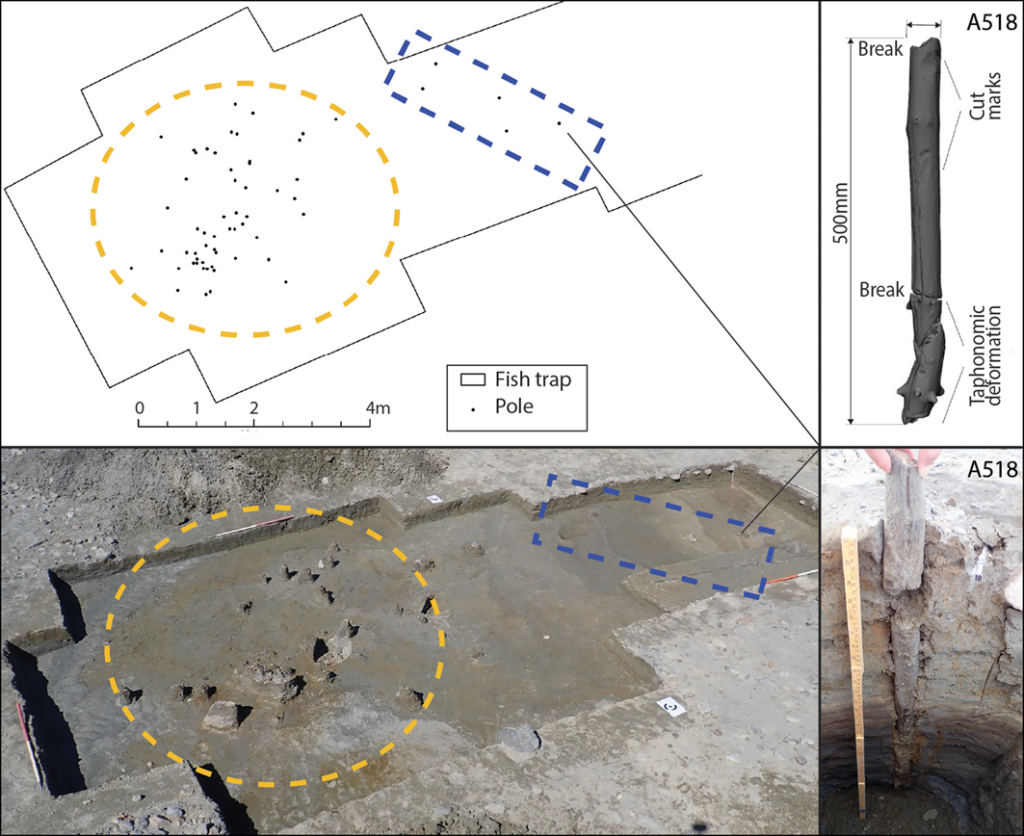
The best-preserved installation, known as Trap 5, contained 46 surviving wooden poles. Forty formed a chamber roughly 3.5 metres in diameter, while six appear to have created a guiding fence that directed fish into the enclosure.
Many of the poles had been worked by hand. Researchers identified cut marks, split surfaces and possible traces of binding. Most were driven vertically into the lakebed and probably supported a woven lattice wall. Eleven angled posts may have reinforced the structure against water movement.
The traps were mainly built from small Scots pine trunks, with smaller amounts of birch and willow. Analysis of the outer tree rings showed that many of the trees were cut in spring or early summer, suggesting that the traps were constructed shortly before the main summer fishing season.
Two posts from one trap were felled about 12 years apart. That interval suggests the structures required periodic maintenance rather than being abandoned after a single season.
Why brown trout point to human intervention
The researchers considered whether birds or other natural processes might have carried fish eggs into isolated mountain lakes. However, they found this explanation unlikely.
Brown trout were consistently the only fish species identified in most of the high-altitude waters examined. If birds had transported eggs randomly, a more varied pattern of species might be expected. The apparent spread of mountain fishing from around 5000 BC also appears too organised and geographically consistent to be explained by chance.
Archaeological evidence from elsewhere in the Jotunheimen and Hardangervidda mountains strengthens the case. Burned fish bones have been radiocarbon dated at nine mountain sites, five of them to the fifth millennium BC. At the sites where the bones could be identified by species, they belonged to brown trout.
The researchers therefore conclude that people deliberately transported live trout upstream and released them into suitable lakes.
How this was done remains uncertain. Fish may have been captured alive in traps and carried in containers made from animal skins, but the study presents this as a plausible reconstruction rather than direct archaeological proof.
An investment that took decades to pay off
Introducing trout into a new lake would not have produced an immediate food supply. The fish needed time to survive, reproduce and form a population large enough to support regular catches.
According to the study, this process may have taken several decades. The people responsible therefore needed more than practical fishing skills. They required a detailed understanding of trout behaviour, reproduction and lake ecology, as well as the confidence that future communities would return to the same mountain areas.
That long-term planning may explain why fishing became so important in the region. The mountains offered access to elk, reindeer, fur and stone raw materials, but big-game hunting was unpredictable. A stocked lake provided a more dependable source of fresh, calorie-rich food.
Trout could have allowed larger groups to remain in the mountains for longer periods and reduced the risks associated with unsuccessful hunts. Fish were therefore not simply an additional food source; they may have changed how people used the entire landscape.
Hunter-gatherers as environmental managers
The earliest trout introductions at Lake Tesse took place before clear evidence of agriculture in central Scandinavia. Farming appeared later, while hunting, fishing and gathering remained dominant for centuries.
For the study’s authors, this makes the discovery particularly important. It shows that large-scale environmental management was not limited to farming societies. Mesolithic hunter-gatherers were already relocating species, modifying ecosystems and creating food resources that did not previously exist.
The authors describe the stocking of mountain lakes as a possible form of food production. It permanently altered local ecosystems and established a fishing tradition that continued through the Neolithic period and far beyond.
The wooden traps at Lake Tesse do not directly preserve the moment when trout were first carried into the mountains. But their early dates, combined with natural barriers, species distribution and fish remains from surrounding sites, form a strong body of evidence for deliberate human action.
Seven thousand years ago, people in Norway were not merely adapting to the mountain environment. They were redesigning it.
Mjærum, A., Friis, E. K., Hesthagen, T., & Kirchhefer, A. J. (2026). The introduction of fish to the Scandinavian mountains by hunter-fisher-gatherers 5000 BC. Antiquity, 1–17. doi:10.15184/aqy.2026.10392
