

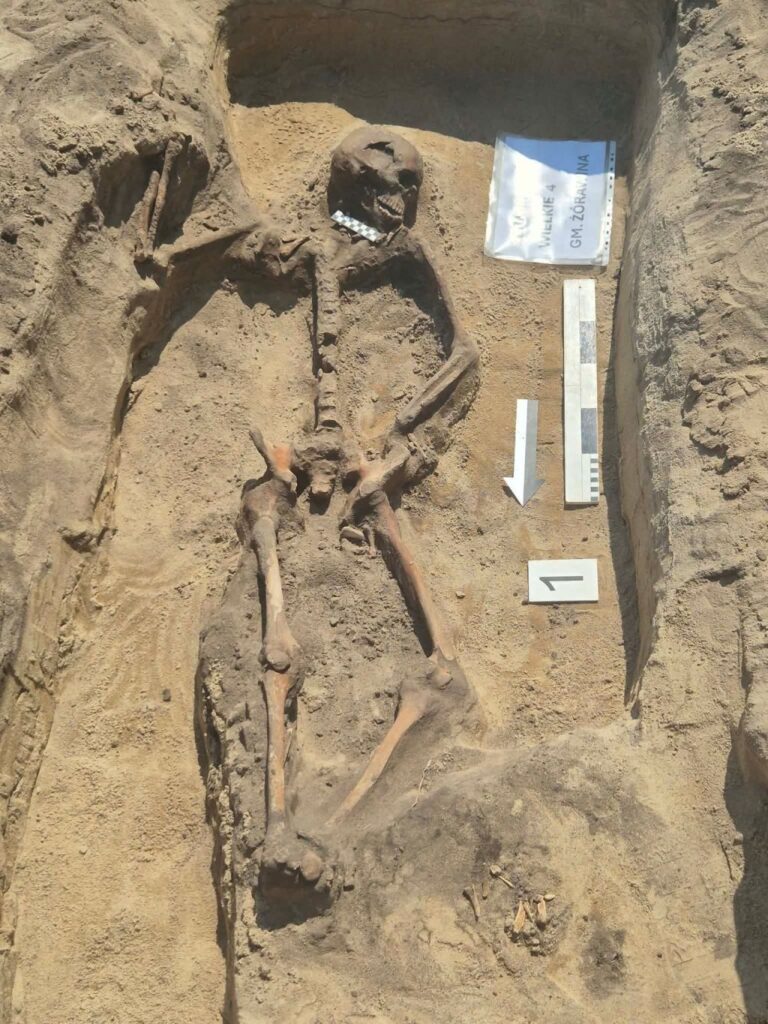
An archaeological excavation near Żórawina in southwestern Poland has uncovered a burial that is thousands of years older than the cemetery researchers originally set out to investigate. Inside the remains of a roughly 5,000-year-old burial mound, archaeologists found an almost complete adult male skeleton accompanied by a necklace made from 42 perforated teeth, amber and bone beads, a flint blade and a serpentinite battle axe.
The grave also contained fragments of two additional adult human skulls, suggesting that the burial may have involved a more complex ritual than a conventional single interment. Provisionally dated to around 2900 BCE, the discovery could be associated with communities belonging to the wider Corded Ware cultural horizon.
Researchers now plan to use radiocarbon dating, ancient DNA, isotope analysis and detailed osteological examination to determine who was buried there and whether the additional human remains belonged to relatives or unrelated individuals. The results may also provide new evidence for population mobility in Lower Silesia during the early third millennium BCE.
A much older grave beneath a known cemetery
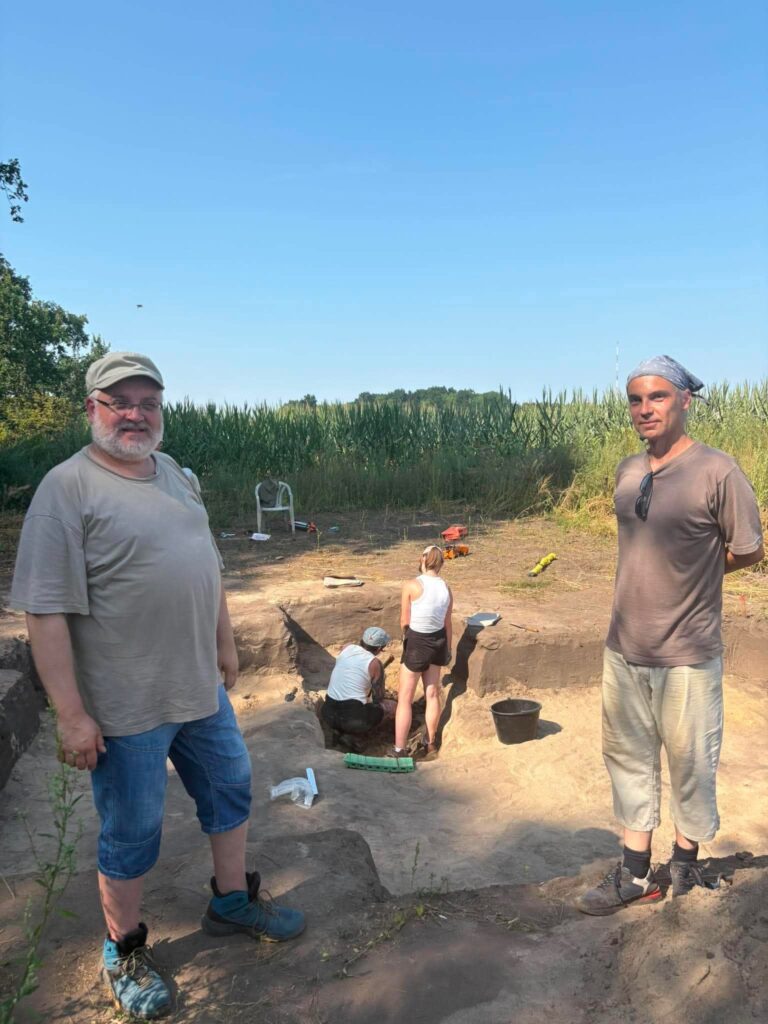
The site near Żórawina, south of Wrocław, had long been known to archaeologists as a cemetery dating to the end of the Roman Period and the beginning of the Migration Period, roughly 1,600 years ago. Excavations are being conducted by the Institute of Archaeology at the University of Wrocław under the direction of Professor Tomasz Gralak.
The research team also includes Dr. Paweł Dąbrowski, an anthropologist and anatomist from Wroclaw Medical University, who specializes in the study of ancient human skeletal remains. The unexpected prehistoric burial emerged only near the end of the excavation season, when researchers were already beginning to clear and organize the site.
A circular feature measuring about four metres across appeared in the soil and resembled the outline of a burial mound. As excavation continued into its central area, the finds quickly showed that the structure belonged to a period far earlier than the surrounding cemetery.
A necklace made from 42 perforated teeth
The first remarkable discovery was a carefully arranged group of 42 teeth positioned in the form of a necklace. Each tooth had been deliberately perforated through the root, indicating that they had once been threaded onto a cord or similar organic material that has not survived.
The arrangement remained sufficiently intact for archaeologists to recognize the ornament’s original form. Dąbrowski’s preliminary examination suggests that the necklace may contain teeth from several groups of mammals, including canids, bears and hoofed animals, while the possibility that some could be human has not yet been excluded.
Genetic analysis is expected to determine which species were represented in the necklace. Researchers may also be able to investigate whether the animals were obtained locally and whether the selection of particular teeth had social, hunting or symbolic significance.
Below the ornament, archaeologists uncovered the almost complete skeleton of an adult man. Bone discs, amber beads, a flint blade and a carefully shaped stone axe were also recovered from the grave and may have formed part of a broader set of personal or funerary objects.
A serpentinite battle axe provides the first dating clue
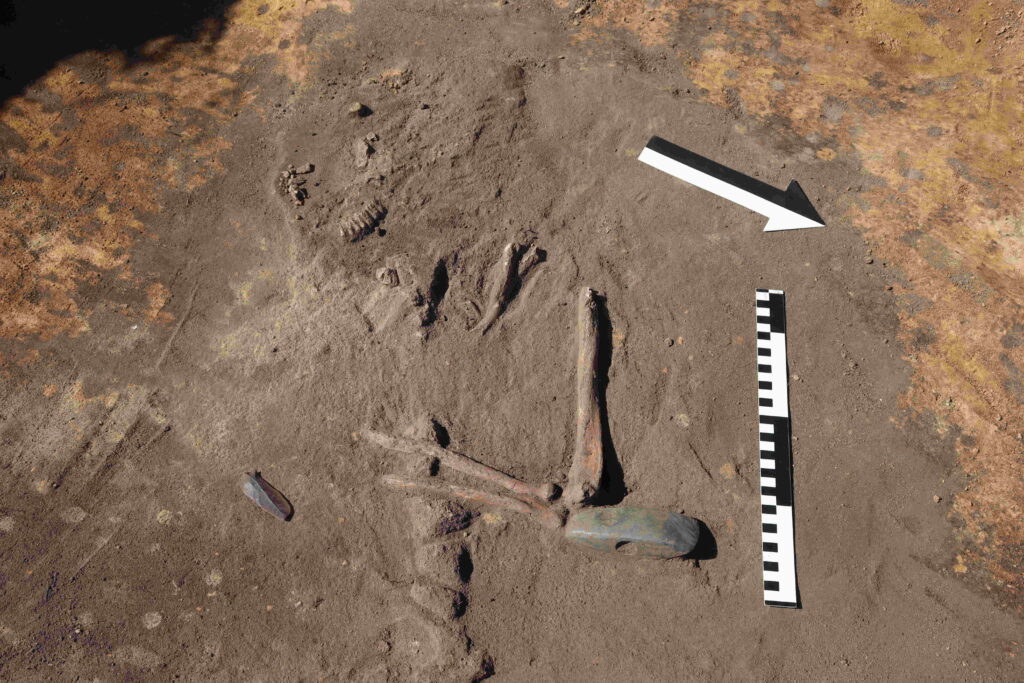
The stone axe has provided one of the strongest initial indications of the burial’s age. Made from serpentinite, a metamorphic rock, its form has led archaeologists to propose a preliminary date of around 2900 BCE.
This chronology would make the mound several thousand years older than the Migration Period graves previously excavated at Żórawina. It also places the burial close to the period in which Corded Ware communities became established across large parts of Central and northern Europe.
Corded Ware burials are frequently associated with distinctive grave practices, stone battle axes and evidence of substantial population mobility. Ancient DNA studies from Central Europe have also identified strong steppe-related ancestry in many individuals connected with Corded Ware archaeological contexts.
That broader genetic pattern does not, however, establish where the Żórawina man himself was born or raised. His individual origin remains an open question that radiocarbon, isotope and genetic analyses will now be used to investigate.
Two additional skulls raise questions about the burial ritual
Fragments of two incomplete and heavily damaged adult skulls were recovered in the same grave as the principal burial. Their presence is one of the most unusual elements of the discovery because researchers do not yet know why they were placed with the man.
One preliminary hypothesis considered by Dąbrowski and Gralak is that the remains could represent deliberately severed heads deposited as offerings or ritual objects. The interpretation remains speculative and will depend on whether physical traces of intentional decapitation can be identified on the surviving bones.
Detailed examination will focus on cut marks, fractures, and other alterations that could have been produced by sharp-edged tools. Researchers will also need to distinguish any injuries inflicted around the time of death from damage caused by burial conditions, later disturbance or deterioration over thousands of years.
Ancient DNA could provide an additional line of evidence if sufficient genetic material survives. Establishing whether the two individuals were biologically related to the man at the centre of the grave could significantly change how the burial is interpreted.
Was the buried man a warrior, hunter or community leader?
The richness and unusual composition of the grave goods have already raised questions about the social position of the deceased. The serpentinite axe shows signs of use, including minor damage along its cutting edge, which suggests that it may have functioned as a practical object before being placed in the grave.
Dąbrowski considers it possible that the axe had been used in combat or hunting rather than produced purely as a funerary object. Professor Gralak has also discussed the possibility that the man may have been a prominent hunter, warrior or senior figure within his kin group.
None of these interpretations can yet be demonstrated directly from the archaeological evidence. Nevertheless, the combination of the large tooth necklace, amber ornaments, used axe, and additional human remains indicates that considerable attention was devoted to the burial.
The skeleton itself may provide clues to the man’s activities during life. Researchers plan to examine it for healed injuries, microscopic trauma, stress-related changes, and evidence of inflammation or repetitive physical strain.
Teeth may reveal where people and animals grew up
Some of the most informative evidence may come from the well-preserved teeth belonging both to the buried individuals and to the animals represented in the necklace. Researchers plan to conduct isotope analyses, including measurements of strontium isotope ratios, to investigate geographical origin and mobility.
Strontium incorporated into teeth during childhood reflects aspects of the geological environment in which an individual lived while the teeth were forming. By comparing those isotopic signatures with known environmental patterns, researchers may be able to determine whether the Żórawina man grew up locally or spent his early life elsewhere.
The same method could potentially be applied to the animal teeth used in the necklace. This may reveal whether the animals were obtained in the surrounding region or whether some originated farther away, adding another dimension to the interpretation of the ornament.
Genetic testing will address different questions, including biological sex, ancestry, and possible kinship between the human remains. Analysis of genetic lineages may also help place the individuals within broader patterns of prehistoric population movement.
A second nearby burial could provide crucial context
The Żórawina discovery may not be an isolated case. According to the research team, another archaeological group recently uncovered a similar burial mound at Iwiny, also near Wrocław.
Researchers are particularly interested in comparing the chronology, skeletal evidence and laboratory results from the two sites. If radiocarbon dates show that the burials are contemporary and genetic or isotopic analyses reveal comparable patterns, they could provide important new evidence for the presence and mobility of Corded Ware-associated groups in Lower Silesia.
This question matters because Europe underwent major demographic changes during the third millennium BCE. Archaeogenetic research has documented substantial genetic connections between many Corded Ware populations and groups carrying steppe-related ancestry from regions farther east.
The Żórawina burial offers an opportunity to test those broad population models at the level of a specific individual. Rather than assuming that the buried man himself migrated from eastern Europe or the Pontic-Caspian region, researchers will be able to examine whether he was locally raised, whether his ancestry reflects more distant origins, and how his biological profile compares with individuals from nearby sites.
Fragile remains will be examined before cleaning
Some of the human bones are so poorly preserved that they were removed from the ground together with blocks of surrounding soil. This precaution was necessary to prevent fragile fragments from disintegrating during excavation.
The soil blocks will first be examined using X-rays so that researchers can identify the position and orientation of bone fragments before attempting to expose them. This should allow conservators and anthropologists to plan the cleaning process while preserving as much material as possible.
Only after initial dating and laboratory work will the remains undergo detailed anatomical, anthropological and odontological examination. Planned methods also include radiology, paleohistology, chemical analysis, mass spectrometry and scanning electron microscopy of dental wear.
Together, these techniques may provide information about diet, nutrition, physical activity, injury and disease. The degree and microscopic pattern of tooth wear, for example, could help researchers investigate not only what kinds of food were consumed but also how those foods were processed.
The first laboratory results are expected in the coming months, but the wider interpretation will depend on combining evidence from radiocarbon dates, DNA, isotopes, skeletal analysis and the archaeological context. Only then will researchers be able to assess whether the Żórawina burial represents an unusual local funerary tradition or part of a broader movement of people across prehistoric Central Europe.
