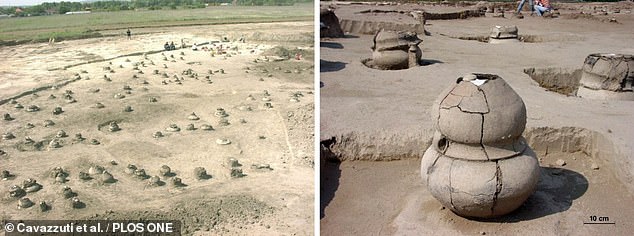
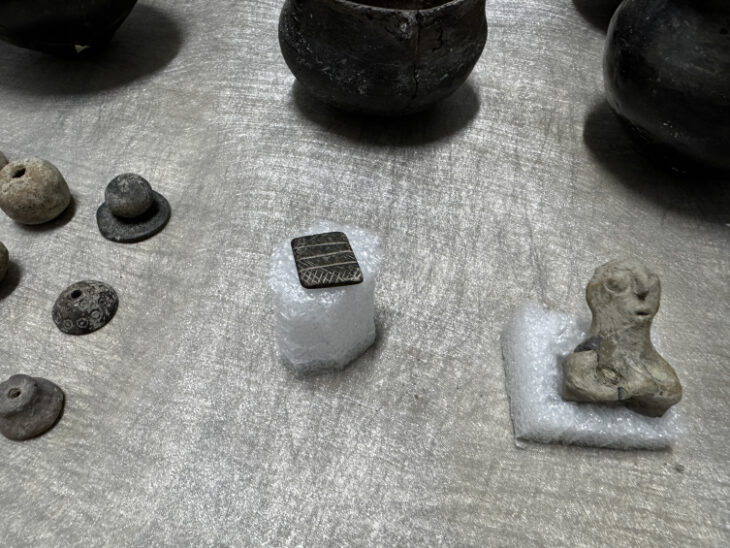
Archaeologists working in Iraqi Kurdistan have uncovered a remarkably well-preserved 3,000-year-old pottery workshop that is reshaping what researchers know about craft production, urban life, and social organization in the ancient Near East. The discovery — made at the Iron Age settlement of Dinka — offers one of the clearest archaeological records to date of how pottery was produced, fired, and distributed across an early urban community.
According to researchers from the University of Tübingen, the workshop dates to roughly 1200–800 BCE and contains two kilns, ceramic fragments, fuel remains, and layered sediments that together preserve an entire manufacturing chain — from raw clay processing to finished vessels. The findings were recently published in the Journal of Archaeological Science and mark one of the most comprehensive studies of ancient Near Eastern pottery production to date.
For archaeologists, pottery has long been one of the most valuable sources of historical evidence. But while finished ceramics often survive in abundance, the technologies and workflows behind their creation remain far less documented. Production sites are rarely preserved intact, and firing installations — especially those used at relatively low temperatures — tend to erode or vanish entirely over time. That makes the Dinka discovery exceptionally rare, providing a full archaeological snapshot of how Iron Age potters worked, organized labor, and supplied their community.
A Modular, Highly Organized Production System
Lead researcher Dr. Silvia Amicone explains that the outstanding state of preservation allowed the team to combine multiple scientific techniques to reconstruct the entire production process. The team analyzed raw clay, finished vessels, kiln linings, and traces of fuel, revealing a workshop that operated within a structured and modular manufacturing system designed to serve not only the settlement itself, but the wider region as well.
Despite visible differences in vessel shape and decoration, the variations followed standardized patterns rather than random experimentation. This suggests that the pottery was produced through a collective and coordinated system rather than by isolated craftspeople working independently. The workshop appears to have functioned as a central production hub — one that may have been overseen by community authorities or local institutions.
📣 Our WhatsApp channel is now LIVE! Stay up-to-date with the latest news and updates, just click here to follow us on WhatsApp and never miss a thing!!
The study also found that potters used low-temperature firing techniques below 900°C, employing slow heating in oxidizing conditions. These consistent firing profiles indicate shared technical knowledge and repeated routines, reflecting both cultural continuity and meaningful technological control. According to the researchers, such coordination signals a level of organization and oversight that goes well beyond what scholars traditionally assumed for Iron Age craft industries.

Craft Production as a Pillar of Urban Life
Excavations at Dinka have been underway since 2015, and the site is now considered one of the best-documented Iron Age settlements in the region. The pottery workshop adds compelling evidence that artisanal production was not a marginal activity, but rather a central component of the urban economy and community identity. Far from being small-scale or domestic, pottery making at Dinka was systematic, skilled, and socially embedded.
The discovery challenges older archaeological models that portrayed Iron Age workshops as informal or loosely structured. Instead, the remains at Dinka point to specialized labor, interdependent workflows, and shared craftsmanship traditions that supported broader patterns of trade and regional interaction.
Dr. Amicone notes that the findings reveal a society in which technology, collaboration, and knowledge transfer were essential to daily life — and where craft workers held a meaningful role within urban organization and governance. The workshop demonstrates that the residents of Dinka were not only farmers or traders, but active participants in a complex production economy shaped by expertise and innovation.
Reconstructing Daily Life Through Science
By combining sediment analysis, materials science, and archaeological excavation, the research team was able to move beyond the pottery fragments themselves and reconstruct the lived reality of the people who produced them. Every kiln wall, discarded sherd, and layer of ash contributed to a detailed picture of work rhythms, firing sequences, and resource management across the workshop’s operational lifespan.
This integrated approach, the authors argue, offers a rare opportunity to understand how Iron Age communities balanced tradition with adaptation — refining their methods over generations while maintaining recognizable stylistic and technological signatures.
Ultimately, the Dinka workshop highlights the vital role of interdisciplinary archaeology in revealing the social worlds hidden behind everyday objects. Far more than simple tools, these vessels — and the processes that created them — illuminate how ancient communities organized labor, sustained knowledge, and built their cities.
As research at the site continues, archaeologists hope that further discoveries will deepen our understanding of how production, technology, and community life intertwined across the ancient landscapes of northern Mesopotamia — and how the legacy of those craft traditions shaped the cultures that followed.
Amicone, S., Dinckal, A., Gur-Arieh, S., Solard, B., Frenken, M., Squitieri, A., Herr, J.-J., Berthold, C., Miller, C. E., & Radner, K. (2025). Assembling the puzzle pieces: Integrating pottery and kiln analysis to reconstruct pyrotechnology at the Dinka Settlement Complex (Iraqi Kurdistan). Journal of Archaeological Science. https://doi.org/10.1016/j.jas.2025.106425
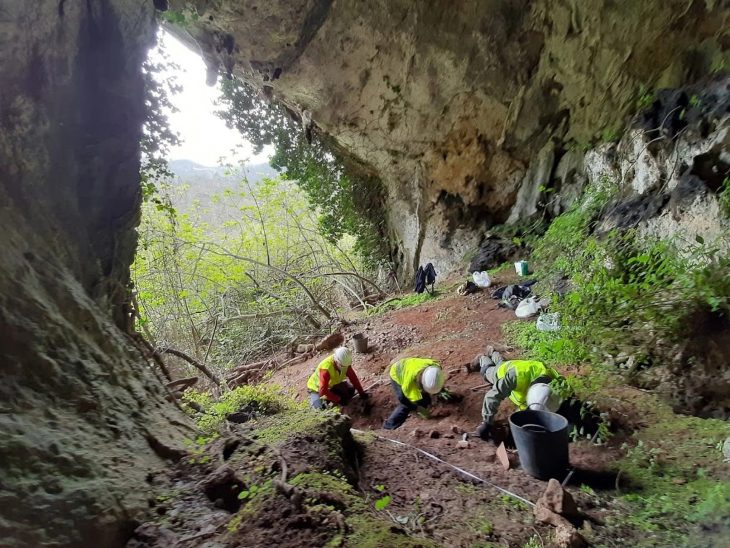
Cover Image Credit: The unearthed pottery workshop of Gird-i Bazar. From this perspective, the walls of the buildings are clearly visible, along with the kilns. Andrea Squitieri