
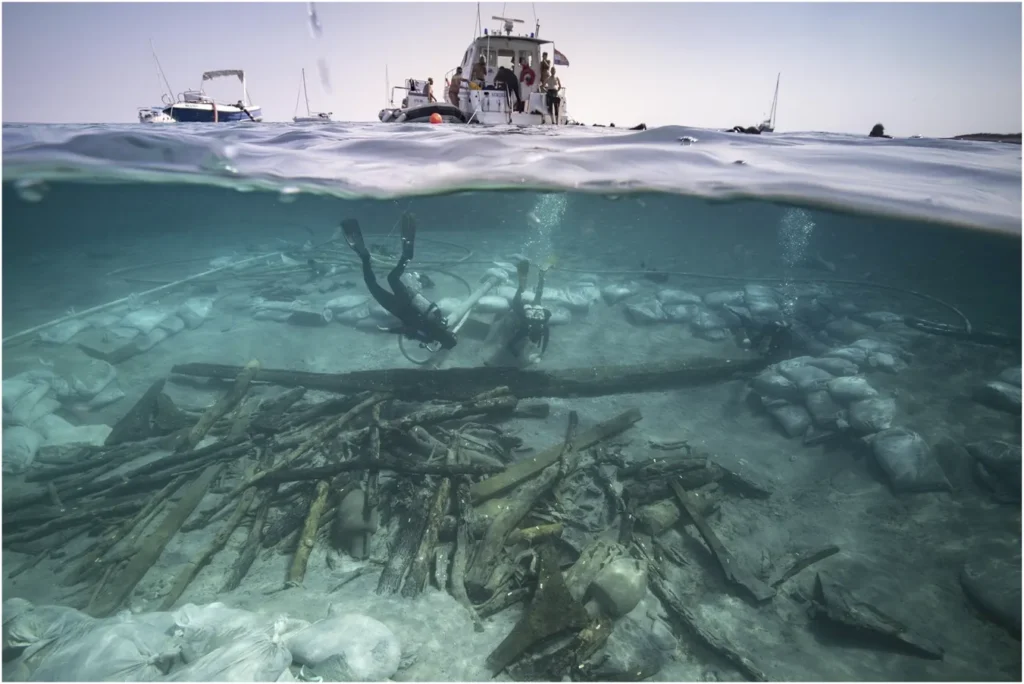
A Roman-era shipwreck resting off the Croatian coast is offering an unusually intimate look at how ancient shipbuilders protected their vessels from the relentless forces of the sea. By combining chemical analysis with pollen research, scientists have reconstructed not just the materials used on the ship—but the environments and repair journeys it likely experienced more than 2,000 years ago.
The findings come from the study of the Ilovik–Paržine 1 wreck, a merchant vessel dating to the mid-second century BC, discovered in shallow waters near Ilovik Island in the Adriatic Sea. Researchers analyzed the ship’s protective coatings using a rare interdisciplinary approach that blends molecular chemistry with palynology—the study of pollen.
A Hidden Layer of Ancient Engineering
Ancient ships relied on more than timber and craftsmanship. To survive saltwater exposure, shipbuilders applied waterproof coatings that sealed hulls and resisted biological decay. These coatings were typically made from natural materials such as plant resins, tar, bitumen, and wax—substances chosen for their hydrophobic properties and availability.
In the case of Ilovik–Paržine 1, researchers found that the hull had been coated both inside and out with a thick organic layer.
Chemical analysis revealed that the primary ingredient was pine-derived pitch, produced by heating conifer wood under low-oxygen conditions. This process creates a sticky, water-resistant substance that has been used in shipbuilding for millennia.
But the study did not stop at identifying materials. It went deeper—into how those materials were made, altered over time, and even where they might have originated.
Molecular Clues in Ancient Tar
Using advanced techniques such as gas chromatography–mass spectrometry (GC-MS) and infrared spectroscopy, researchers identified specific molecular “fingerprints” within the coating.
These fingerprints included compounds derived from abietic acid—a chemical marker strongly associated with conifer resins. The presence of these molecules confirmed that the coating originated from pine-based materials.
Even more revealing were signs of high-temperature processing. Certain aromatic compounds found in the samples only form when resin is heated above 300°C, indicating that Roman shipbuilders were deliberately refining raw materials to improve performance.
Over time, these coatings had also undergone significant degradation. The molecular structure showed clear evidence of long-term exposure to environmental stress, including microbial activity and seawater interaction.
In one sample, researchers detected something unusual: beeswax mixed into the pitch.
This combination, known in ancient texts as zopissa, would have made the coating more flexible and easier to apply—suggesting that Roman shipbuilders were not only skilled craftsmen but also material engineers.
Pollen as a Map of Movement
If chemistry revealed what the coating was made of, pollen revealed where it had been.
Because sticky substances like pitch trap microscopic particles, they can preserve traces of surrounding vegetation. By analyzing pollen grains embedded in the coating, researchers reconstructed the landscapes associated with the ship’s construction and maintenance.
The results were striking.
The pollen profiles pointed to a mix of Mediterranean ecosystems—oak forests, shrublands, wetlands, and coastal vegetation.
More importantly, the data suggested that the coatings were not applied all at once. Instead, the ship appears to have undergone multiple repair phases, each using materials sourced from different regions.
Some pollen signatures matched environments near Brundisium (modern Brindisi in southern Italy), a major Roman port and likely shipbuilding center.
Others pointed to the eastern Adriatic coast, including areas in present-day Croatia—implying that the vessel was repaired during its voyages.
A Ship with a Story
The Ilovik–Paržine 1 wreck was first discovered in 2016 and excavated over several seasons. Lying just four meters below the surface, the site preserved fragments of amphorae, ballast stones, and sections of the wooden hull.
Radiocarbon dating and cargo analysis confirmed its age at around 170 BC, placing it firmly within the Roman Republic period—a time of expanding maritime trade across the Mediterranean.
What makes this ship exceptional is not just its preservation, but the story encoded in its materials.
The coating analysis revealed four to five distinct application phases, suggesting repeated maintenance over the ship’s operational life.
Each layer represents a moment in time—a repair in a foreign port, a routine maintenance stop, or an adaptation to new environmental conditions.
Beyond Materials: Reconstructing Ancient Networks
This study highlights a shift in archaeological research. Instead of focusing solely on visible structures wood and cargo, scientists are now extracting information from microscopic and chemical traces.
By integrating molecular science with environmental data, researchers can reconstruct trade routes, technological choices, and even cultural exchanges.
For example, the presence of beeswax in one sample may reflect influence from Greek shipbuilding traditions, which were well established in southern Italy during the Roman Republic.
In other words, the ship’s coating is not just a technical feature—it is evidence of knowledge transfer across ancient maritime networks.
A New Frontier in Naval Archaeology
The Ilovik–Paržine 1 study demonstrates how interdisciplinary science is reshaping our understanding of the past.
Traditional archaeology might identify a ship’s origin and cargo. But this approach goes further—revealing how the ship was built, maintained, and adapted over time.
It turns a static wreck into a dynamic object with a life history.
And in doing so, it reminds us that even something as simple as a layer of tar can carry the imprint of ancient innovation, trade, and survival at sea.
Charrie-Duhaut A, Couillebault Q, Miholjek I and Boetto G (2026) Adhesive coatings in naval archaeology: molecular and palynological investigations on materials from the Roman Republican wreck Ilovik–Paržine 1 (Croatia). Front. Mater. 13:1758862. doi: 10.3389/fmats.2026.1758862
Cover Image Credit: View of the excavation of the bow area of the Ilovik-Paržine 1 shipwreck. In the foreground, the cargo of logs and amphoras can be seen. Archaeologists are working near the structure of the bow complex (Adriboats © L. Damelet, CNRS/CCJ). Charrie-Duhaut A, et. al., 2026
