
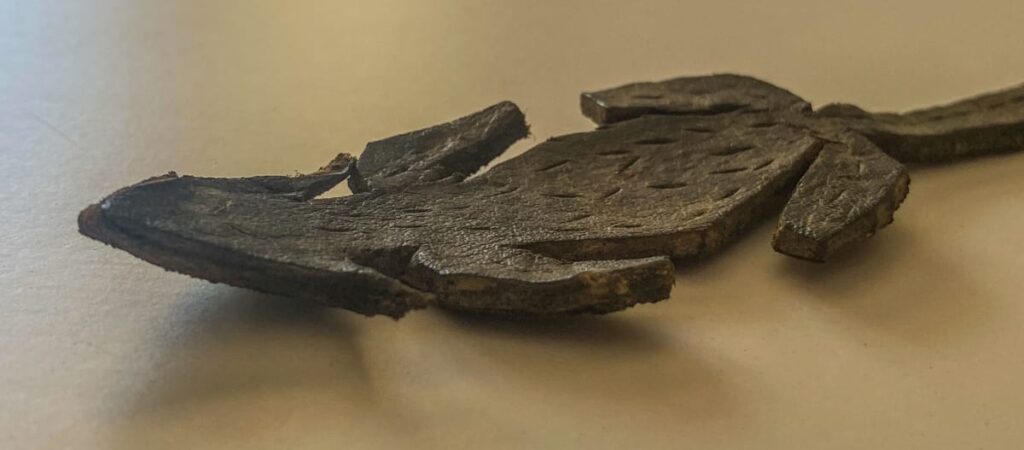
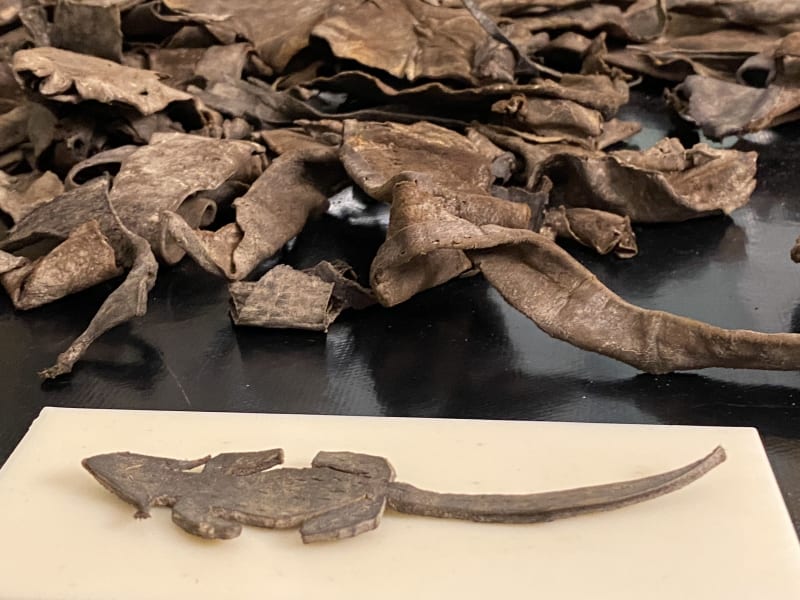
At first glance, it looks like a remarkably simple object: a thin piece of leather cut into the shape of a mouse. But the tiny animal found at the Roman fort of Vindolanda in northern England has become one of the site’s most unusual glimpses into everyday life nearly 2,000 years ago.
The leather mouse dates to around AD 105–130, when Roman soldiers and their families were living at Vindolanda, just south of what would later become Hadrian’s Wall.
Hidden among scraps for decades
The object was actually excavated in 1993 from a room in the commanding officer’s residence. It then spent years among bags containing hundreds of pieces of scrap leather before curators recognized its unusual shape while reviewing the collection in 2020.
Measuring 12.2 centimeters long and only 2.6 centimeters wide, the mouse was deliberately shaped rather than being an accidental offcut. Small markings were added to represent its fur and eyes.
A toy — or a Roman joke?
Exactly why someone made it remains unknown. Vindolanda Trust researchers have suggested that it may have been a child’s toy, although another possibility is far more playful: it could have been used as a practical joke.
Evidence for children is well documented at Vindolanda, but identifiable toys are comparatively rare. That makes even a modest object such as the leather mouse unusually interesting.
Real mice were everywhere
The choice of animal would have been immediately familiar to Vindolanda’s inhabitants. Archaeologists excavating the fort’s granaries in 2008 discovered the bones of thousands of mice beneath the floors.
The rodents had lived under the buildings and fed on grain that slipped between the stone slabs. A fake leather mouse, therefore, represented an animal Roman soldiers and their families probably encountered constantly.
A small object from ordinary Roman life
Vindolanda is famous for its exceptional preservation of organic materials, including wooden writing tablets, shoes and other leather objects. Oxygen-poor archaeological layers helped materials survive that would normally have disappeared centuries ago.
The leather mouse may never reveal whether it belonged to a child or was made simply to make someone jump. Either way, its appeal lies precisely in its ordinariness: someone at the edge of the Roman Empire once took a scrap of leather and turned it into something instantly recognizable.
