
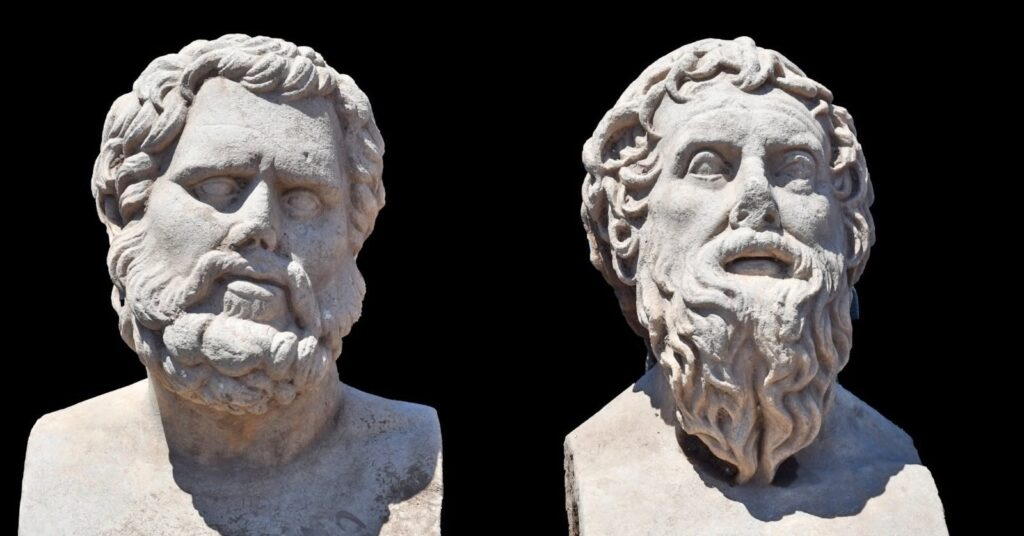
Two remarkably preserved marble busts dating back about 1,700 years have been discovered near Binyamina in northern Israel, where archaeologists found them buried face down inside the wine collection pit of a Roman-Byzantine winepress.
The discovery was announced by the Israel Antiquities Authority, which said the busts, known as protomes, depict historical figures from the Greco-Roman world. One of them still carries a Greek inscription preserving the name “Lycurgus,” a name associated with two prominent figures of classical antiquity: Lycurgus of Sparta and Lycurgus of Athens.
Marble portraits in an unexpected place
The busts were uncovered during an excavation directed by the Israel Antiquities Authority as part of the “Connecting Israel” project, led by the Ministry of Transportation and Israel Railways.
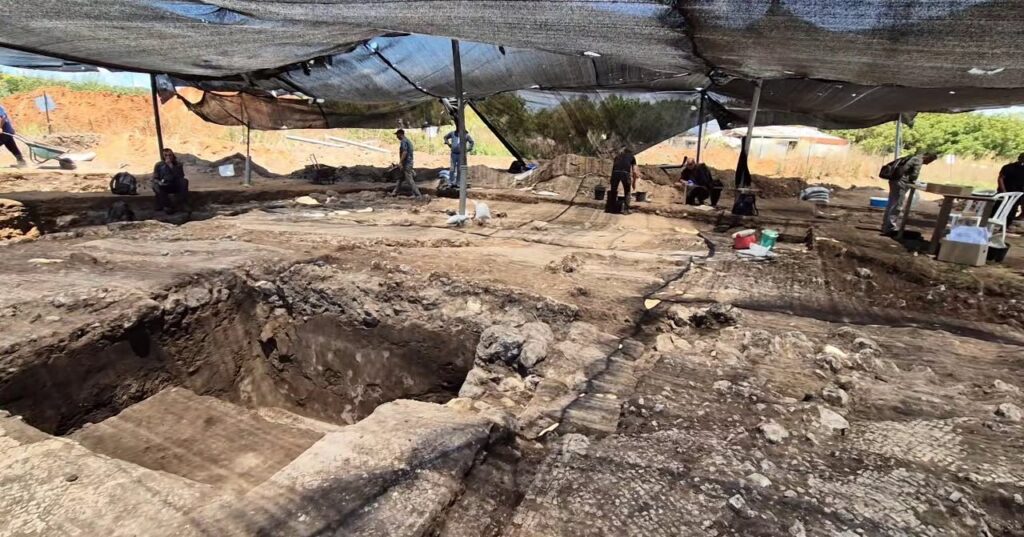
What makes the find especially unusual is not only the quality of the marble sculptures, but also where they were found. According to excavation directors Eliran Oren and Avishag Reiss, the statues were not discovered in their original display location. Instead, they had been carefully placed face down inside the wine collection pit of a Roman-Byzantine winepress after the installation had gone out of use.
The archaeologists described the discovery as unexpected and rare, noting that the busts were found intact rather than broken or scattered as reused architectural material.
A Greek name preserved on one bust
One of the statues bears the Greek name “Lycurgus.” The inscription immediately raises questions about the identity represented by the sculpture.
Dr. Peter Gendelman, an Israel Antiquities Authority expert on the Caesarea region, said two famous historical figures carried this name. One was Lycurgus of Sparta, traditionally remembered as the legendary lawgiver of the Spartan state. The other was Lycurgus of Athens, a fourth-century BCE statesman and orator.
At this stage, researchers have not yet determined which figure the bust was intended to represent. Even so, the inscription places the object within a cultural world in which educated elites continued to display admiration for the political, literary, and philosophical heritage of Greece.
Why were they inside a winepress?
The most intriguing part of the discovery is the final resting place of the busts. A wine collection pit was not where such portraits would normally stand. These marble figures were likely once displayed in a public building, elite residence or decorated architectural setting before being moved.
The fact that they were laid face down and preserved almost whole suggests a deliberate act rather than simple abandonment. Archaeologists have not yet explained why the statues were placed there, but the setting points to a later phase in the life of the site, when the winepress was no longer functioning.
Near the excavation area, archaeologists have also identified remains of a bathhouse. This raises the possibility that the busts may have once decorated a luxurious villa belonging to a resident of the Caesarea region.
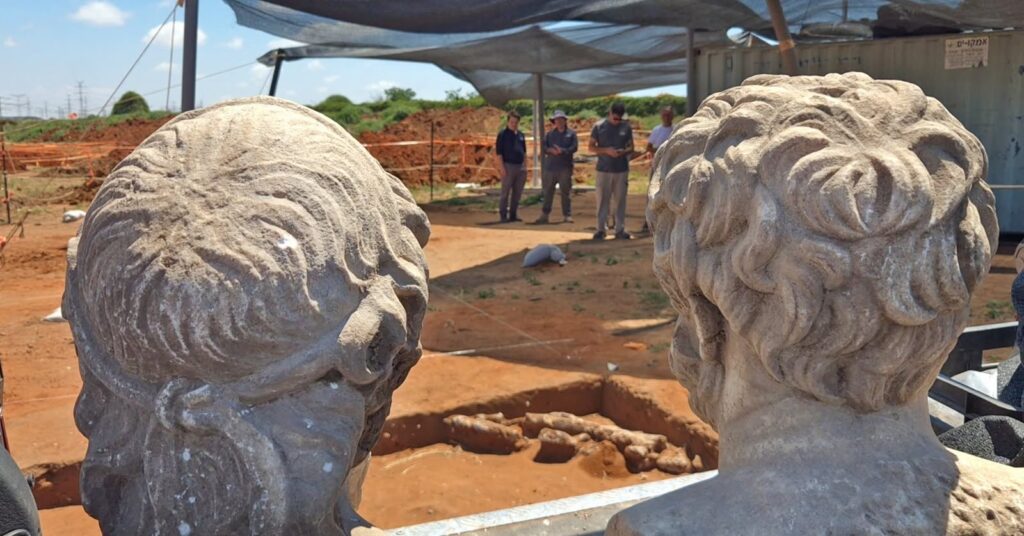
Two 1,700-year-old marble busts discovered inside a Roman-Byzantine wine collection pit near Binyamina. Credit: Emil Aladjem, Israel Antiquities Authority
Binyamina and the world of Roman Caesarea
Binyamina lies near Caesarea, one of the most important coastal cities of the Roman and Byzantine periods in the eastern Mediterranean. Founded as a major harbor city under Herod the Great, Caesarea became a key administrative and cultural center under Roman rule.
The region was not only a political and maritime hub. It was also a landscape of estates, bathhouses, agricultural installations, and wine production. In this setting, a Roman-Byzantine winepress was not an isolated structure. It belonged to a broader economic world in which viticulture, elite display, and Mediterranean trade intersected.
The discovery of marble portraits inside such a setting adds a human and cultural layer to that landscape. These were not ordinary agricultural remains. They point to people who wanted to associate themselves with the prestige of the classical past.
Elite taste and classical memory
During the Roman period, portrait busts and protomes of Greek intellectuals, statesmen, and legendary figures were commonly displayed in public buildings and wealthy private homes. They were not merely decorative objects. For elite patrons, such images reflected education, status, and cultural identity.
The Binyamina busts now join a broader group of historical figure portraits previously found in the Caesarea region. Their preservation offers another glimpse into how the Roman elite in this part of the eastern Mediterranean used art to express belonging to the Greco-Roman cultural world.
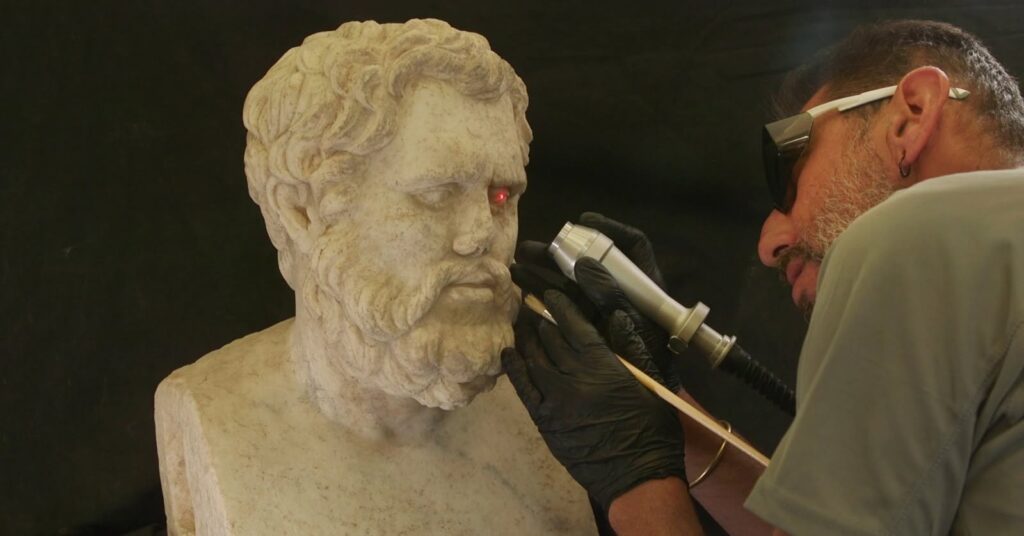
After their first public presentation, the busts are expected to undergo cleaning, conservation, and further study. Researchers will examine the marble, inscriptions, and style of the sculptures in greater detail, work that may help clarify where they were made, whom they represented, and why they were eventually buried inside a disused winepress.
For now, the discovery stands out because of its strange combination of beauty and context: two intact marble portraits, drawn from the intellectual memory of antiquity, hidden face down in the working remains of a wine-producing landscape.
Cover Image Credit: Emil Aladjem, Israel Antiquities Authority
