
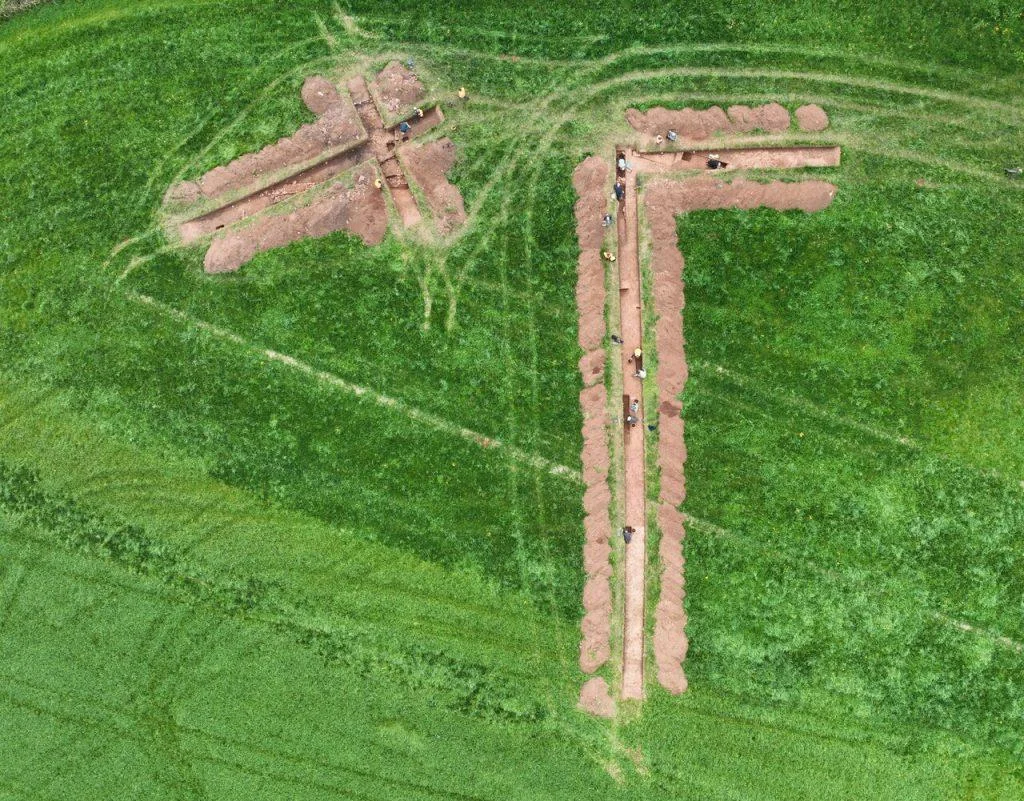
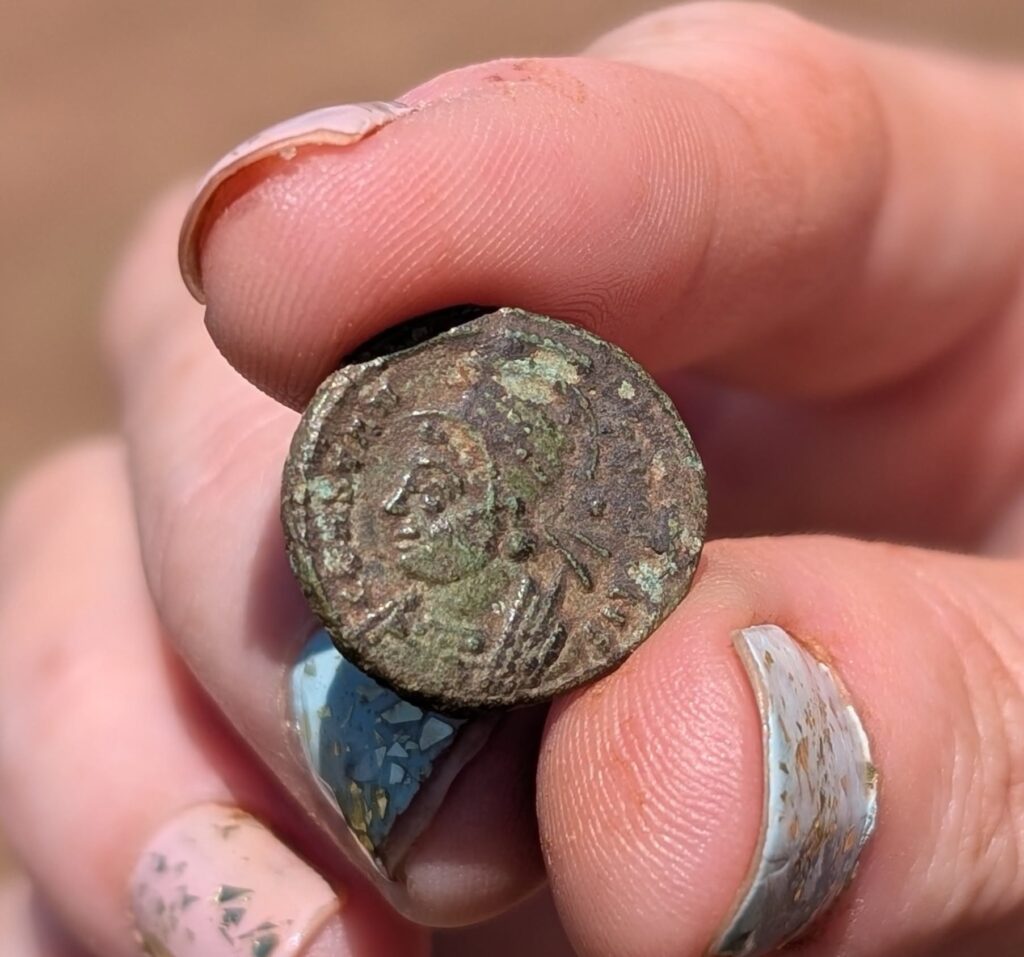
A Roman coin issued to commemorate Constantinople—modern-day Istanbul—has been discovered during excavations at a rare Roman villa complex in Devon, England.
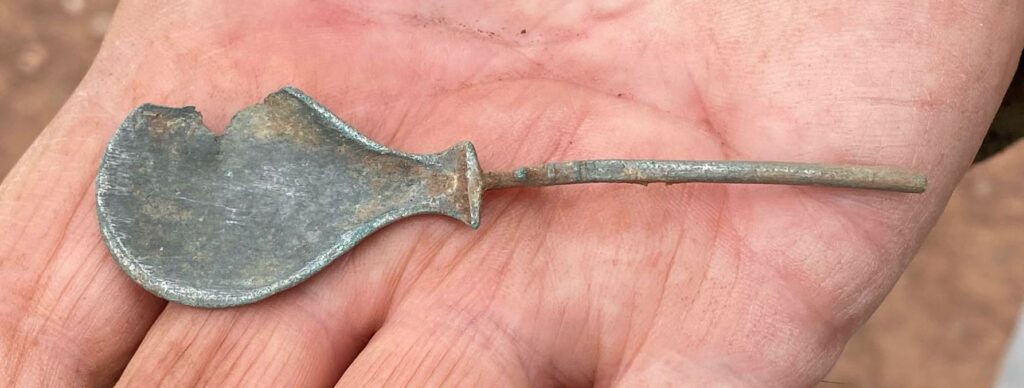
Dating to between AD 330 and 340, the coin was among several objects revealed during the 2026 community excavation near Halberton. Other finds include a silver-plated spoon, a decorated bone pin and fragments of a large amphora that may have carried olive oil from southern Spain to Roman Britain.
A coin linked to Constantine’s new capital
The small coin belongs to the Constantinopolis commemorative series produced following the establishment of Constantinople as Emperor Constantine’s imperial capital in AD 330.
Coins of this type generally show a helmeted personification of Constantinople on the obverse. The reverse depicts the winged goddess Victory standing on the prow of a vessel, usually holding a sceptre and shield. Comparable examples are known from museum collections and archaeological discoveries across Britain.
Cotswold Archaeology dates the Devon example to AD 330–340 and links the naval image to the Battle of the Hellespont in AD 324. Constantine’s son Crispus commanded the fleet that defeated the forces of Licinius during the struggle that left Constantine in control of the Roman Empire.
Rather than a commemorative token in the modern sense, the object was circulating currency carrying an imperial political message. Its discovery in Devon shows how imagery associated with the empire’s new eastern capital reached one of the westernmost parts of Roman Britain.
The coin also fits the known chronology of the villa, which appears to have remained occupied between the mid-second and fourth centuries AD.
Imported pottery and luxury tableware
Among the other finds are large pottery fragments identified as part of a possible Dressel 20 amphora. These distinctive containers were manufactured in the Guadalquivir Valley of southern Spain and were widely used between the mid-first and late third centuries AD.
Dressel 20 amphorae were primarily used to transport olive oil. The fragments therefore provide evidence that supplies from the Mediterranean trade network may have reached the villa’s inhabitants in rural Devon.
Archaeologists also recovered a copper-alloy spoon with a mandolin-shaped bowl and traces of silver plating. This form of high-quality tableware is generally associated with the later Roman period. Similar spoons have been recorded at Colchester, the Roman city of Camulodunum.
A hand-carved bone pin with a decorated terminal offers a more personal connection to the people who occupied the villa. Pins of this kind could be used to arrange hair, secure clothing or fasten small bags. Comparable objects have also been recovered from Roman graves.
The discoveries join an expanding collection from the 2026 excavations, including painted pottery, an indented drinking beaker, a Samian ware fragment with a lion-shaped spout, a copper-alloy bracelet and a blue glass intaglio depicting Victory.
A rare Roman villa threatened by ploughing
The villa lies beneath farmland between Halberton and Sampford Peverell. Roman villas are uncommon in Devon, and only a small number have been confirmed through excavation. The site was first identified in 2004 after local metal detectorist John Hill found Roman coins and other objects. Later fieldwalking and geophysical surveys revealed buildings, enclosures and evidence of a much larger estate.
The principal villa measured approximately 35 by 10 metres and was initially constructed as a rectangular winged-corridor building. Excavations indicate that rooms, a porch and other sections were added during several phases of expansion.
One room, possibly used for dining, contained a polychrome mosaic with a central floral roundel. The pavement is considered the westernmost known example of this multicoloured mosaic tradition in Britain. Evidence of underfloor heating, painted wall plaster and luxury personal objects further suggests that the complex belonged to occupants of considerable status.
Excavation of nearby ancillary buildings has also uncovered a waterproofed tank that may have served as a plunge bath. Another structure produced animal bones and worked antler, possibly indicating craft production, food processing or agricultural activity within the wider estate.
The work forms part of SHARE—Saving Halberton’s Ancient Roman Environment—a five-year project running from 2025 to 2030. Led by the University of Exeter with local heritage organisations and Cotswold Archaeology, the project aims to document the villa before its remaining walls and mosaics are further damaged by agricultural ploughing. Finds and lifted mosaic sections are expected to enter the collection of the Tiverton Museum of Mid-Devon Life.
