

A pair of 1,500-year-old “golden shoes” found in the grave of an elite woman in western Kazakhstan is offering a striking glimpse into the wealth, craftsmanship and long-distance connections of communities living along the Caspian Sea during the post-Hunnic period.
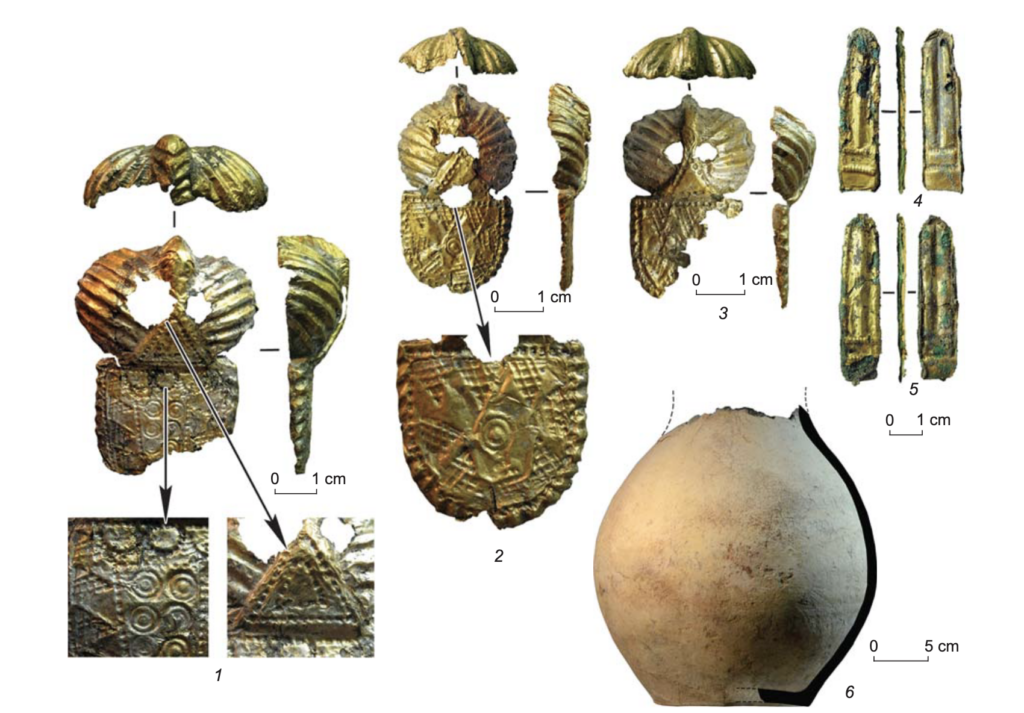
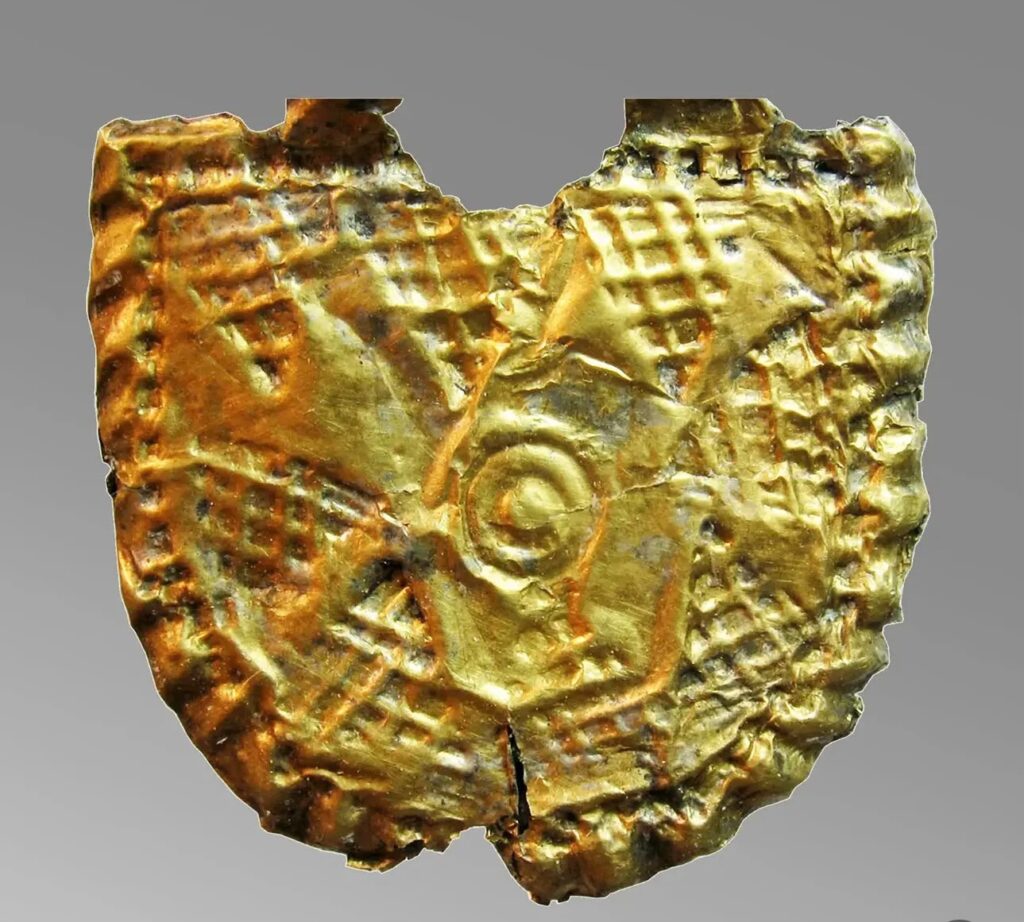
The discovery comes from the Karakabak cemetery on the Mangyshlak Peninsula, near the modern city of Aktau, where archaeologists uncovered the grave of an elite woman buried in an extraordinary ceremonial costume. Among its most striking elements were shoes decorated with gleaming gold fittings, accompanied by similarly elaborate ornaments on her belt and headdress. The surviving pieces consist of thin gold coverings applied to buckles and fittings made from wood or other organic materials, creating the appearance of richly adorned “golden shoes.”
The burial was excavated in 2019 and later studied in detail by archaeologists Andrei Astafyev and Evgeny Bogdanov. Their research identifies the grave as the burial of a young female who was dressed in an extraordinary ceremonial costume designed to imitate royal clothing.
A funerary costume covered with gold
The shoes formed only one element of a much more elaborate ensemble.
The woman also wore a reconstructed headdress consisting of a cape decorated with round gold plaques and a red-cloth diadem fitted with mask-shaped ornaments. A central plaque placed over the forehead reproduced the form of a Hellenistic gorgoneion, while other gold-covered wooden ornaments appear to draw on much older Scythian traditions.
The buckle frames themselves were shaped like stylized birds of prey with outstretched wings.
Yet one detail makes the costume particularly unusual: archaeologists concluded that the belt and shoe buckles were not functional. They lacked the attachments needed for ordinary use and were probably manufactured specifically for the burial ceremony.
In other words, this was not necessarily the clothing the woman wore while alive. It was a carefully constructed display of status intended for the grave.
The artifacts belong to what archaeologists call the Shipovo horizon, a group of objects associated with the late Hunnic and post-Hunnic world. The burial is dated broadly to the second half of the fifth or first half of the sixth century AD. Comparable objects have been found at nearby Altynkazgan, suggesting that communities across the region shared craftsmen, technologies or ceremonial traditions.
The gold fittings may have been made nearby
The most intriguing possibility is that the elaborate objects were not imported from a distant imperial center.
Astafyev and Bogdanov argue that the costume fittings were probably produced in workshops at the nearby Karakabak settlement, which developed into an important craft and trading center on the eastern Caspian coast.
Earlier archaeological research at Karakabak has identified evidence for metallurgy, jewelry production, glassmaking and pottery manufacture. Studies of other burials in the area have also revealed cloisonné-style jewelry showing technological influences associated with Byzantine craftsmanship, while researchers have proposed that at least some of these objects were locally produced.
This makes the golden shoe fittings more than symbols of individual wealth. They may also provide evidence for a local industry supplying prestigious objects to nomadic elites living around the Aral-Caspian region.
Karakabak was connected to a much larger world
Karakabak itself is emerging as one of the most important archaeological sites in western Kazakhstan.
The settlement, discovered in 2006, was occupied between approximately the first and sixth centuries AD. Recent excavations by the A.Kh. Margulan Institute of Archaeology have revealed a substantial production and commercial center positioned close to maritime and overland routes crossing the Caspian region.
More than 150 coins dating from the first century to the first half of the sixth century have been recovered from the site. They include issues associated with Parthia, ancient Khorezm, Sogdiana, Sasanian Iran, the Kushano-Sasanian realm, the Byzantine Empire and China. The extraordinary geographical range of the coins illustrates how widely connected this apparently remote settlement had become.
Archaeologists now believe Karakabak may have operated as an important node in an ancient Azov-Caspian trade corridor, linking Central Asia with the northern Caucasus, the Volga region, the southern Urals and territories farther west.
The cemetery reinforces that picture. Recent research indicates that the population associated with Karakabak was culturally diverse. Some groups appear to have followed traditions associated with Zoroastrian practices, while others continued burial customs rooted in the Late Sarmatian nomadic world.
The burial was excavated in 2019 and later studied in detail by archaeologists Andrei Astafyev and Evgeny Bogdanov. Credit: Andrei Astafyev – Aspabota
Could Karakabak be Ptolemy’s lost Aspabota?
There is an even more proraphical tradition associated with the second-century scholar Claudius Ptolemy.
The identification remains a hypothesis. No inscription has been discovered at Karakabak giving the ancient settlement’s original name, so archaeologists cannot yet demonstrate that Karakabak and Aspabota were the same place. Kazakhstan’s Ministry of Science and Higher Education likewise describes the connection as a possibility rather than a confirmed identification.
Nevertheless, Karakabak increasingly fits the profile of a settlement that would once have mattered far beyond the Caspian coast: a fortified craft center, a marketplace and a transfer point between nomadic communities and long-distance commercial networks.
Against that background, the so-called golden shoes take on a different significance. The thin sheets of gold buried with one elite woman were not simply extravagant decoration. Together with the jewelry workshops, imported coins and culturally mixed cemeteries surrounding Karakabak, they reveal a Caspian world in which steppe elites, local craftsmen and distant trading networks were closely connected about 1,500 years ago.
Astafyev A.E., Bogdanov E.S. Burial of a Hunnic Period Noblewoman at Karakabak, Mangystau, Kazakhstan. Archaeology, Ethnology & Anthropology of Eurasia. 2021;49(4):57-68. https://doi.org/10.17746/1563-0110.2021.49.4.057-068
