

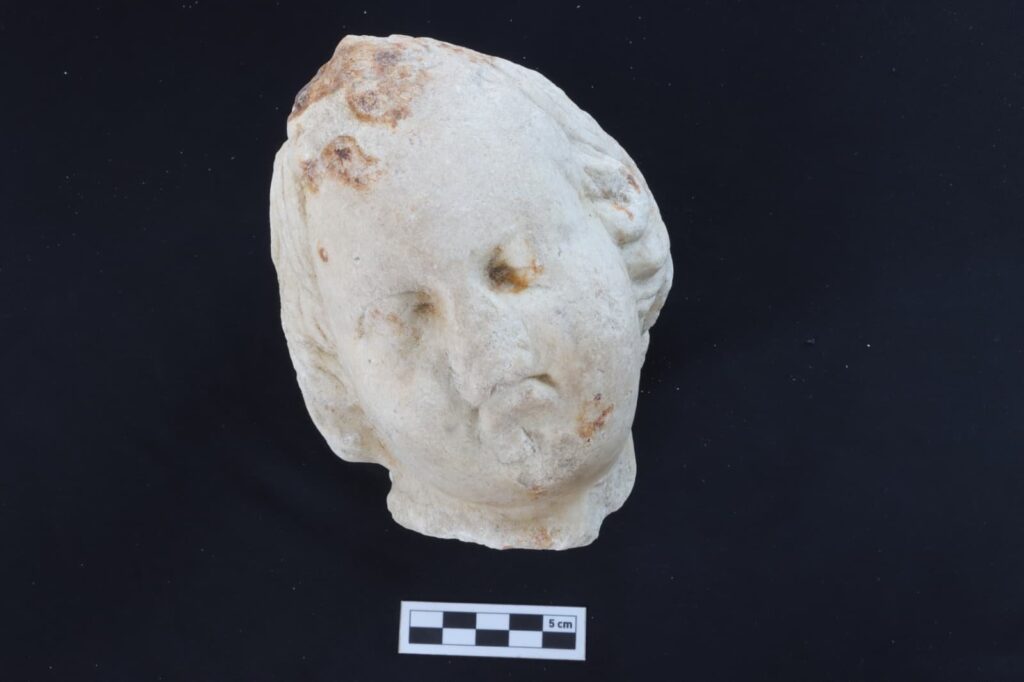
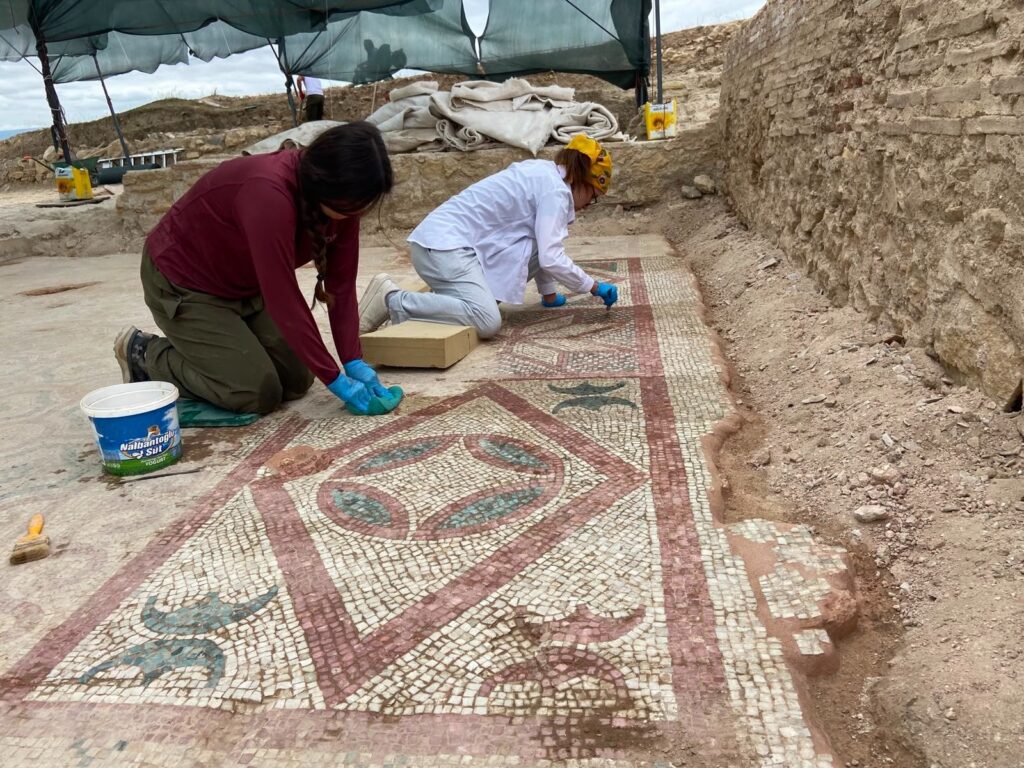
Archaeologists working at the ancient city of Pompeiopolis in northern Türkiye have uncovered approximately 105 square meters of remarkably well-preserved floor mosaics, while a second discovery — the marble head of Eros dating back around 1,800 years — is offering a glimpse into a much earlier chapter of the city’s Roman past.
The discoveries were made during the 2026 excavation season at the Basilica in Pompeiopolis, located in the Taşköprü district of Kastamonu. Türkiye’s Minister of Culture and Tourism Mehmet Nuri Ersoy announced that the mosaics, composed of geometric designs and dated to the 4th century AD, cover part of the building’s central nave.
The mosaic is not yet fully exposed.
According to Ersoy, archaeologists have still not reached the limits of the decorated pavement beneath the central nave, meaning its total surviving area could be considerably larger than the 105 square meters uncovered so far. Excavation and conservation work is continuing across the structure.
The scale of the pavement is impressive, but the importance of the discovery lies equally in what is emerging beneath and around it. Evidence from the building appears to preserve several stages in the transformation of Pompeiopolis, from one of Roman Paphlagonia’s major urban centers into a city whose religious landscape was increasingly shaped by Christianity in Late Antiquity.
An Eros Head from an Earlier Pompeiopolis
A second discovery from the same excavation provides a striking contrast to the Late Antique mosaic floor. Archaeologists recovered the head of Eros, the Greco-Roman god associated with love and desire, from the building’s pastophorion area.
The sculpture has been dated to the second half of the 2nd century AD, roughly the same period to which researchers currently assign the earliest construction phase detected at the site of the Basilica.
This does not necessarily mean that a Christian basilica stood here in the 2nd century. Architectural characteristics, stratigraphy and archaeological finds instead indicate that the structure went through substantial changes in both form and function over the following centuries. The Eros head therefore belongs to an earlier Roman context that preceded the building’s later Christian phase.
Together, the finds allow archaeologists to examine two very different periods within the same architectural complex: the artistic environment of a prosperous Roman metropolis and the religious transformation of the city several centuries later.
A Roman Metropolis in Northern Anatolia
Pompeiopolis was founded by the Roman commander Pompey in 65–64 BC, following Rome’s wars against Mithridates VI of Pontus and the subsequent reorganization of northern Anatolia.
Its position was strategic. The city stood in the fertile valley of the ancient Amnias River, today’s Gökırmak, along an important east-west route connecting inland Anatolia with the Black Sea region. Pompeiopolis developed rapidly and eventually became one of the principal cities of ancient Paphlagonia.
Its importance reached a peak during the Roman Imperial period. Historical and archaeological research indicates that Pompeiopolis held the title of metropolis of Paphlagonia between the reigns of Antoninus Pius and Gallienus, broadly spanning the 2nd and 3rd centuries AD.
That prosperity left a substantial archaeological footprint. Research at Zımbıllı Tepe, where the center of the ancient city lies opposite modern Taşköprü, has identified monumental public buildings, residential areas, streets, marketplaces and bath complexes. Geophysical surveys have also allowed researchers to trace parts of the city that remain buried beneath the ground.
Previous excavations have revealed elaborate Roman mosaics in residential buildings, demonstrating that richly decorated interiors were already part of elite life in Pompeiopolis. The newly discovered Basilica mosaics, however, belong to a later stage in the city’s history and help document how its monumental architecture evolved as Roman society itself changed.
From Roman City to Christian Center
By the 5th century AD, Pompeiopolis had become an episcopal center, marking its growing religious and administrative importance during Late Antiquity.
The Basilica appears to preserve physical evidence of that transition. Architectural modifications, decorative elements and the newly exposed mosaic floors belong to phases in which the building was reshaped as the religious character of the city changed.
Rather than providing a snapshot of a single moment, the excavations are therefore revealing a structure that accumulated layers of history.
A 2nd-century Eros sculpture points toward the imagery and cultural world of Roman Pompeiopolis. Several generations later, extensive geometric mosaics covered the floors of a monumental building associated with a city that had become a Christian episcopal center.
The approximately 105 square meters of mosaic uncovered in 2026 may only represent part of that story. With sections of the central nave still unexcavated, archaeologists are now following the pavement further beneath the soil while documenting and conserving what has already emerged.
As work continues, the Basilica could become one of the key archaeological contexts for understanding how Pompeiopolis changed from a major Roman metropolis into one of Late Antiquity’s important regional religious centers.
