

Nearly a thousand years ago, a Scandinavian visitor stood in the upper galleries of Hagia Sophia and scratched a familiar name into its marble: Halvdan. Who he was remains unknown, but his small act of graffiti survives as an extraordinary trace of the northern warriors who once made Constantinople part of their world.
For Scandinavians travelling east during the Viking Age, Constantinople was known as Miklagarðr “the Great City.” Some came to trade or seek opportunity, while others entered the service of the Byzantine emperors. By the late 10th century, northern warriors had become an important element of the imperial forces, particularly the famous Varangian Guard. Emperor Basil II relied heavily on these foreign soldiers, and the guard developed into an elite corps closely associated with the emperor.
Their presence in Constantinople was anything but marginal. Varangians fought in Byzantine campaigns and served the imperial court, while generations of Scandinavians travelled between northern Europe, the lands of the Rus and the Byzantine capital. One of the most famous was Harald Sigurðarson, later King Harald Hardrada of Norway, who spent part of the 11th century in Byzantine imperial service before returning north to claim a throne of his own.
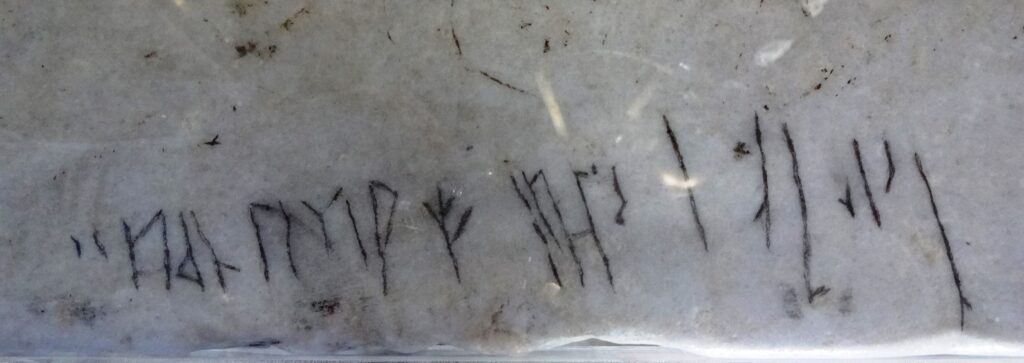
Against that background, the runes inside Hagia Sophia become much more intriguing.
The best-known inscription was identified in 1964 on a marble balustrade in the upper southern gallery. Swedish runologist Elisabeth Svärdström published it in 1970. Much of the carving is now difficult to decipher, but enough survives to identify the Old Norse male name Halvdan, or Halfdan. A possible reconstruction follows a common runic graffiti formula: “Halvdan carved these runes.” The frequently repeated translation “Halvdan was here” expresses the basic idea, but it is not a literal reading of the surviving text.
Another inscription appeared in the galleries in 1975. Its reading has been debated. Mats G. Larsson interpreted the surviving characters as ari, possibly the beginning of a phrase meaning that someone named Ári made the runes. Folke Högberg, and later archaeologist Svein Indrelid, instead read the inscription as Árni, probably simply another Scandinavian name.
More evidence has since emerged. A further runic inscription discovered in Hagia Sophia and studied by runologist Elena Melnikova contains a much longer sequence. It has been interpreted approximately as “Arinbarðr carved these runes” and dated broadly to the 11th or 12th century, adding another Scandinavian voice to the graffiti preserved within the building.
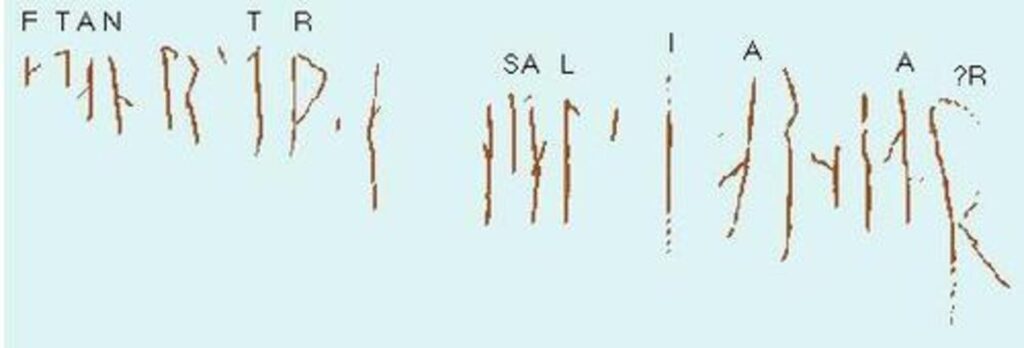
It is tempting to imagine Halvdan, Árni and Arinbarðr as members of the Varangian Guard standing inside Hagia Sophia while accompanying the Byzantine emperor. That remains a possibility rather than a proven fact. The inscriptions do not tell us their occupations.
What they do reveal is more personal. Behind the armies, trade routes and imperial politics were individual travellers who reached one of the greatest cities of the medieval world and did something remarkably familiar: they carved their names into the stone.
James E. Knirk, Runer i Hagia Sofia i Istanbul, Nytt om runer 14 (1999), 26-27
