In a quiet field in Lincolnshire, a small object has begun to challenge long-standing assumptions about the early medieval world. The discovery of a silver-gilt ring inscribed with runes is not just another archaeological find—it is a rare, personal trace of identity, belief, and expression from a time where written voices are exceptionally scarce.
Unearthed by Rafal Wesolowski and later documented by the Portable Antiquities Scheme, the ring offers something unusual: not a grand narrative of kings or battles, but a fragment of an individual story, preserved in symbols that still resist clear interpretation.
A Rare Runic Treasure
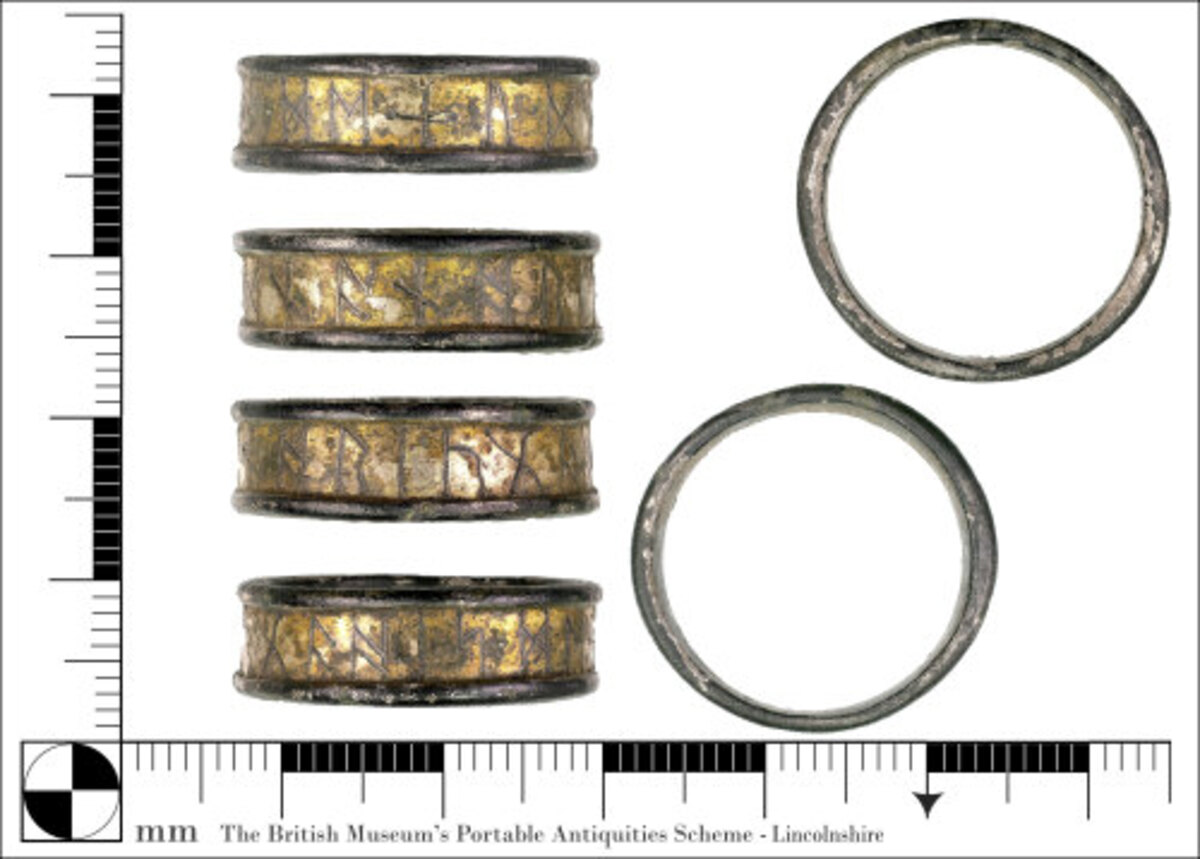
According to records from the Portable Antiquities Scheme (PAS), the ring—catalogued as LIN-E70856—is a complete early medieval piece made of silver with gold gilding. Measuring just over 23 mm in diameter and weighing 4.51 grams, the ring features 16 runic characters engraved along its outer band.
The inscription, written left to right, reads: +udnAnH(:)Ri*aHiSDe. Although the central band retains its gilding, the runes themselves do not, indicating that the inscription was added after the gilding process. Subtle traces of niello—a black inlay used to highlight engravings—can also be observed.
Experts from the University of Nottingham, including Dr Martin Findell and Jasmin Higgs, have analyzed the inscription but caution that its full meaning remains uncertain. Preliminary interpretations suggest the presence of a personal name, possibly “Udnan,” alongside the word “ring” (hring in Old English or Old Norse).
📣 Our WhatsApp channel is now LIVE! Stay up-to-date with the latest news and updates, just click here to follow us on WhatsApp and never miss a thing!!
The Mystery of Runic Inscriptions
Runes were the writing system used by Germanic peoples across northern Europe before the widespread adoption of the Latin alphabet. These symbols were not only used for communication but often carried symbolic, magical, or ritual significance.
The Quadring ring belongs to a very small group of early medieval rings bearing runic inscriptions. Comparable examples include a ring from Kingmoor, Cumbria, and another from Wheatley Hill, both held by the British Museum. Interestingly, inscriptions on such rings are frequently difficult—or even impossible—to interpret fully, leading scholars to believe they may have served amuletic or protective purposes rather than purely decorative ones.
In the case of the newly discovered ring, three main interpretations have been proposed:
It may indicate ownership: “Udnan owns the ring.”
It could denote possession: “Udnan’s ring.”
Alternatively, it might carry a more symbolic or religious meaning involving devotion or status.
However, none of these interpretations are definitive, highlighting the enigmatic nature of runic texts from this period.
A Glimpse into Early Medieval Society
The ring’s significance extends beyond its inscription. Its craftsmanship—featuring precise engraving, dotted rune terminals, and a carefully structured band—suggests it belonged to an individual of considerable status. Archaeologist Dr Lisa Brundle described the artifact as a “treasured possession,” emphasizing its rarity and cultural importance.
Additional discoveries at the same site, including a late Anglo-Saxon buckle, point to the existence of a previously unknown early medieval settlement. This has led researchers to speculate about a community of relatively high status, possibly including a literate elite—an uncommon feature in early medieval England.
What This Runic Ring Reveals About Early Medieval Britain
This ring is not just a piece of jewelry—it is a direct link to a largely undocumented era. The early medieval period, often referred to as the “Dark Ages,” is characterized by limited written records. Finds like this help fill crucial gaps in our understanding of daily life, belief systems, and social structures.
Moreover, the presence of runic writing suggests cultural connections across northern Europe, including influences from Scandinavian and Anglo-Saxon traditions. It also raises intriguing questions about literacy, identity, and the use of symbols in early medieval societies.
From Field to Museum
The ring has been submitted under the Treasure Act 1996 due to its age and precious metal content. It is currently under consideration as an official treasure case (2024T764), and there are hopes it will eventually be displayed in a local museum, allowing the public to engage with this extraordinary piece of history.
For now, the ring remains both a scientific puzzle and a cultural treasure—its message locked in ancient symbols, waiting to be fully understood.
As discoveries like this continue to emerge, they remind us that history is not static. Beneath the soil of quiet English fields lie stories still untold—stories that, like this runic ring, connect us directly to the people of a thousand years ago.
Portable Antiquities Scheme (PAS)
Cover Image Credit: Lincolnshire County Council