Explore the hidden traces of lost early Christian churches beneath the White City of Berat. Mosaic evidence from ancient Antipatrea in Albania reveals clues about a vibrant and previously little-known Christian community during Late Antiquity.
Deep beneath the historic streets of Berat—often called the “White City”—archaeologists have uncovered fascinating traces of a forgotten artistic and religious world. Recent archaeological investigations have revealed two remarkable Late Antique mosaics connected to early Christian basilicas, offering fresh insight into the cultural and spiritual life of the ancient city known as Antipatrea. These discoveries are reshaping our understanding of the Balkans during the 5th and 6th centuries AD and highlighting Berat’s importance in early Christian history.
A UNESCO City with Thousands of Years of History
Berat is widely known for its Ottoman-era architecture and its status as a UNESCO World Heritage Site. Yet the city’s history stretches much deeper. Archaeological evidence in the surrounding region shows human habitation dating back to the Bronze Age and even earlier prehistoric periods.
In antiquity, the settlement was called Antipatrea and occupied a strategic location near the Osum River and the mountainous interior of Albania. Because the city was destroyed and rebuilt multiple times throughout history—from Roman conquests to Ottoman rule—many ancient layers remained hidden beneath later construction.
For decades, limited excavations meant historians had only fragments of information about Berat’s Roman and Late Antique periods. The recent discovery of two mosaic floors has changed that dramatically.
📣 Our WhatsApp channel is now LIVE! Stay up-to-date with the latest news and updates, just click here to follow us on WhatsApp and never miss a thing!!

Accidental Discoveries Reveal Ancient Churches
The first mosaic was discovered in 2012 during infrastructure work inside the medieval castle of Berat. Workers installing a water system unexpectedly uncovered a mosaic floor about 1.8 meters below the modern surface. Archaeologists later identified the fragment as part of a larger floor decoration likely belonging to a Late Antique basilica.
A second mosaic emerged in 2018 during drainage construction in the lower town, partially beneath the foundations of a mosque. Although only a small section was excavated, the design and context suggest that it also belonged to an early Christian religious structure outside the city walls.
Together, these discoveries indicate that Antipatrea once hosted multiple churches during the Late Antique period, revealing a vibrant Christian community that had previously been almost unknown to international researchers.
The Artistic Beauty of the Berat Mosaics
The mosaic inside the castle is particularly striking. It is a polychrome floor decoration measuring nearly 6 by 3.3 meters, made from limestone and ceramic tesserae about 1–1.5 cm in size. The colors include white, red, pink, violet, grey, and black.
The composition is divided into panels bordered by geometric patterns. Among the most notable decorative elements are:
Intersecting circles forming geometric lattice designs
Orthogonal patterns resembling adjacent scales
Interlaced guilloche borders
Ivy-scroll decorative bands
Some panels even contain inscriptions written in Greek letters, likely naming donors or including religious dedications. Unfortunately, many of these inscriptions are fragmented and difficult to interpret.
The second mosaic, found in the lower city, is smaller but equally significant. It features a combination of geometric patterns and Greek text set against a white tessellated background. One surviving word clearly reads “Theotokos,” meaning “Mother of God,” a title widely used in Christian theology after the Council of Ephesus in 431 AD.
This inscription provides an important clue for dating the mosaic.

Dating the Mosaics: A Window into the 5th–6th Centuries
Although precise dating is difficult, several clues point to the late 5th or early 6th century AD.
First, coins found above the mosaic layers include one belonging to Emperor Justin II (565–578). Second, stylistic comparisons with mosaics in other Balkan sites—such as those found in early Christian basilicas across the region—suggest similar artistic traditions.
The reference to “Theotokos” strongly indicates the mosaic was created after the Council of Ephesus in 431 AD, when the title became a key element of Christian doctrine.
Together, these details place the mosaics firmly in the Late Antique era, a time when Christianity was spreading rapidly across the Balkans.
Evidence of Skilled Local Mosaic Artists
The decorative motifs found in Berat are not unique to Albania. Similar patterns appear across the Mediterranean world—from Italy to North Macedonia—suggesting that artistic ideas circulated widely during the Late Antique period.
However, researchers believe the mosaics were likely produced by local craftsmen rather than imported artists. The materials used—limestone and terracotta—are consistent with resources available in the region. The style also resembles mosaics found in nearby Albanian sites such as Bylis and Butrint.
This suggests a network of skilled artisans traveling between Balkan cities and decorating churches throughout the region.

Why These Discoveries Matter
The two mosaics are more than beautiful works of art—they represent crucial archaeological evidence for understanding Berat’s role in Late Antique Christianity.
Until recently, scholars had little proof that the city was an important religious center during this time. The newly discovered basilica floors indicate that Antipatrea hosted active Christian communities and wealthy patrons who funded elaborate church decorations.
These discoveries also connect Berat to broader religious developments of the Byzantine world, including the theological debates that shaped early Christian doctrine.
The Future of Archaeology in Berat
Despite the significance of these finds, both mosaics remain only partially excavated. One has even been temporarily reburied under protective sand layers while awaiting further study.
Archaeologists believe that systematic excavations in Berat could reveal additional churches, buildings, and artifacts from the Roman and Late Antique periods. Such discoveries could finally illuminate the missing chapters of the city’s early history.
For now, the hidden mosaics of ancient Antipatrea serve as a reminder that beneath the stone houses and medieval walls of Berat lies a much older story—one written in colorful tesserae, geometric patterns, and fragments of ancient faith.
Omari, E., & Lafe, O. (2025). Two new mosaics from Antipatrea (Berat) in Albania. Journal of Mosaic Research, 18, 267–286. https://doi.org/10.26658/jmr.1814188
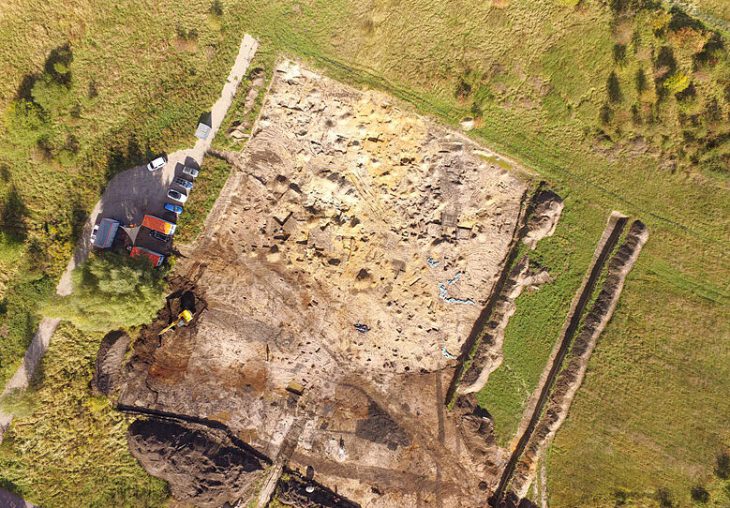
Cover Image Credit: Orthophotos of Berat showing excavated sites (left) and an aerial photograph of the excavation area (right) (courtesy of O. Lafe and R. Mazari; revised by E. Omari). Credit: Omari and Lafe (2025)