
15 February 2026 The Future is the Product of the Past

Roman Bone Box with No Known Parallels Discovered in Broadway Grave

Archaeologists in England have uncovered an extraordinary artefact that is reshaping our understanding of daily life and burial practices in Late Roman Britain. A rare and finely crafted bone box, unlike anything previously recorded, has been discovered in a Roman-era grave at the Milestone Ground site in Broadway, Worcestershire.

The discovery was made during an archaeological excavation led by Worcestershire Archaeology ahead of planned development in the north Cotswolds. The site has revealed evidence of continuous human activity spanning approximately 8,000 years, from the Mesolithic period through Roman occupation and into the Anglo-Saxon Middle Ages. While many important finds were uncovered, this unique Roman bone box has emerged as the most remarkable.

A One-of-a-Kind Late Roman Artefact

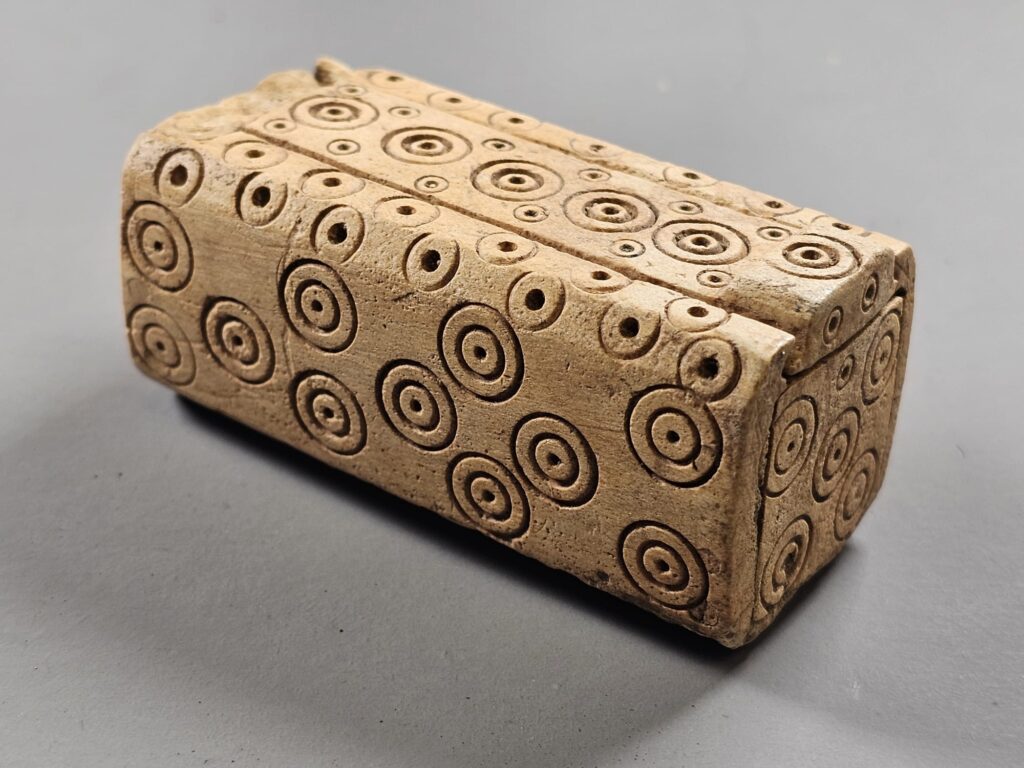
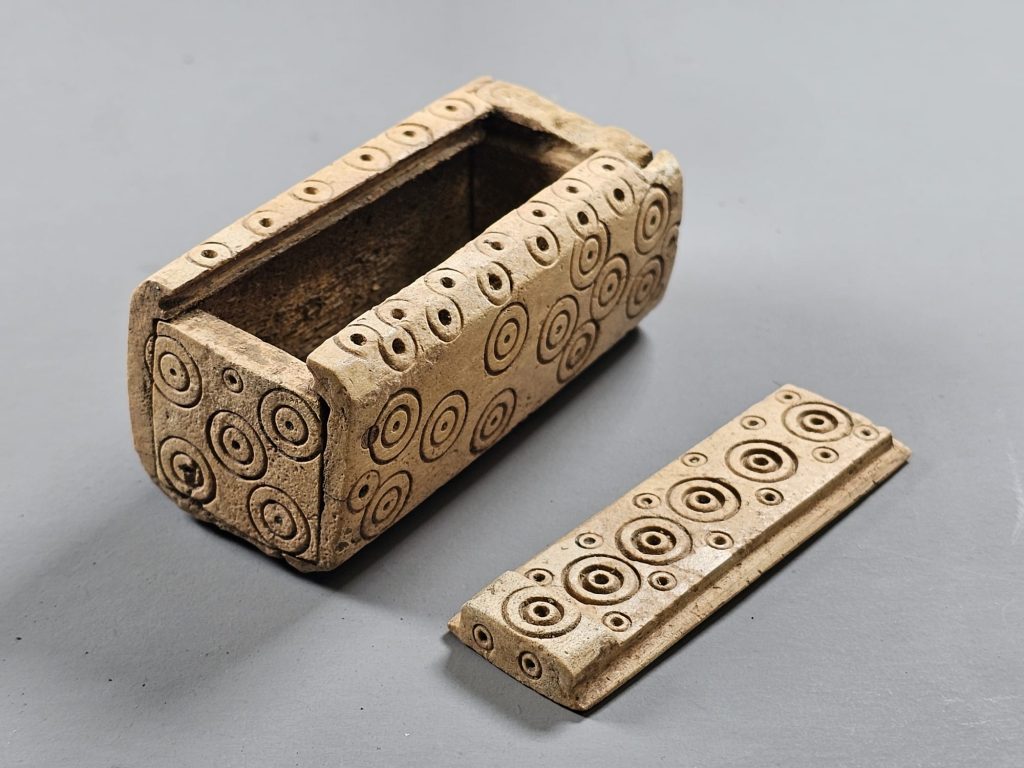
The box was found carefully placed in the grave of a young woman and remains intact in exceptional condition. Measuring just 2.7 inches (68mm) long, 1.3 inches (33mm) wide, and 1.2 inches (30mm) deep, the artefact is petite yet highly detailed. It features a sliding lid and is decorated with a distinctive ring-and-dot pattern, a motif commonly associated with Roman objects such as gaming dice.

Specialist analysis has revealed that the box was carved from the bone of a roe deer, highlighting the advanced craftsmanship and material knowledge of the period. Radiocarbon dating of the burial confirms a late Roman date, supporting stylistic interpretations based on the decoration.

What makes this find particularly significant is its uniqueness. To date, no comparable bone box has been identified in the archaeological record, making it a one-of-a-kind Roman discovery in Britain.


📣 Our WhatsApp channel is now LIVE! Stay up-to-date with the latest news and updates, just click here to follow us on WhatsApp and never miss a thing!!


Carved bone box with sliding lid removed. Credit: Wychavon District Council

Insights into Roman Life and Burial Customs

Archaeologists believe the box may have been used to store ointment, cosmetics, or a similar substance. Its careful placement within the grave strongly suggests that it was a valued personal possession, either cherished by the woman during her lifetime or considered symbolically important by those who buried her.

Jamie Wilkins, who led the excavation, described the discovery as “extraordinary, not only because of the box’s craftsmanship and condition, but because of the story it tells about the community that lived here.” He added that he had never encountered an object like it before, emphasizing the rarity and importance of the find.

The burial offers valuable insight into personal identity, status, and ritual in Late Roman Britain, particularly regarding the lives of women, which are often underrepresented in the archaeological record.

Thousands of Years of History at Milestone Ground

The Roman bone box is just one highlight from the Milestone Ground excavation. Archaeologists uncovered evidence of prehistoric activity, Roman settlement, and Saxon occupation, demonstrating Broadway’s long-standing significance as a place of human habitation.

Broadway’s location along a major routeway across the Cotswolds escarpment likely contributed to its enduring importance. Over millennia, different communities were drawn to the area for trade, travel, and settlement, leaving behind a rich archaeological landscape beneath today’s village.

The excavation was commissioned and funded by Wychavon District Council as part of the planning process. Ongoing specialist research is now underway, and once completed, all finds and records will be deposited with the county museum in line with best archaeological practice.

Featured on BBC’s Digging for Britain

The remarkable Roman bone box discovery will soon reach a wider audience. The Broadway excavation is set to feature in episode three of the upcoming series of Digging for Britain, presented by Professor Alice Roberts. The new series will air on BBC Two and BBC iPlayer from 7 January 2026, with the Broadway site appearing on Wednesday 21 January.

This unique artefact not only highlights the skill of Roman craftspeople but also provides a rare, personal connection to an individual who lived nearly 1,600 years ago—making it one of the most significant Roman archaeological discoveries in recent years.

Wychavon District Council

Cover Image Credit: Wychavon District Council

Related Articles

Portugal’s Enigmatic Roman Building “Tower of Centum Cellas”

4 February 2024

4 February 2024

The Tower of Centum Cellas (also known as the “Tower of St. Cornelius”), located in the Mount of Santo Antão...

The Mysterious Figure of Anatolia: Alexander of Abonoteichus, the False Prophet of Rome

12 February 2025

12 February 2025

In the annals of history, few figures are as intriguing as Alexander of Abonoteichus, the self-proclaimed prophet who captivated the...

Unprecedented Large Burial Urns in the Amazon May Reveal a Previously Unknown Indigenous Tradition

21 June 2025

21 June 2025

A remarkable archaeological discovery in the heart of the Amazon—seven giant funerary urns buried beneath a fallen tree—is offering fresh...

A previously unknown subterranean tract of an Augustan-era aqueduct has been rediscovered in Naples

4 February 2023

4 February 2023

A previously unknown subterranean tract nearly half a mile long of an Augustan-era aqueduct has been rediscovered in Naples, southern...

3,500-Year-Old Human-Bodied, Eagle-Headed Seal Discovered in Central TĂŒrkiye

9 September 2025

9 September 2025

Archaeological excavations at KarahöyĂŒk in central TĂŒrkiye have led to a remarkable discovery: a 3,500-year-old human-headed, eagle-bodied seal. According to...

Unique 9th–10th Century Chain-Mail and Helmet Unearthed at Rustavi Fortress, Georgia

29 October 2025

29 October 2025

Archaeologists uncover a rare medieval helmet and chain-mail shirt — the only known combat artifacts of their kind in the...

New insights into Scotland’s ‘bodies in the bog’

31 March 2022

31 March 2022

Fourteen bodies were found at Cramond near Edinburgh in 1975. New research suggests that two of the remains of these...

Archaeologists Uncover Asini’s Hidden Ancient Port Beneath the Waves of Greece

11 March 2025

11 March 2025

An international team of underwater archaeologists has made a groundbreaking discovery at the submerged site of Asini, near Tolo in...

Origin of Ivory Rings Found in Elite Anglo-Saxon Burials

2 July 2023

2 July 2023

An elite class of ancient Anglo-Saxon women were buried with hundreds of ivory rings, and the origin of these ivory...

Explore 1,400-year-old ruins, submerged in Eastern China – Atlantis of China

10 June 2023

10 June 2023

Deep in Qiandao Lake, between China’s Five Lion Mountains, lie the mysterious ruins of two ancient cities, dating back to...

Ancient Rituals and ‘Devil’s Money’: Elite Pagans’ Medieval Cult Site Unearthed at Hezingen

15 February 2025

15 February 2025

Researchers in the eastern Netherlands have uncovered a medieval cult site featuring structural remains and a hoard of gold and...

Remains of a 12-year-old boy wearing a bronze warrior belt found in Pontecagnano

6 July 2021

6 July 2021

The remains of a 12-year-old boy wearing a bronze warrior belt were found at Pontecagnano, an outpost of the pre-Roman...

Graves Older Than Pyramids: 11,000-Year-Old Burials Discovered in TĂŒrkiye’s ÇayönĂŒ

27 September 2025

27 September 2025

Archaeologists working in ÇayönĂŒ Tepesi (ÇayönĂŒ Hill), one of the world’s most significant early human settlements, have uncovered six ancient...

New Roman Settlement Discovered in TĂŒrkiye May Be Linked to the Lost City of Arsameia

17 October 2025

17 October 2025

Archaeologists in southeastern TĂŒrkiye have discovered a previously unknown Roman settlement dating to the 4th century AD — a site...

In French Necropolis 21 Roman “curse tablets” discovered including one written in the extinct Celtic language of Gaulish

18 January 2025

18 January 2025

During the excavation of an eighteenth-century hospital in north-western France by researchers from the Orléans Archaeological Service, a 2,000-year-old necropolis...