A previously unknown Achaemenid-period cemetery in northern Iran is offering an unusually intimate glimpse into how ordinary people lived—and died—under one of the ancient world’s largest empires. Excavated over a decade near the village of Talajim in Semnan Province, the burial ground challenges long-held assumptions about how imperial power shaped local traditions on the Iranian plateau.
Rather than a story of domination, the site tells something more nuanced: a community negotiating identity at the edge of empire.
A Cemetery Hidden Between Mountains and Desert
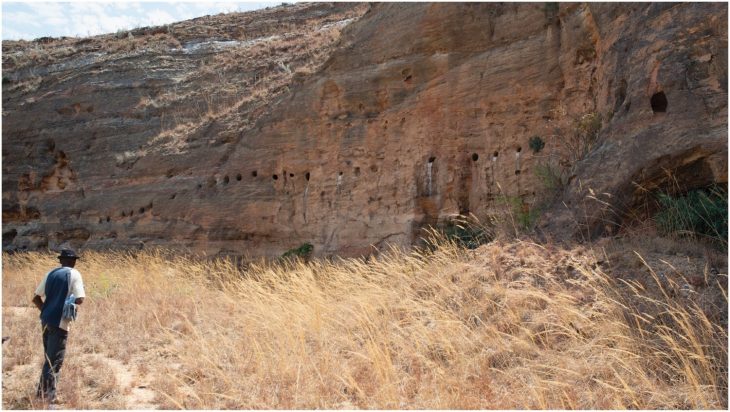
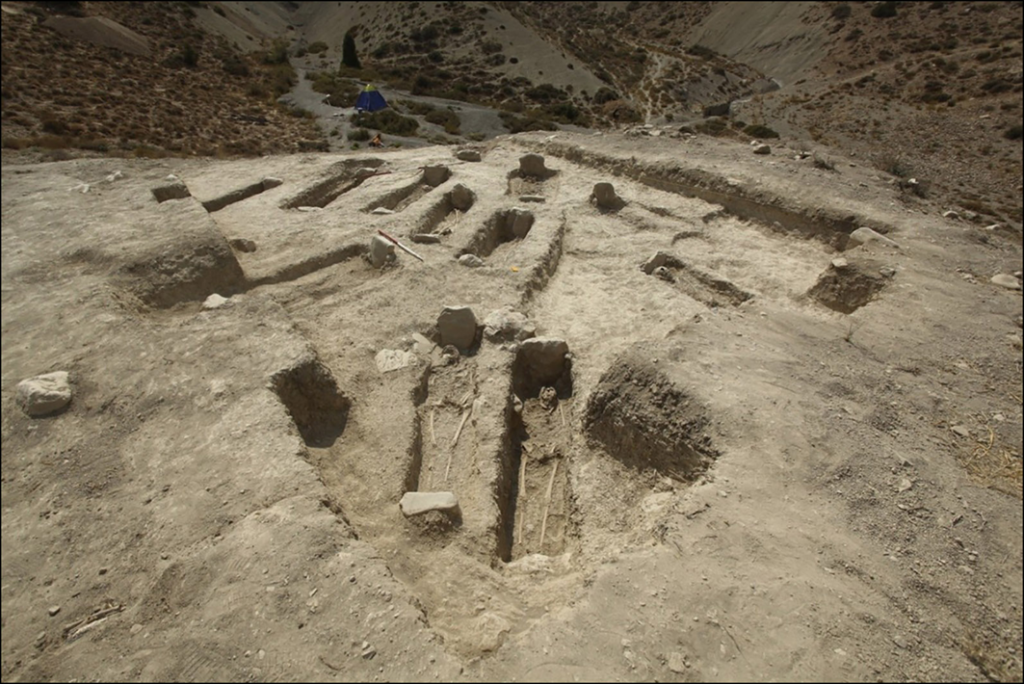
The burial site, known as the Mersin cemetery, occupies a striking natural position. It sits on a promontory overlooking the Sefidrud River, where the Alborz Mountains begin to dissolve into the vast expanse of the Dasht-e Kavir desert. This transitional landscape was not accidental—it functioned as a corridor of movement, linking inland communities with wider regional networks.
Archaeologists first encountered the cemetery during salvage excavations tied to the construction of the Finesk Dam. What began as a rescue operation soon developed into one of the most important Achaemenid-period discoveries in the region.
Over multiple excavation campaigns between 2014 and 2024, researchers uncovered 34 graves, many remarkably well preserved. Radiocarbon dating places the cemetery firmly between 519 and 358 BC, squarely within the Achaemenid era.
📣 Our WhatsApp channel is now LIVE! Stay up-to-date with the latest news and updates, just click here to follow us on WhatsApp and never miss a thing!!
Yet what stands out is not just the date—but the consistency.
A Community That Buried Its Dead the Same Way—With Subtle Differences
At first glance, the burials appear highly standardized. Individuals were laid in rectangular pits, typically aligned northwest to southeast, with bodies placed in a supine position. Stone slabs marked the head and foot of many graves, while coverings ranged from simple soil fills to carefully placed stone or wooden slabs.
This repetition suggests a tight-knit community with shared funerary rules, likely used for only one or two generations.
But within this uniformity, archaeologists began to notice something more intriguing: small, deliberate variations.
Some graves contained no objects at all. Others were richly furnished with ceramics, jewelry, or weapons. These differences were not random—they appear to reflect social roles, gender identities, and status distinctions within the community.
Ceramics, Jewelry, and Weapons—Signals of Identity
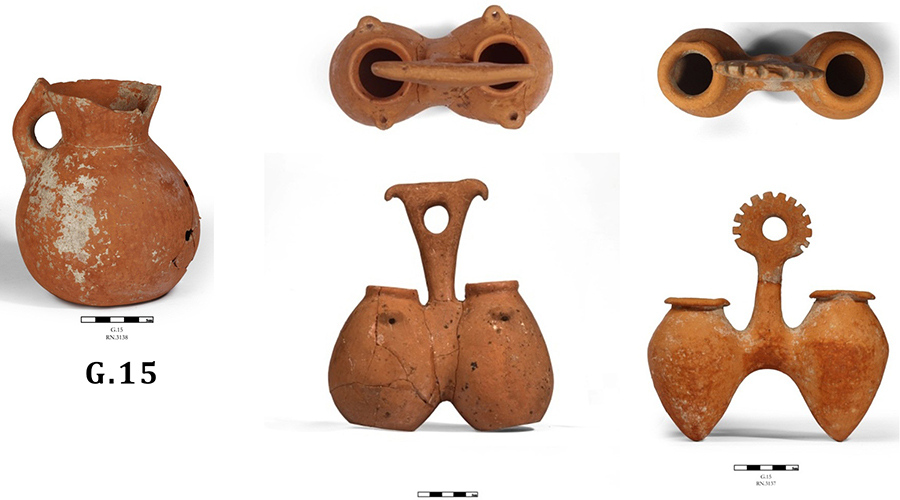
Nearly every furnished grave contained ceramics, making pottery the backbone of burial ritual. Bowls, jars, and spouted vessels appear again and again, forming a consistent “core package” of grave goods.
Beyond that baseline, variation emerges.
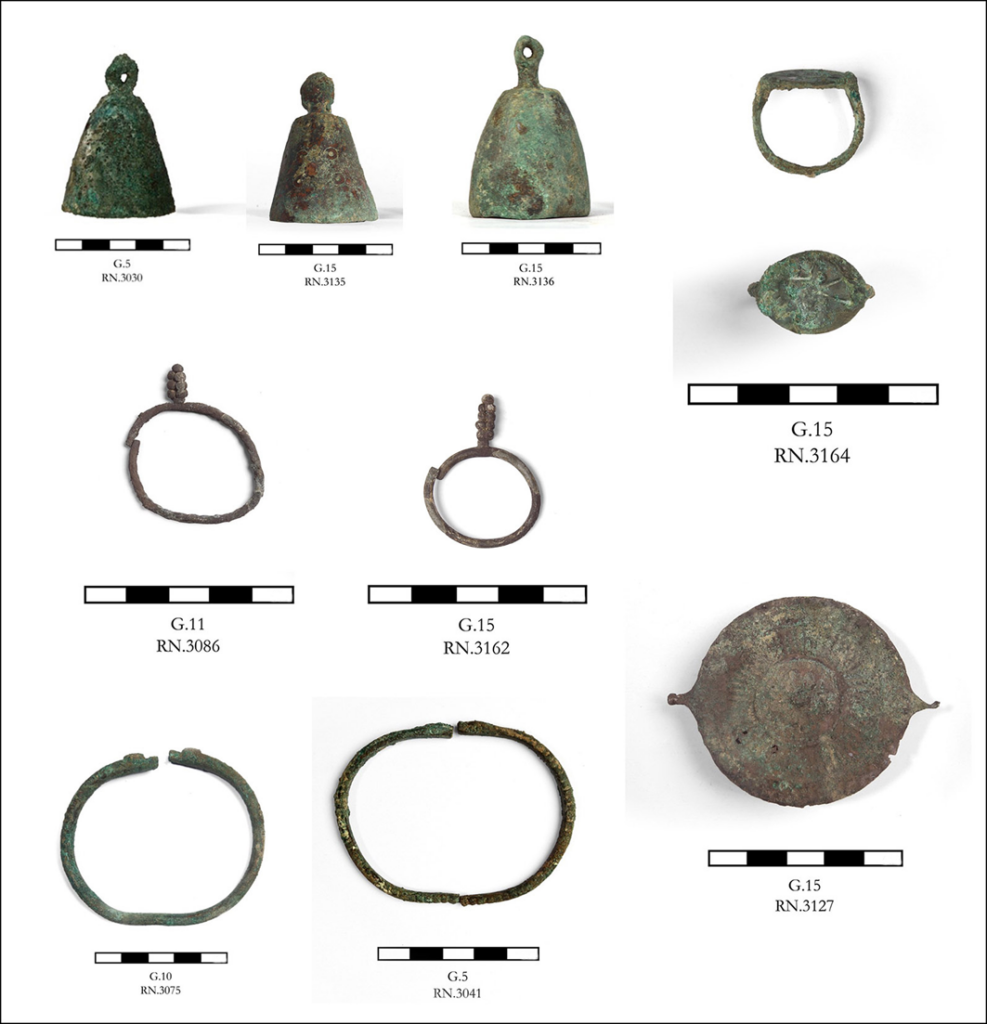
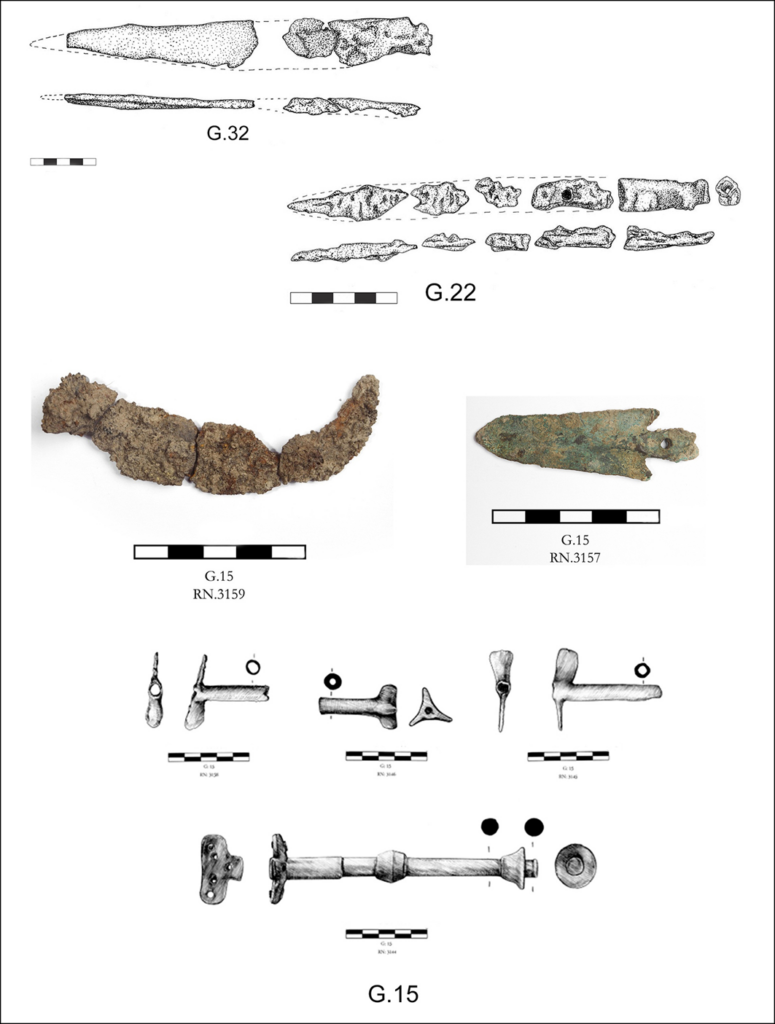
Personal ornaments—bracelets, earrings, beads—appear in roughly a third of burials, while iron weapons such as blades and spearheads occur in about a quarter. These additions seem to function as markers of identity rather than wealth alone.
One detail stands out: bracelets with animal-head terminals. These designs echo elite Achaemenid metalwork, yet here they are crafted in bronze instead of precious metals. The message is clear—local artisans were adapting imperial styles into their own material vocabulary.
In other words, this was not imitation. It was a translation.
Gender Patterns Written in the Grave
The cemetery also offers rare insight into how gender was expressed in burial practices.
Graves associated with women often contain richer assemblages, including jewelry, beads, and spindle whorls—tools linked to textile production. Male-associated burials, by contrast, more frequently include iron weapons, though they tend to be otherwise less elaborate.
One burial defies easy categorization: the only grave containing horse-harness equipment appears to belong to a female individual. This unexpected combination hints at status roles that do not neatly align with modern assumptions about gender.
Such anomalies suggest a society where identity was flexible, negotiated, and context-dependent.
Not a Military Outpost—but a Stable Community
Despite the presence of weapons, the cemetery does not point to a militarized settlement. Instead, archaeologists interpret these items as indicators of authority or social function, rather than evidence of warfare.
Equally notable is what’s missing.
There is no clear evidence of an associated settlement nearby, and certain elite material markers common in other Achaemenid regions—such as Triangle Ware—are absent. This suggests the community occupied a distinct social tier within the imperial system, neither elite nor isolated.
A Window Into Life on the Edge of Empire
The broader significance of the Mersin cemetery lies in its location—far from the imperial centers of Persepolis or Pasargadae. Sites like this are rare, especially in the northeastern interior of the Achaemenid world.
Here, the archaeological record captures something often lost in imperial histories: how ordinary communities experienced empire on their own terms.
Rather than adopting imperial culture wholesale, the people buried at Mersin appear to have selectively incorporated its symbols—jewelry styles, objects, and aesthetic cues—into long-standing local traditions.
The result is a cultural landscape shaped not by imposition, but by negotiation.
Rethinking the Achaemenid World
For decades, the Achaemenid Empire has been understood through its monumental centers and royal inscriptions. But discoveries like Mersin shift the focus toward everyday life—toward communities that existed beyond the imperial spotlight.
What emerges is a more complex picture: an empire not defined solely by power, but by interaction, adaptation, and local agency.
The graves at Mersin may be silent, but together they tell a story that resonates far beyond their remote setting—one of identity, belonging, and the subtle ways people navigate the forces that shape their world.
Malekzadeh M, Naseri R, Fausti E, Cesaretti A, Dan R. The Achaemenid cemetery of Mersin (Semnan Province, Iran): local identities and imperial connections on the northern Iranian plateau. Antiquity. Published online 2026:1-9. doi:10.15184/aqy.2026.10317
Cover Image Credit: Twin joined jars. Credit: Malekzadeh et al., 2026