New discoveries at the Templo Mayor in Mexico City reveal a colossal 15th-century Aztec ceremony led by Motecuhzoma Ilhuicamina.
A breathtaking chapter of Mexican history is coming back to life beneath the heart of Mexico City. Archaeologists from the Instituto Nacional de Antropología e Historia (INAH) have unveiled compelling new evidence of what may be the largest ritual offering ever dedicated by the Aztec ruler Motecuhzoma Ilhuicamina at the sacred precinct of Tenochtitlan.
The announcement, made by experts from the Proyecto Templo Mayor (PTM), centers on Offerings 186, 187, and 189—three ritual deposits that, when analyzed alongside earlier finds (Offerings 18, 19, and 97), reveal a single, colossal ceremonial event dating to the mid-15th century.
This discovery not only confirms a decades-old archaeological hypothesis but also “closes the circle” around the Great Temple, both physically and symbolically.
A Ceremony of Unprecedented Scale in Aztec History
Picture the scene: towering twin shrines rising above the island-city of Tenochtitlan, incense smoke curling into the sky, conch shells sounding across the plaza. Dozens of priests and thousands of devotees gather around the Huei Teocalli—the Great Temple—to witness a ritual that would immortalize imperial conquest and divine devotion.
📣 Our WhatsApp channel is now LIVE! Stay up-to-date with the latest news and updates, just click here to follow us on WhatsApp and never miss a thing!!
According to Leonardo López Luján, director of the PTM, the six offerings were deposited simultaneously during Construction Phase IVa of the temple (1440–1469), the reign of Motecuhzoma Ilhuicamina—whose name means “He Who Shoots Arrows at the Sky.”
The synchronized placement of these ritual boxes suggests a single, spectacular dedication ceremony—one that required immense logistical planning and political power.
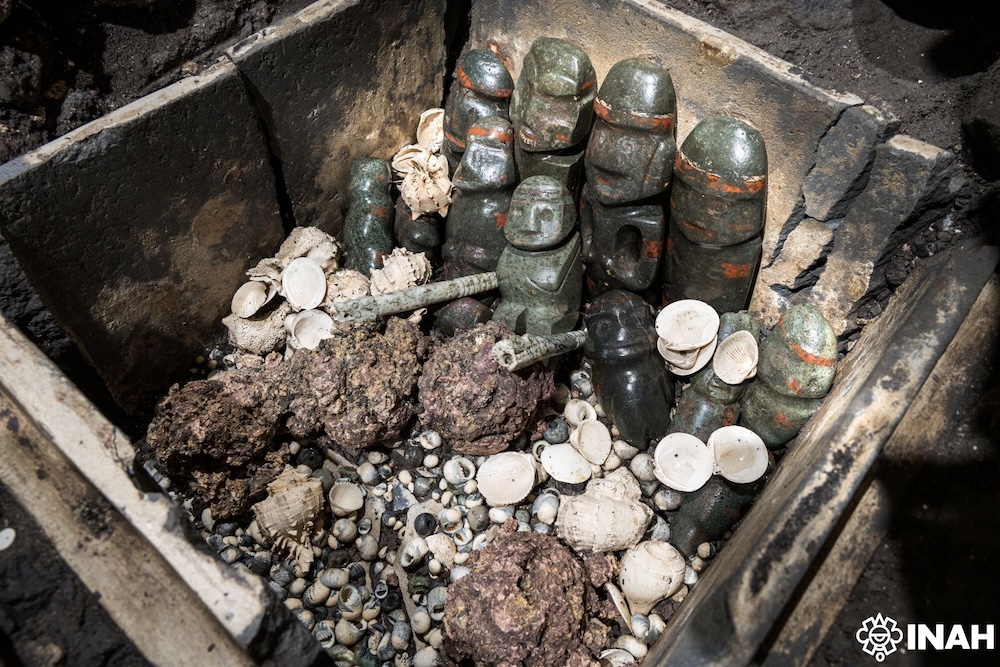
83 Mezcala Figurines: Sacred War Booty from Guerrero
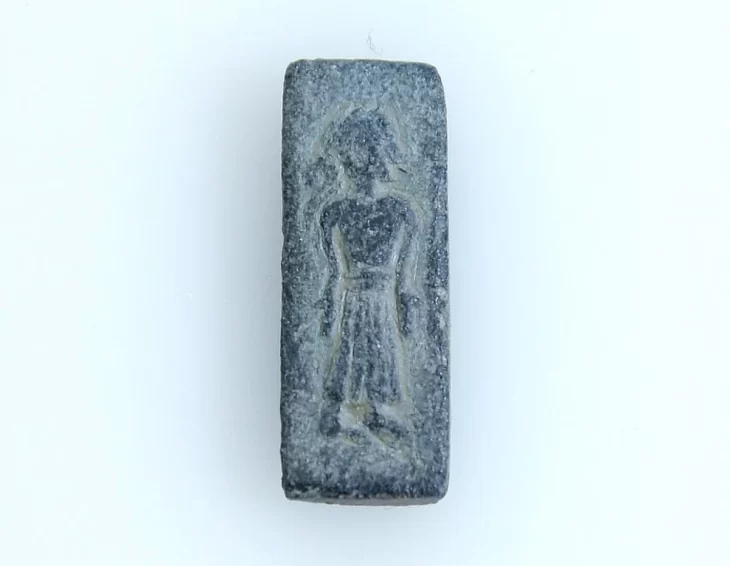
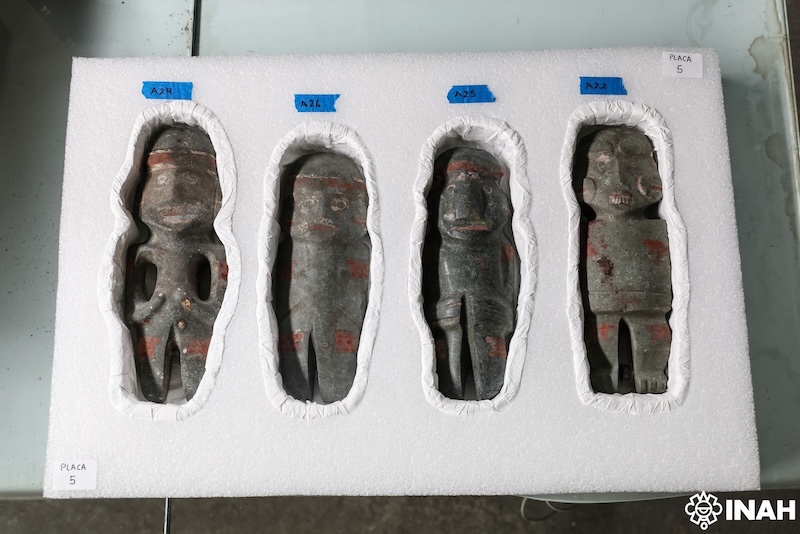
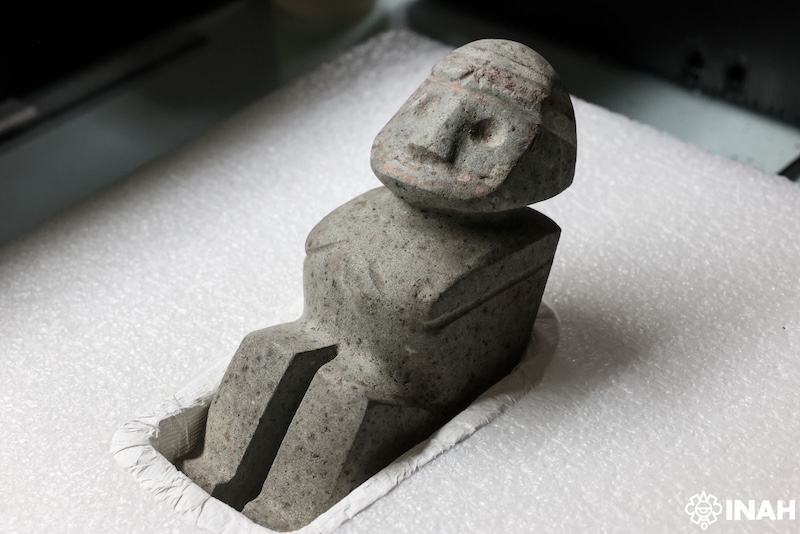
At the heart of this discovery are 83 anthropomorphic greenstone figurines crafted in the Mezcala style, an artistic tradition associated with what is now the state of Guerrero.
These artifacts were likely seized as war trophies from the lordships of Tlaxco and Tlaxmalac, territories conquered by Motecuhzoma between 1447 and 1450. Their abundance is extraordinary: Mezcala figurines appear neither before nor after this moment in the archaeological record of the Templo Mayor.
This concentration strongly indicates a deliberate political and religious act—an imperial statement. By dedicating these foreign sacred objects to the Mexica gods, Motecuhzoma was not merely offering tribute; he was symbolically integrating conquered lands into the sacred cosmos of Tenochtitlan.
Each figurine, weighing part of a deposit whose stone chests ranged from 600 to 1,000 kilograms, had to be transported using ropes, wooden rollers, and levers—an enormous engineering feat in itself.
The Sacred Geography of the Excavation Area
The newly analyzed offerings were discovered along the eastern and southern sides of the Templo Mayor’s pyramid base—exactly where archaeologists had hypothesized additional deposits might exist.
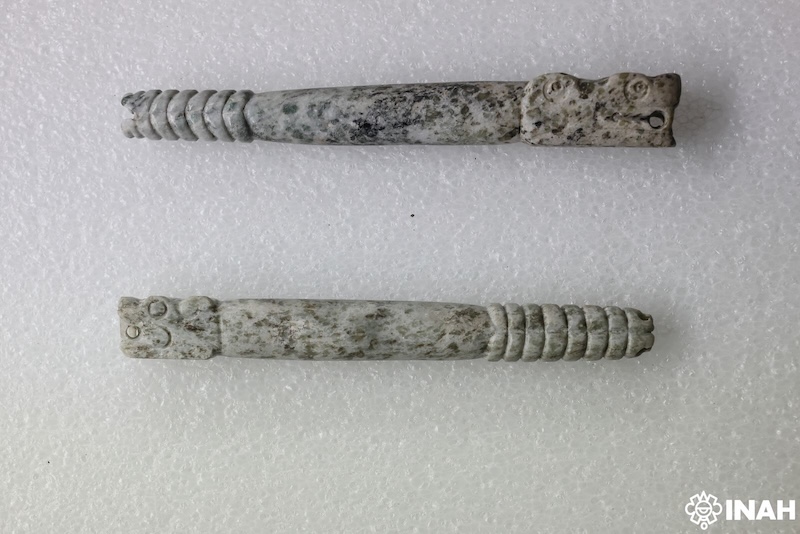
Construction Phase IVa is particularly significant because it is the only one of the temple’s seven building phases where the surrounding platform remains nearly intact. Architectural elements include sculpted serpent heads flanked by braziers on every side—imagery loaded with cosmological symbolism.
The strategic placement of the six tepetlacalli (stone chests) around this platform reinforces the interpretation of a unified ceremonial program. For the first time in nearly five decades of excavation, archaeologists have mapped a complete ritual circuit encircling the Great Temple.
This breakthrough reshapes scholarly understanding of Mexica ritual planning and spatial symbolism within the sacred precinct.
Marine Treasures and Biological Evidence of Empire
The offerings did not contain figurines alone. More than 4,000 malacological elements—marine shells and mollusks—were carefully deposited inside the stone boxes.
Biologist Belem Zúñiga Arellano identified species such as Nerita scabricosta and Hexaplex brassica, many originating from the Atlantic coast. Remarkably, some shells preserved their periostracum—the delicate organic outer layer usually lost soon after death.
This detail suggests the mollusks may have been transported alive in saltwater containers across vast distances to the Aztec capital. The implication? A highly organized imperial supply network capable of moving delicate marine life hundreds of kilometers inland.
The inclusion of Atlantic species in the heart of central Mexico is tangible proof of the Mexica Empire’s far-reaching economic and political influence.
Conservation Challenges and Scientific Precision
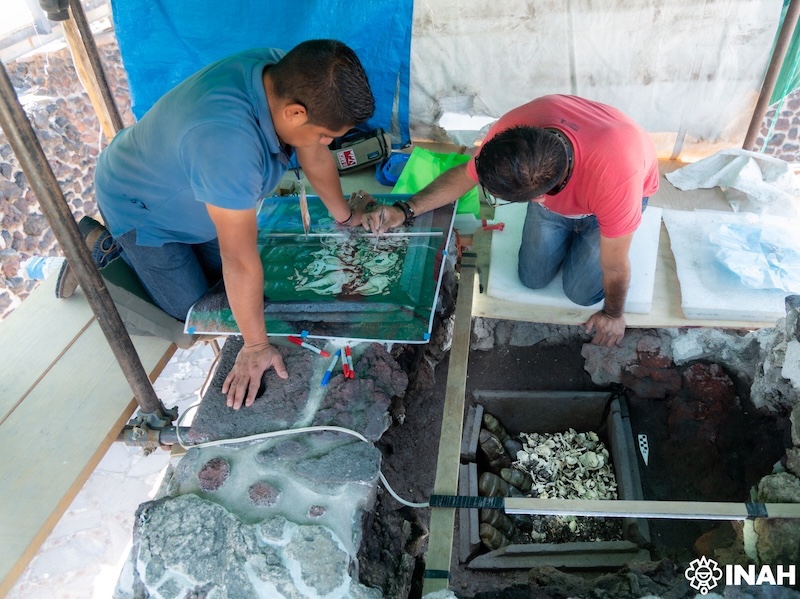
The recovery of Offerings 186, 187, and 189 presented formidable conservation challenges. Each stone chest—approximately 50 cm wide and tall—required months of controlled excavation under carefully regulated humidity and limited sunlight exposure.
Conservator Adriana Sanromán Peyron explained that specialists used cotton swabs to remove sediment and applied natural fixatives to stabilize surviving pigments. Traces of red and white paint reveal that the Mexica reinterpreted the Mezcala figurines, adding features such as goggles and fangs associated with the rain deity Tlaloc, to whom part of the Templo Mayor was dedicated.
This process of ritual “resignification” demonstrates the dynamic nature of Aztec religious practice—foreign objects transformed into sacred embodiments of Mexica cosmology.
Closing the Archaeological Circle
The significance of this discovery cannot be overstated. The earlier offerings (18 and 19) were found in the late 1970s by archaeologist Eduardo Matos Moctezuma, and Offering 97 was uncovered in 1991. For decades, scholars suspected corresponding deposits existed to complete a symmetrical pattern.
Now, nearly 50 years later, that hypothesis has been confirmed.
For the first time, researchers have reconstructed a complete ceremonial ring from Phase IVa—an achievement that deepens our understanding of Aztec statecraft, religion, and imperial identity.
What Comes Next?
After undergoing conservation, the newly discovered offerings will be safeguarded at the Templo Mayor Museum. Plans are underway to mount an unprecedented exhibition uniting all six deposits, offering the public a rare glimpse into the ritual grandeur of 15th-century Tenochtitlan.
This upcoming display promises to transform how visitors understand Aztec civilization—not merely as a warrior society, but as a culture of complex religious symbolism, logistical mastery, and artistic sophistication.
A Breakthrough in Aztec Archaeology
The findings from the Proyecto Templo Mayor provide powerful new evidence of how ritual, warfare, and imperial expansion were intertwined in Mexica society. By analyzing architectural alignment, artifact style, biological remains, and conservation data together, researchers are reconstructing a moment of extraordinary political theater staged over 550 years ago.
In the shadow of modern Mexico City, the sacred heart of Tenochtitlan continues to reveal its secrets—layer by layer, offering by offering.
And with each discovery, the story of Motecuhzoma Ilhuicamina’s monumental ceremony becomes not just an archaeological finding, but a vivid testament to the spiritual and imperial ambition that shaped one of the greatest civilizations of the ancient Americas.
Cover Image Credit: Detail of Excavation Level 2-A of Offering 189. Photograph by Mirsa Islas, courtesy of the Proyecto Templo Mayor (PTM-INAH).