
Archaeologists in Germany’s Sauerland region have uncovered a 2,000-year-old lead-processing site near Brilon, offering rare physical evidence for early metallurgy in an area long known for its ore resources but still poorly understood in archaeological terms.
The discovery was announced by the Landschaftsverband Westfalen-Lippe (LWL), whose archaeologists carried out a nearly two-week excavation campaign in June on a ridge of the Rothaar Mountains near Brilon, in the Hochsauerland district of North Rhine-Westphalia. According to the first results, the site appears to be a Roman Imperial-period workplace where locally available lead ore was processed and possibly prepared for casting into ingots.
The find is considered especially important because clear archaeological evidence for this kind of early lead production had not previously been documented in South Westphalia.
A lead ingot that changed the investigation
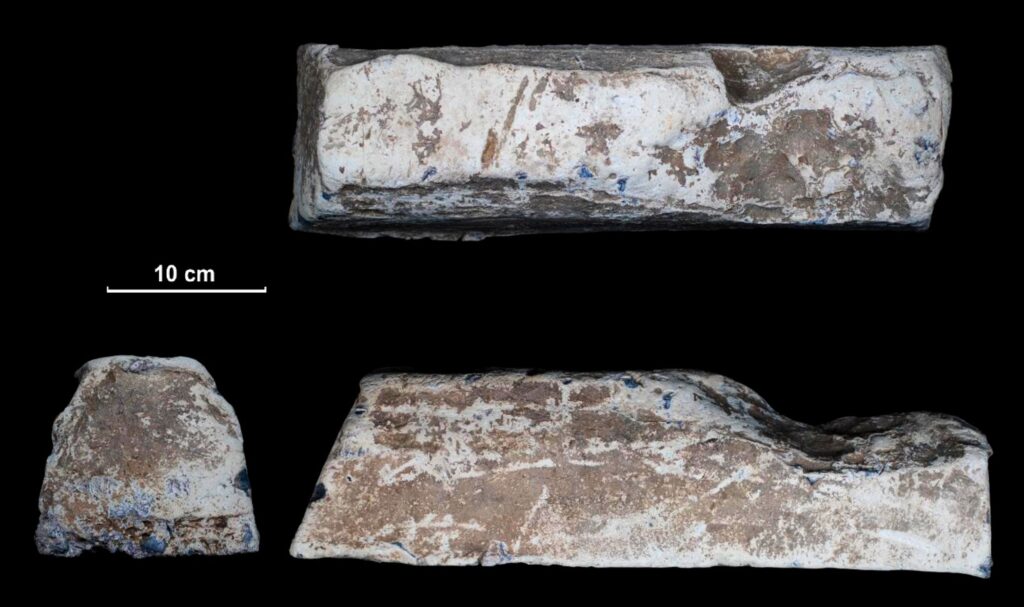
The excavation began with an unusual find: a large cast lead ingot of Roman Imperial-period form. It had been reported by Peter Hoffmann, a licensed detectorist from Brilon. LWL archaeologists from the Olpe branch suspected that the ingot did not come from an isolated loss, but from a nearby workplace connected with ancient metal production.
The local ore was mainly galena, a lead sulfide mineral. Researchers believe the ore may have been prepared on site and then cast into finished ingots in what the LWL describes as a “Roman manner.” Whether the people carrying out the work were Romans, local Germanic groups, or communities operating in contact with Roman technology is not yet known.
For now, archaeologists are careful about who operated the site. While the production method appears to follow Roman-style metallurgical practice, the workers themselves may have been Romans, local Germanic groups, or communities in close contact with Roman technology.
Geophysical survey revealed hidden structures
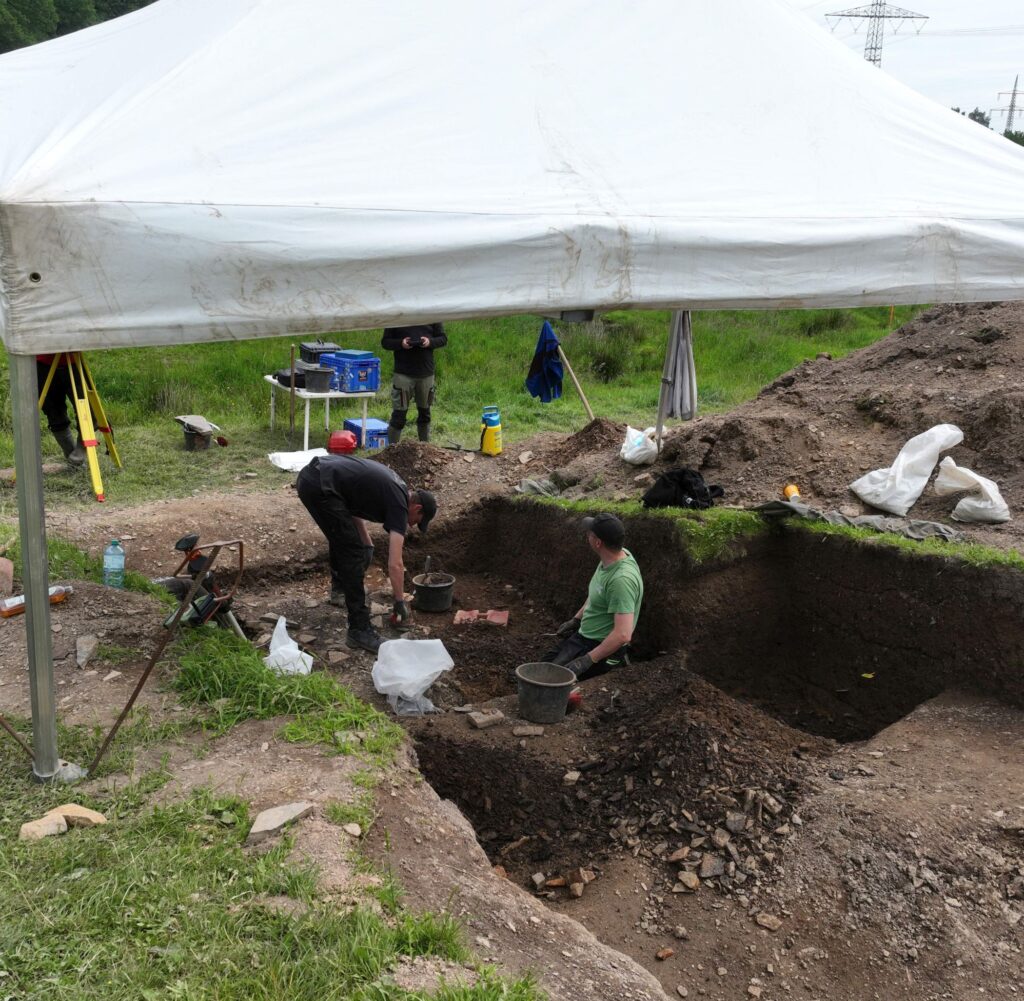
Before excavation began, LWL specialist Joris Coolen, head of archaeological prospection, carried out large-scale geophysical surveys around the spot where the ingot had been found. The measurements revealed several strong anomalies below the surface, suggesting buried structures or activity zones.
One of those anomalies was opened during the June excavation. The results confirmed that the area had been affected by intense heat and repeated human activity.
Excavation director Sebastian Magnus Sonntag said the team recovered a broad range of finds, including prehistoric-style ceramic fragments and many small pieces of lead directly connected with ancient lead extraction or processing.
Traces of fire, stone and charcoal
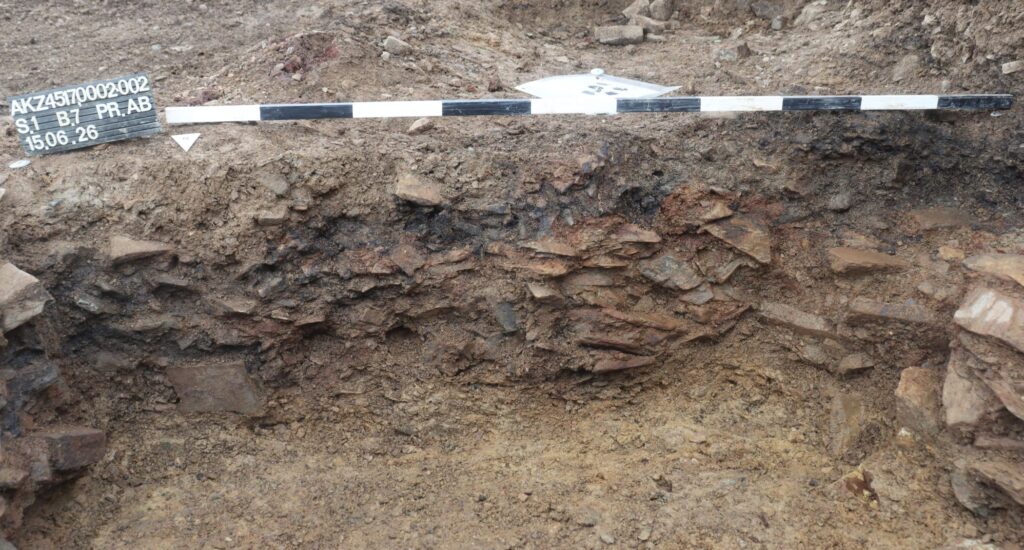
The most important feature uncovered so far is a carefully laid base made of stone slabs. Both the slabs and the clay-rich soil beneath them show clear signs of burning and high temperatures. Charcoal survived in the joints between the stones and will now be examined in further analyses.
The pottery fragments suggest that the workplace probably belongs to the beginning of the Roman Imperial period, around the turn of the era. The stratigraphy also shows that the site was not used only once. Layers of clay, stone slabs, and charcoal were documented one above another, indicating repeated use over a longer period.
For archaeologists, this vertical sequence is crucial. It suggests that ancient metalworkers returned to the same place periodically, perhaps over several working seasons, to process ore from the surrounding mineral district.
Probably a roasting site for galena
According to the current interpretation, the excavated feature was probably a roasting place. Here, galena was likely heated together with charcoal in order to reduce its sulfur content before the lead could be smelted and cast.
That process would have been one step in a wider metallurgical chain: ore extraction, roasting, smelting and casting. The miscast ingot that first drew attention to the site may have been rejected after a failed casting attempt and left behind at the workplace. Sonntag suggested that it may have been intended for remelting during a later season, but was never recovered.
Another important point is what archaeologists did not find. LWL archaeologist Dr. Manuel Zeiler noted that only relatively small quantities of lead were detected at the site. This supports the idea that lead itself was being processed here, rather than appearing as a by-product of silver extraction.
A new chapter in Sauerland’s mining history
The Brilon discovery fills a gap in the economic history of the Sauerland. The region’s ore resources have long been known, but early lead production during the Roman Imperial period has remained difficult to prove through excavated archaeological contexts.
The new evidence shows that the mineral resources of the Brilon area were being exploited with considerable technical knowledge around 2,000 years ago. It also raises wider questions about exchange, technology and cultural contact in the borderlands beyond the Roman Empire.
For now, the most cautious conclusion is also the most interesting one: near Brilon, ancient metalworkers were not merely collecting ore. They were processing it through a structured sequence of metallurgical steps, using techniques associated with the Roman world, in a region where such early production had rarely been visible in the archaeological record.
Landschaftsverband Westfalen-Lippe (LWL)
Cover Image Credit: A miscast Roman-style lead ingot found near Brilon, Germany, which led archaeologists to a 2,000-year-old lead-processing site. LWL/F. Geldsetzer
