31 January 2026 The Future is the Product of the Past

Medieval gold ‘lynx’ earrings from Ani Ruins

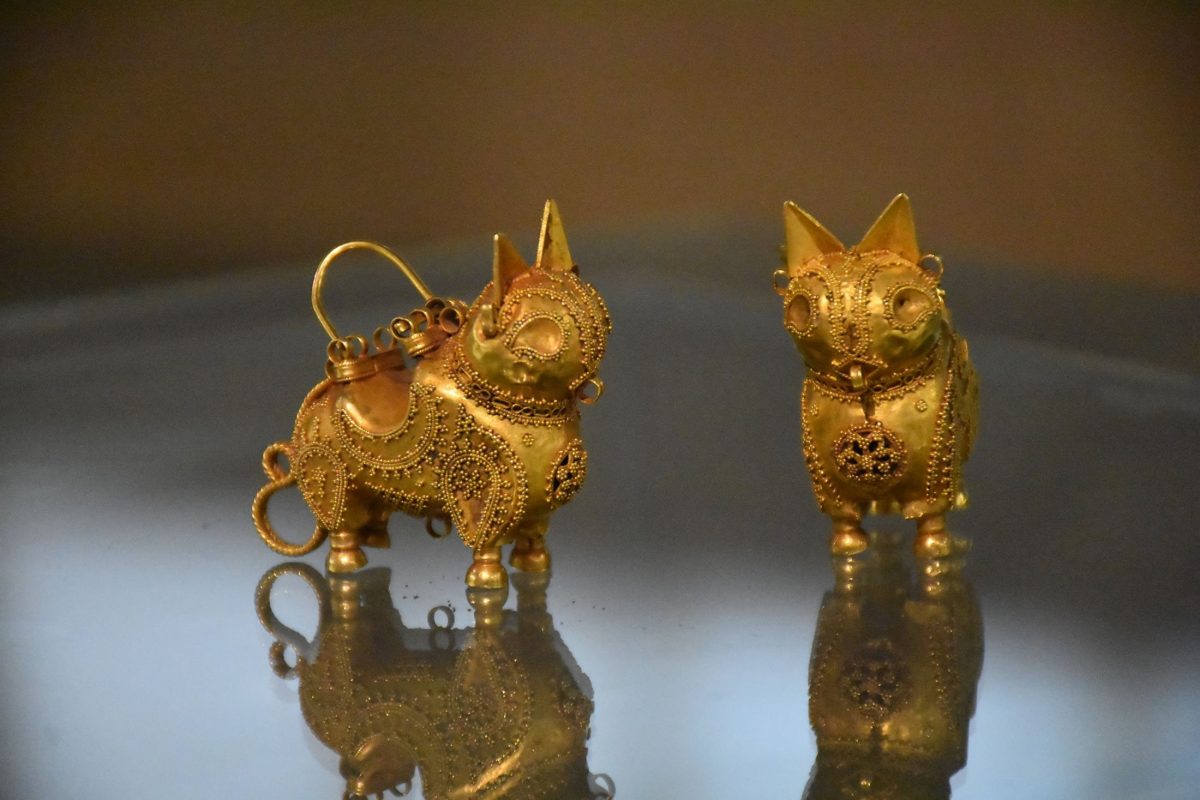
A pair of lynx-shaped gold earrings have been unearthed near the ruins of Ani, the once great metropolis known as the “city of a thousand and one churches”, on Turkey’s eastern border, across the Akhuryan River from Armenia.

The Medieval earrings, which weigh 22 grams and have engraved star, droplet, and crescent motifs, are now preserved in the Kars Archaeology and Ethnography Museum.

The priceless artifacts, which astounded archaeologists with their exquisite engravings, are scheduled to be displayed briefly at the Kars Archaeology and Ethnography Museum in 2023 after having been carefully stored in a warehouse up until then.

Yavuz Çetin, director of Kars Archaeology and Ethnography Museum, told Anadolu Agency (AA) that Kars has hosted many civilizations throughout history as it is located on the border of countries and is on the historical Silk Road’s route.
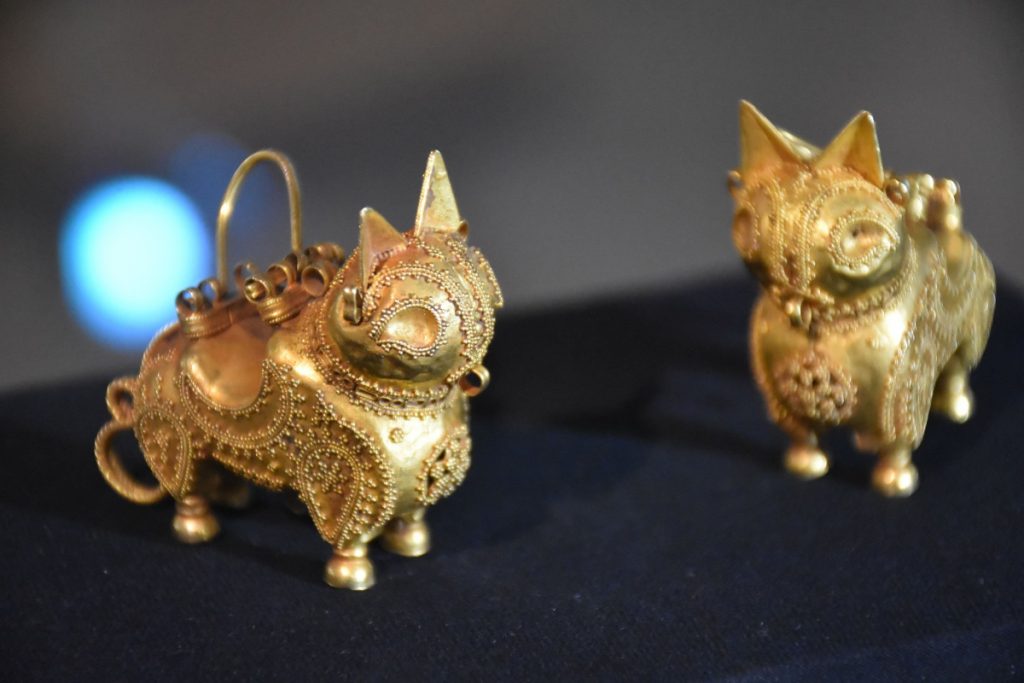
A pair of lynx-shaped gold earrings discovered near the Ani Ruins, in Kars, Türkiye. Photo: AA
A pair of lynx-shaped gold earrings was discovered near the Ani Ruins, in Kars, Türkiye. Photo: AA

Stating that it is possible to see the cultural assets of many civilizations in Kars, Çetin said that there are many historical immovable pieces of cultural heritage such as the Köşevenk and Mağazberk archaeological sites in and around the Ani Ruins.


📣 Our WhatsApp channel is now LIVE! Stay up-to-date with the latest news and updates, just click here to follow us on WhatsApp and never miss a thing!!


Çetin noted that people have benefited from animals throughout history and attributed physical or characteristic meanings to them.

“The lynx from the feline family is one of these animals. People were influenced by the ferocity and power of this animal and used it in artistic elements,” he said. “The existence of the lynx is also known in our Kars region. A couple of lynx-shaped earrings in our museum were found in the village of Subatan, about 16 kilometers (9.9 miles) north of Ani, and brought to us in 1994.”

Çetin said that they would exhibit the earrings next year.

A pair of lynx-shaped gold earrings discovered near the Ani Ruins, in Kars, Türkiye. Photo: AA
A pair of lynx-shaped gold earrings was discovered near the Ani Ruins, in Kars, Türkiye. Photo: AA

“Our earrings are kept in the warehouse. We plan to temporarily display them to our public in 2023. I invite everyone to see this magnificent work. Our earrings are lynx-shaped, highly decorated earrings … The motifs on them show the artistic elegance of the earrings.”

Ani, which was founded more than 1,600 years ago, was located on several trade routes and grew to become a walled city with over 100,000 residents by the 11th century. Ani was in steep decline by the 1300s, and it was completely abandoned by the 1700s.

Cover Photo: A pair of lynx-shaped gold earrings discovered near the Ani Ruins, in Kars, Türkiye. Photo: AA
Related Articles

Rare and Unusual Fossil Shows Small Mammal Attacking Larger Dinosaur

20 July 2023

20 July 2023

An unusual fossil from about 125 million years ago that depicts a dramatic event when a carnivorous mammal attacked a...

Iznik Archaeology Museum reveals 2,500-year-old love letter

16 January 2023

16 January 2023

İznik is an ancient habitation that hosts various civilizations due to its fertile lands, trade routes, and many other reasons....

Archaeologists Uncover Monumental Roman Building Near Waal River in Nijmegen, Netherlands

4 June 2025

4 June 2025

During a routine excavation ahead of a major urban development in the Waalfront district of Nijmegen, municipal archaeologists have uncovered...

Underwater Archaeologists Discover a 7,000-Year-Old Road in Croatia

8 May 2023

8 May 2023

A team of underwater archaeologists from the University of Zadar has discovered the sunken ruins of a 7,000-year-old road that...

Croatian Team Finds a Way to Effectively and Permanently Preserve Stuka Aircraft Wreck Under the Sea

11 December 2024

11 December 2024

 The ICUA Zadar team of conservators and archaeologists carried out in situ underwater conservation of the wreckage of the Junkers...

“Last Rhodes shipwreck” of Roman period found in Turkey’s Fethiye

5 March 2022

5 March 2022

Turkish researchers, a Rhodes shipwreck from the third century A.D. was discovered in the depths of the Gulf of Fethiye...

Uncovering the ritual past of ancient mustatils: Cult, herding, and ‘pilgrimage’ in the Late Neolithic of north-west Arabia

16 March 2023

16 March 2023

Mustatils—stone monuments from the Late Neolithic period thought to have been used for ritual purposes—have been the subject of new...

Nature Strikes—and History Answers: Could lost Punic-Roman city of Neapolis Be Resurfacing in Tunisia?

22 January 2026

22 January 2026

A violent storm surge in Nabeul, Tunisia, exposed ancient stone ruins along the coast, sparking speculation that the lost Punic-Roman...

The largest embalming cache ever found in Egypt unearthed at Abusir

10 February 2022

10 February 2022

Archaeologists from the Czech Institute for Egyptian Science have discovered a cache of artifacts related to the practice of Egyptian...

Archaeologists opened an untouched Etruscan tomb

31 October 2023

31 October 2023

In Vulci Archaeological Park, central Italy, a 2,600-year-old intact double-chambered Etruscan tomb that was discovered in April and had remained...

Evidence of Necromancy during Roman era in the Te’omim Cave, Jerusalem Hills: Oil Lamps, Spearheads, and Skulls

14 July 2023

14 July 2023

Te’omim Cave in the Jerusalem Hills may once have served as a local oracle where people communed with the dead...

Nearly 2,000-Year-Old Service Station Unearthed Along a Major Roman Road

7 December 2025

7 December 2025

Archaeologists in Gloucestershire have uncovered an extraordinary window into everyday life in Roman Britain: the remains of what can only...

A Circular Building with Six Towers of the Achaemenid Period discovered in Khorasan

3 April 2024

3 April 2024

Archaeologists have uncovered an almost circular adobe building with six towers, built in the 6th century BC, near Birjand in...

Archaeologists discovered the secret ingredient that made Mayan plaster durable

20 April 2023

20 April 2023

Ancient Mayan masons had their own secrets for making lime plasters, mortars, and plasters, which they used to build their...

AI Uncovers Lost Babylonian Hymn After 3,000 Years — A Glorious Ode to the Ancient City

3 July 2025

3 July 2025

Archaeologists and AI experts uncover a 3,000-year-old hymn praising Babylon‘s grandeur, revealing rare insights into ancient urban society, education, and...