
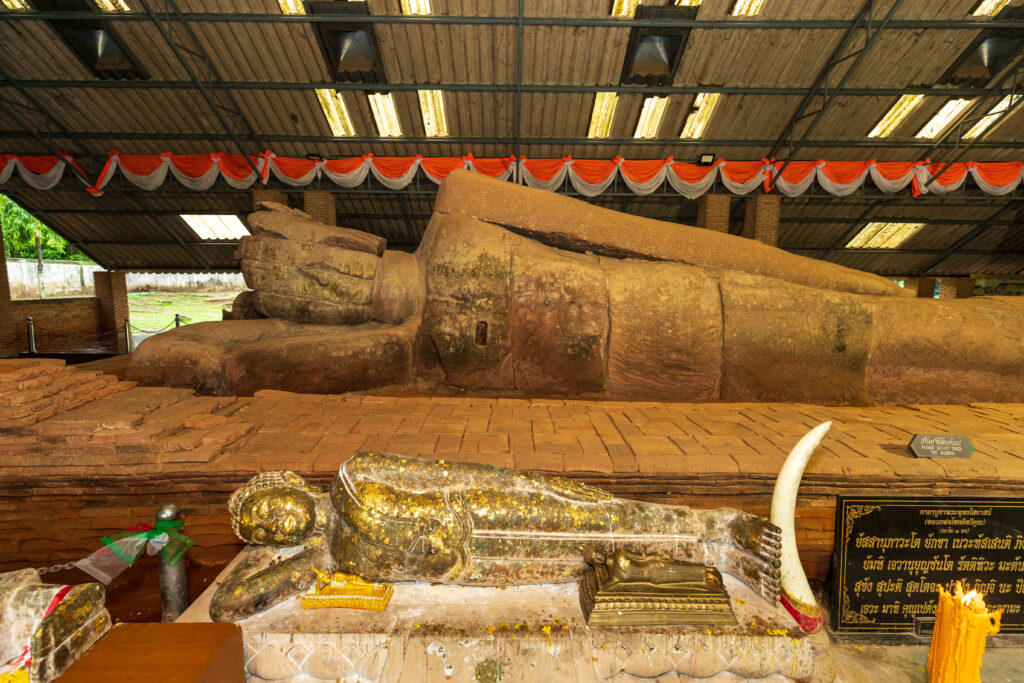
Archaeologists in Thailand have made an extraordinary discovery, unearthing a hidden trove of gold and silver treasures beneath a 1,300-year-old reclining Buddha statue.
In a groundbreaking archaeological discovery, Thailand’s Fine Arts Department has uncovered a hidden collection of gold, silver, and bronze artifacts beneath a 1,300-year-old reclining Buddha statue at Wat Thammachak Sema Ram Temple in Sung Noen District, Nakhon Ratchasima Province.
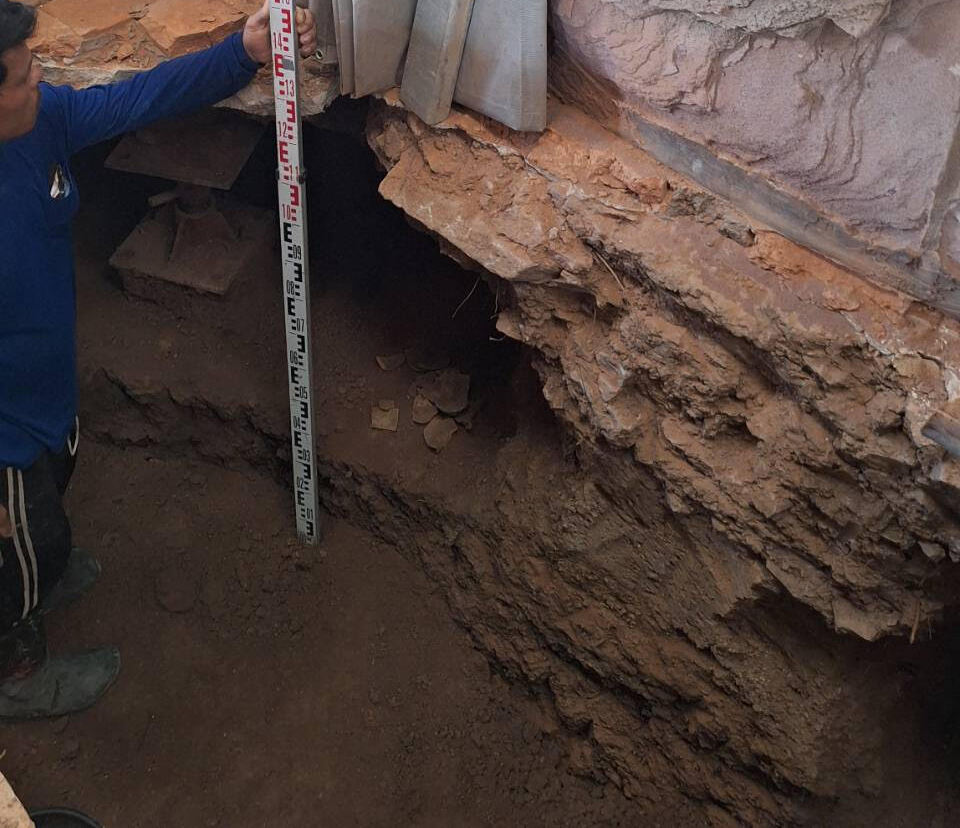
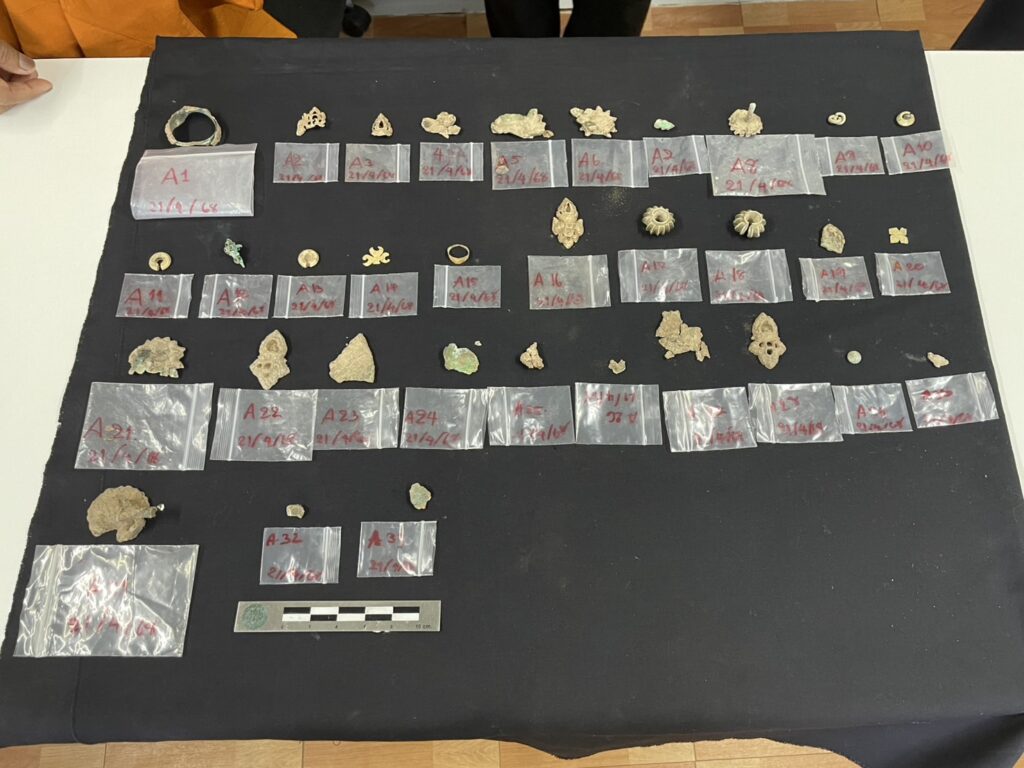
The discovery was made during a conservation project aimed at reducing underground moisture around the sandstone Buddha image—one of Thailand’s oldest and largest reclining Buddha statues. While preparing for the drainage system, workers stumbled upon a ceramic container holding metal ornaments about 1.3 meters below the statue’s base. Inside were 33 items, including gold rings, silver earrings, and intricately shaped bronze ornaments, believed to date back to the Dvaravati period (6th–11th centuries CE).
From Routine Excavation to Historical Revelation
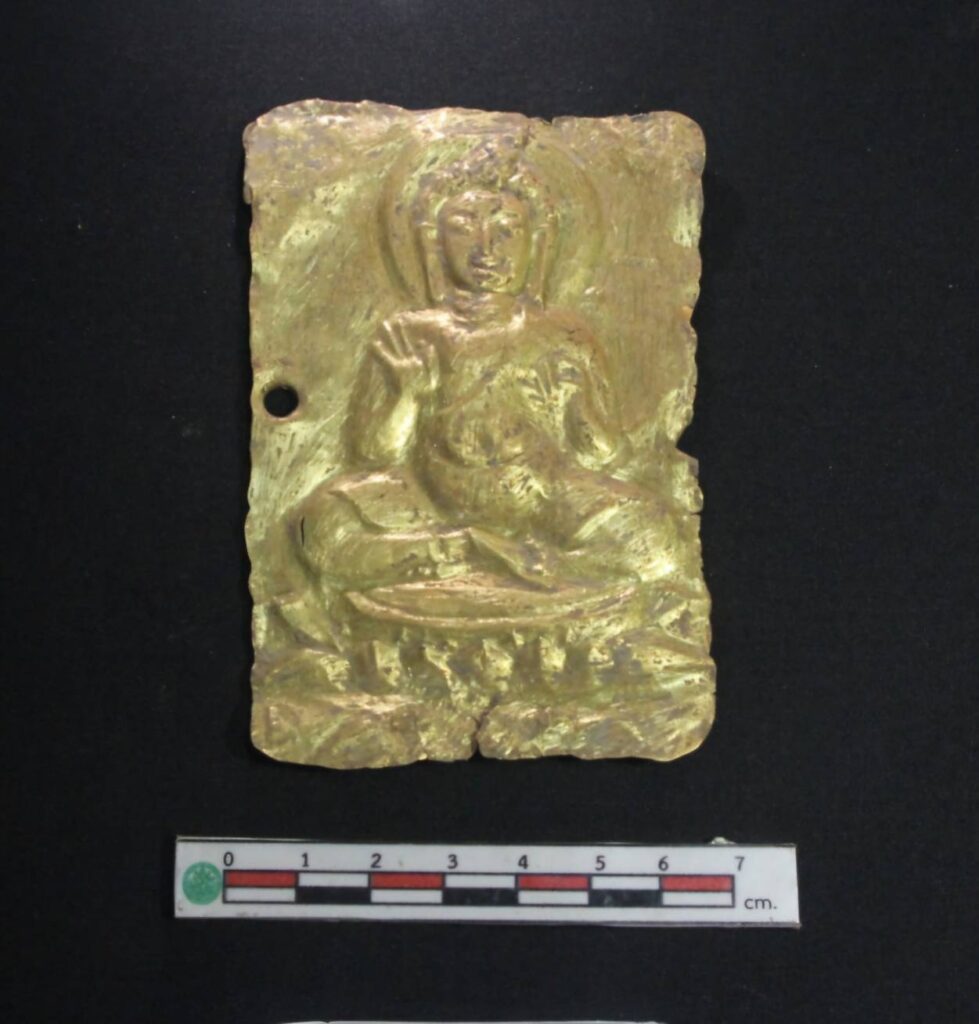
According to Mr. Panombut Chantrachote, Director-General of the Fine Arts Department, the initial find on April 21, 2025, sparked further investigation. Days later, on April 30, archaeologists unearthed additional relics made from gold, lead, and a tin-lead alloy known as chin. Among them were three extraordinary metal sheets featuring repoussé depictions of Buddha—artworks that reveal the exceptional craftsmanship and deep spiritual symbolism of the Dvaravati era.
One of the most remarkable discoveries was a rectangular gold sheet measuring 8 centimeters wide and 12.5 centimeters tall, depicting a seated Buddha in the Vitarka Mudra, or the teaching gesture. The image shows the Buddha with a halo, elongated earlobes, and tightly coiled hair, draped in a monastic robe that falls gracefully over his left shoulder. A small circular hole near one corner suggests it may have been suspended or tied as a ritual object.
Another artifact, a curved lead sheet, portrays a standing Buddha flanked by attendants. Though partially damaged, the sheet’s details—such as the Buddha’s serene expression and delicate robe folds—mirror Dvaravati-style art found at Wat Phra Pathon, Nakhon Pathom. This resemblance strengthens the link between central Thailand’s Dvaravati heritage and the newly discovered artifacts in the northeast.
The third find included three metal sheets encased in soil and lime layers, discovered behind the Buddha’s head. Though fragile, these pieces may have served as sacred deposits or ritual offerings during the original construction of the statue.
A Window Into the Dvaravati Era’s Artistic Soul
Experts believe these metalworks were created using the repoussé technique—hammering the metal from the reverse side to form detailed images. This method, requiring precision and patience, reflects the artistic mastery and spiritual devotion of the Dvaravati artisans.
The Dvaravati civilization, which flourished in what is now central and northeastern Thailand between the 6th and 11th centuries, played a crucial role in spreading Buddhism and shaping the region’s early art forms. The discovery of such refined repoussé images beneath a major Buddhist monument underscores the deep intertwining of religion, art, and ritual in early Thai society.
These artifacts not only highlight the technical sophistication of ancient craftsmen but also illuminate the symbolic rituals that accompanied monumental Buddhist constructions. Placing sacred offerings beneath statues was likely intended to bless the monument and ensure spiritual protection for generations.
Preservation and Research at the Phimai National Museum
Following the discovery, all artifacts have been transferred to the Phimai National Museum, where specialists are carefully cleaning, cataloging, and studying each piece. The museum, renowned for its dedication to preserving Southeast Asia’s ancient heritage, will analyze the metal composition, manufacturing techniques, and iconography to determine the artifacts’ origins and historical context.
“The finds provide invaluable insight into the artistic evolution and spiritual practices of the Dvaravati period,” said Director-General Panombut. “They remind us of Thailand’s deep cultural roots and the sophistication of early Buddhist art.”
The conservation team has already completed preliminary stabilization procedures to protect the delicate metal surfaces. Further studies, including 3D scanning and metallurgical analysis, are planned to understand the techniques used by Dvaravati artisans and the significance of each object within ancient Buddhist rituals.
A Treasure That Connects Past and Present
This extraordinary find adds a new chapter to Thailand’s rich archaeological record, connecting modern Thai identity to the spiritual legacy of the Dvaravati kingdom. Beyond its aesthetic beauty, the discovery reflects a continuum of faith and artistry that has endured for over a millennium.
The reclining Buddha at Wat Thammachak Sema Ram—already an iconic monument of devotion—now holds even greater significance as a vessel of ancient history. As the Fine Arts Department continues its research and preservation work, these treasures will soon be displayed to the public, allowing visitors to witness firsthand the splendor of early Thai civilization.
For Thailand and the world, the uncovering of gold beneath the Buddha is more than an archaeological triumph—it is a rediscovery of cultural memory, an echo from a sacred past that still shines today.
Thailand’s Fine Arts Department
Cover Image Credit: Wat Thammachak Sema Ram Temple
