

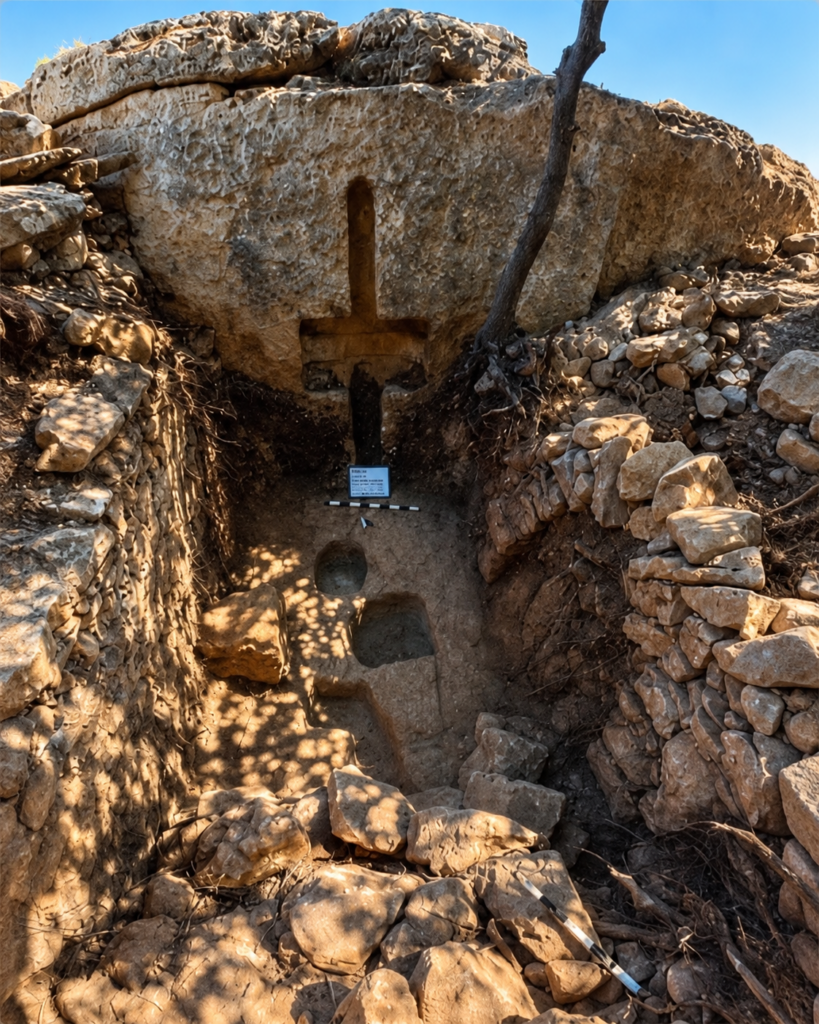
A previously unknown Khirbet Qabla church uncovered in northern Jordan has revealed an unexpected earlier life: before becoming a Christian place of worship, the building had been used as an olive press.
A small church uncovered at Khirbet Qabla in northern Jordan has turned out to have a very different earlier life. Before the building became a place of Christian worship, it had been used to process olives, making the structure one of the most intriguing discoveries from Yarmouk University’s first systematic excavation season at the site.
The church had not been identified before the 2026 campaign. Rather than revealing a building with a single purpose, the excavation exposed evidence that the same space had been adapted as the needs of the surrounding community changed over time.
According to Yarmouk University’s Faculty of Archaeology and Anthropology, archaeological remains inside the structure show that it originally functioned as an olive press. At a later stage, the building was converted into a small church, preserving two very different chapters of the site’s history within the same architectural footprint.
The university has not yet announced precisely when that conversion occurred, and the excavation results remain preliminary. Even so, Khirbet Qabla is already beginning to reveal a broader sequence of occupation spanning the Roman, Byzantine and early Islamic periods.
From Olive Oil to Worship
Reusing buildings was common in antiquity, but the shift identified at Khirbet Qabla is especially striking because the structure moved from agricultural production to religious use. A space once associated with pressing olives eventually became a place of worship, suggesting a significant change in how this part of the settlement was being used.
That transformation raises questions that future excavation may help answer. Archaeologists will want to know whether olive production had ceased in this area, whether a growing community required a local church, and how much of the earlier industrial installation remained visible after the conversion.
For now, the excavators are treating the chronology cautiously. The two phases have been identified, but a more precise date for the conversion will depend on continued excavation and detailed study of the material recovered from the structure.
A Complete Byzantine Wine Press Emerged Nearby
The church was not the only production-related discovery made during the season. Elsewhere at Khirbet Qabla, the team uncovered a Byzantine-period wine press cut directly into the limestone bedrock, adding another layer to the settlement’s economic history.
The installation preserves several elements required to process grapes, including pressing areas, settling basins and collection tanks linked by rock-cut channels. Rather than surviving as a single isolated basin, the system appears to preserve much of the wine-production process in one place.
Together with the earlier olive-processing phase beneath the church, the wine press suggests that agricultural production played a substantial role in life at Khirbet Qabla. Olives and grapes were both being processed at the settlement, linking the excavated remains directly to the productive landscape that surrounded it.
In an earlier statement issued during the excavation season, Yarmouk University described Khirbet Qabla as a site containing numerous ancient presses alongside different types of tombs. The 2026 campaign is now beginning to place those remains within a clearer archaeological context.
Roman and Byzantine Tombs Across the Site
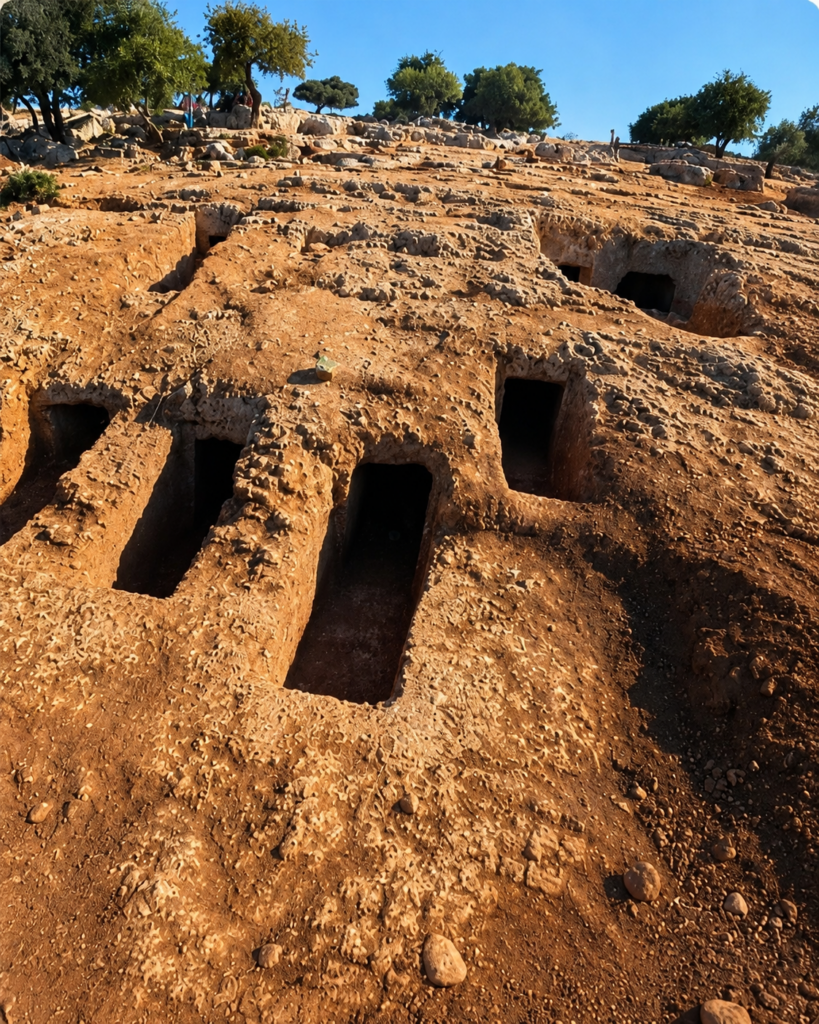
Excavators also identified individual and family tombs dating to the Roman and Byzantine periods. Photographs released from the site show rectangular rock-cut openings across the limestone terrain, some apparently leading into larger burial chambers.
The presence of these tombs broadens the picture significantly. Archaeologists are not dealing only with production installations or an isolated church, but with a landscape in which people worked, worshipped and buried their dead over successive generations.
This combination is what gives Khirbet Qabla particular archaeological value. A wine press can illuminate production, a church can reveal aspects of religious life, and tombs can provide evidence for burial practices, but here those different elements survive together within the same settlement.
A Site That Had Never Been Systematically Excavated
Khirbet Qabla lies southwest of Zubia in Jordan’s Irbid Governorate. Ancient remains in the area were known before the current project, but the 2026 campaign marked the first systematic excavation season undertaken there by Yarmouk University.
The work was led by Dr. Ma’an Ammoush, with Dr. Hussein Sabbah and Nasser Gharaibeh, and also served as practical field training for students in archaeology, anthropology, and heritage studies. Students took part in excavation, archaeological drawing, photography, documentation, and artifact recording.
The site was also visited during the season by Fawzi Abu Danneh, director general of Jordan’s Department of Antiquities. His visit reflected the growing interest in a settlement that is only now beginning to be investigated in a systematic way.
The significance of the first season lies not simply in the number of structures uncovered, but in the sequence they reveal. At Khirbet Qabla, one building moved from olive production to Christian worship, while nearby wine presses and tombs point to a settlement whose economic, religious and funerary landscape changed over centuries.
Future excavation may establish when those changes occurred and how they related to wider developments in northern Jordan. What the 2026 season has already shown is that Khirbet Qabla was repeatedly reshaped by the communities that lived there, and that its history is considerably more complex than the visible ruins first suggested.
Yarmouk University’s Faculty of Archaeology and Anthropology
