
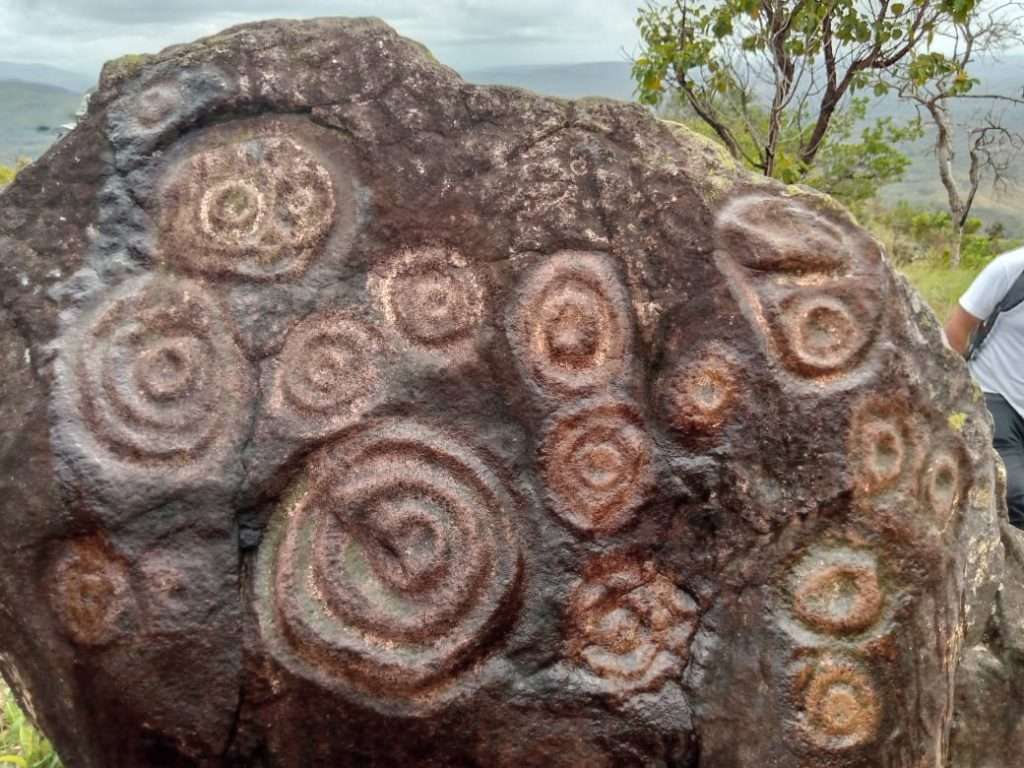
A remarkable archaeological discovery in northeastern Venezuela is drawing international attention after authorities confirmed the finding of a major petroglyph complex estimated to be between 4,000 and 8,000 years old. The ancient rock carvings were uncovered on January 30 in the highland community of Quebrada Seca, located 3.5 kilometers from San Félix in Cedeño municipality, in Monagas state, at an elevation of 647 meters above sea level.
Officials from Venezuela’s National Land Institute and local authorities announced the discovery, describing it as one of the most significant archaeological finds in the country in recent years. If early dating estimates are confirmed, the Quebrada Seca petroglyphs could rank among the oldest known symbolic expressions in eastern Venezuela.
Ancient Symbols Reflect Cosmology and Migration
The newly identified stone features a striking array of engravings, including spirals, concentric circles, and anthropomorphic (humanoid) figures. Researchers believe these motifs reflect the cosmology of the region’s earliest inhabitants, symbolizing connections to the sun, water cycles, and ancestral spirits.
According to local historians, the municipality of Cedeño—whose administrative center is Caicara de Maturín—is widely regarded as the “capital of petroglyphs” in Monagas. The area preserves the cultural legacy of Indigenous groups such as the Chaimas and Kariñas, who are thought to have inhabited or traversed the region thousands of years ago.
Historian Luis Peñalver described the discovery as a milestone, noting that it not only confirms the presence of ancient rock art in Cedeño but also strengthens the region’s status as a key transit and settlement corridor in eastern Venezuela. The engravings suggest that the area may have served as a strategic passageway for migrating groups during the Paleoindian and Mesoindian periods, roughly between 6000 and 1700 BCE.
📣 Our WhatsApp channel is now LIVE! Stay up-to-date with the latest news and updates, just click here to follow us on WhatsApp and never miss a thing!!
Estimated Age and Dating Challenges
The estimated age of the petroglyphs—between 4,000 and 8,000 years—has been determined through stylistic and comparative analysis rather than direct laboratory testing. Direct dating of petroglyphs remains notoriously complex. Archaeologists typically rely on factors such as the degree of weathering and patina formation, comparisons with nearby dated sites, and the sequencing of overlapping engravings.
If scientific testing confirms the earlier end of the proposed timeframe, the Quebrada Seca site could significantly reshape current understanding of symbolic traditions in the region. Such an early date would suggest that complex spiritual and cosmological systems developed in eastern Venezuela far earlier than previously documented.
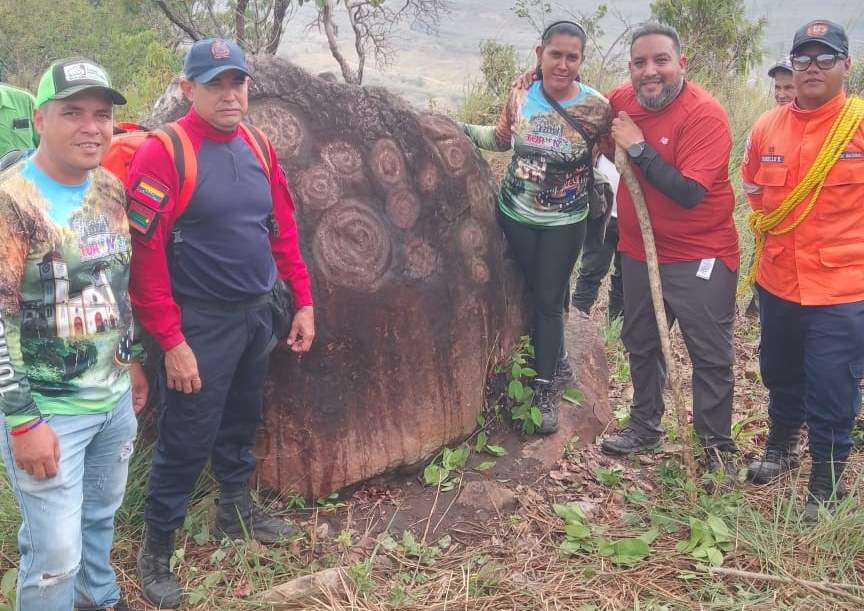
A large petroglyph complex with unique carvings has been discovered in Monagas state in northeastern Venezuela. Credit: National Land Institute
Engraving Techniques Reveal Advanced Craftsmanship
Technical analysis shows that the images were carved using a linear low-relief technique. The grooves measure an average depth of 1.24 centimeters and a width of 1.71 centimeters. Researchers believe ancient artisans used abrasive stones in combination with sand and water, along with stone hammers and chisels, to achieve the precise incisions visible today.
Four main engraving techniques have been identified in Venezuelan rock art: linear low relief, planar low relief, linear high relief, and planar high relief. The Quebrada Seca petroglyphs correspond to the linear low-relief style, in which lines are incised into the rock surface without fully excavating the surrounding area.
In some Venezuelan sites, traces of pigments have also been detected within carved grooves, suggesting that certain petroglyphs may once have been painted to enhance their visual impact. Although no pigment residue has yet been confirmed at Quebrada Seca, further fieldwork may provide additional insights.
Cultural and Archaeological Significance
Venezuela’s Indigenous rock art tradition includes a wide range of expressions beyond petroglyphs. Archaeological evidence across the country features cave paintings, megalithic alignments, mythic stones, rock depressions known as bateas, tool-sharpening grooves called amoladores, micropetroglyphs carved into lithic slabs, and monumental geoglyphs.
The diversity of these forms underscores the sophistication of early societies in the region. Scholars have long interpreted recurring figures—such as the sun, moon, frogs, human faces, animal tracks, and geometric patterns—as markers of spiritual beliefs, territorial boundaries, migration routes, meeting places, or sacred enclaves.
Some theories suggest that highly visible petroglyphs may have functioned as guide markers for migrating groups, signaling water sources or safe passage corridors. Others propose that they marked ancestral burial grounds or ceremonial gathering sites.
Preservation and Sustainable Tourism Plans
Local authorities have emphasized that protecting the newly discovered site is an urgent priority . Exposure to natural weathering, combined with the risk of vandalism, poses a significant threat to the integrity of the carvings. Similar sites in Venezuela have suffered irreversible damage due to insufficient monitoring and unauthorized human activity.
To safeguard the monument, officials plan to geolocate and formally register the site while implementing surveillance protocols to prevent deterioration. Collaboration with the Venezuelan Cultural Heritage Institute is expected to facilitate scientific study, systematic documentation, and potentially laboratory-based dating.
At the same time, the Monagas Tourism Directorate has announced plans to design an “archaeological route” that would integrate Quebrada Seca into a sustainable tourism framework. The initiative aims to balance scientific preservation with responsible public access, ensuring that the site can be appreciated without compromising its historical value.
A Discovery with Global Implications
As field investigations continue, archaeologists hope that further research will clarify the chronological and cultural context of the Quebrada Seca petroglyphs. Whether they ultimately date back 4,000 or 8,000 years, the engravings represent a powerful testament to the symbolic complexity and spiritual life of Venezuela’s earliest inhabitants.
For Monagas state—and for Venezuela as a whole—the discovery reinforces the country’s rich archaeological heritage and opens new avenues for research into prehistoric migration, settlement patterns, and cosmological expression in South America.
Cover Image Credit: National Land Institute