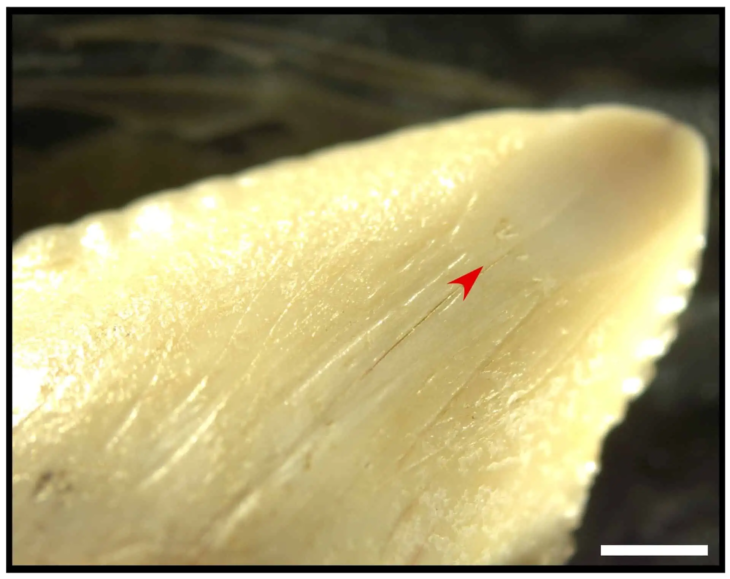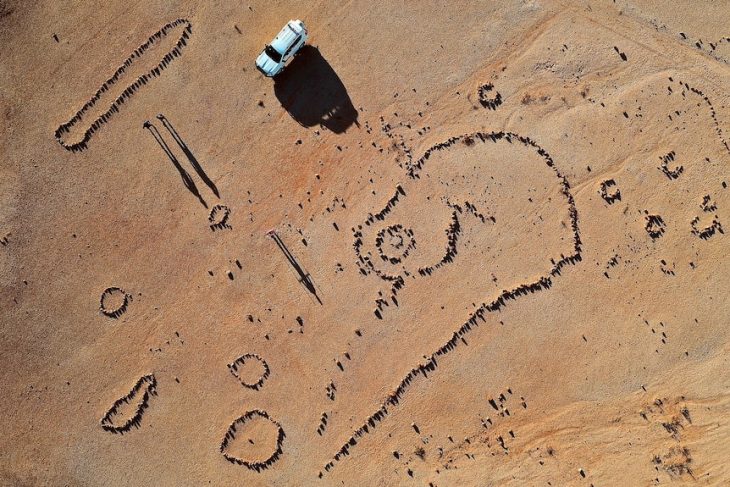
Scientists have uncovered one of the most extraordinary wildlife discoveries of recent years: naturally mummified cheetahs hidden deep inside caves in northern Saudi Arabia. The rare find, described in the journal Communications Earth & Environment, sheds new light on the long-lost cheetah populations of the Arabian Peninsula and could play a crucial role in future conservation and rewilding efforts.
The discovery was made in a complex of limestone caves near the city of Arar, close to Saudi Arabia’s northern border. Archaeologists and zoologists identified the mummified remains of seven cheetahs, alongside skeletal remains belonging to at least 54 additional individuals. Radiocarbon dating revealed that these animals lived across a vast time span, from roughly 130 years ago to more than 4,000 years before present.
Such well-preserved remains of large carnivores are exceptionally rare. According to researchers, the cheetahs were naturally mummified due to the caves’ extremely dry conditions, stable temperatures, and low humidity. These environmental factors slowed decomposition and protected both bones and soft tissues, creating ideal conditions for preservation.
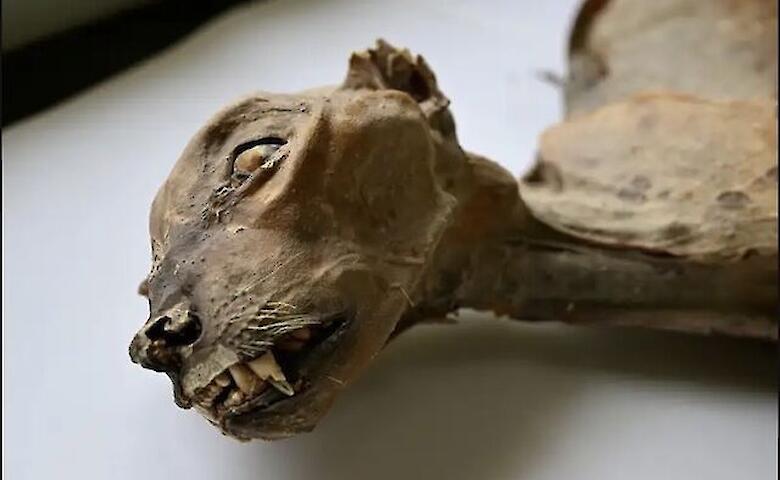
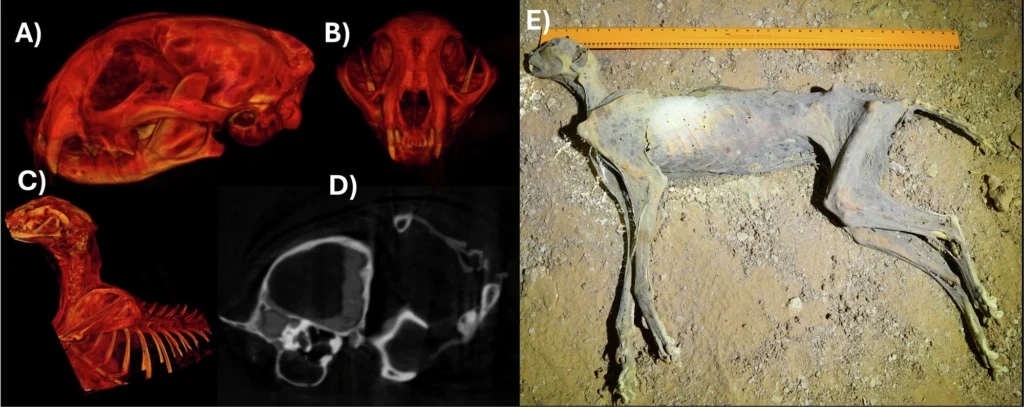
The mummified cheetahs show striking features: clouded eyes, desiccated skin, and shrunken limbs resembling dried shells. Unlike most animal remains, their bodies were not scavenged, a key reason they survived in such remarkable condition. Scientists believe that some of the caves may have served as dens, possibly used by female cheetahs to give birth and raise their cubs.
Radiographic analyses of skulls revealed a mix of cubs, subadults, and adult cheetahs, further supporting the denning hypothesis. The concentration of cheetah remains compared to prey animals suggests the caves were not simple hunting sites but places of repeated and long-term use.
📣 Our WhatsApp channel is now LIVE! Stay up-to-date with the latest news and updates, just click here to follow us on WhatsApp and never miss a thing!!
For the first time in scientific history, researchers successfully extracted and analyzed DNA from naturally mummified big cats. Genomic sequencing revealed surprising results. The youngest cheetah mummy was genetically closest to the Asiatic cheetah (Acinonyx jubatus venaticus), which today survives only in small numbers in Iran. Older remains, however, showed closer genetic ties to the Northwest African cheetah (Acinonyx jubatus hecki), one of the world’s most endangered big cat subspecies.
These findings challenge long-held assumptions that only Asiatic cheetahs once inhabited the Arabian Peninsula. Instead, the region appears to have been a genetic crossroads for multiple cheetah lineages over thousands of years.
Cheetahs once ranged widely across Africa, the Middle East, and much of Asia. Today, they occupy just about 9% of their historical range, having disappeared from Saudi Arabia decades ago. Habitat loss, unregulated hunting, declining prey populations, and human-wildlife conflict are believed to be the primary causes of their regional extinction.
The new discovery arrives at a critical moment. Saudi Arabia has invested heavily in wildlife conservation, restoring habitats and reintroducing species such as the Arabian oryx, gazelles, and Nubian ibex. With prey populations recovering and protected areas expanding, conservationists are now seriously considering the reintroduction of apex predators like the cheetah.
The ancient DNA data from the cave cheetahs provides invaluable guidance for these plans. By identifying which subspecies historically lived in the region, scientists can make informed decisions about which modern cheetah populations would be most suitable for future rewilding efforts.
Researchers emphasize that caves across arid regions may hold more hidden records of ancient biodiversity. These natural archives can help reconstruct lost ecosystems and provide crucial baselines for conservation in areas where written or observational records are scarce.
Beyond its scientific importance, the discovery captures the imagination. Frozen in time beneath the desert landscape, the mummified cheetahs tell a powerful story of survival, extinction, and the possibility of return. As conservation science increasingly looks to the past to shape the future, Saudi Arabia’s cave cheetahs may become a symbol of how ancient evidence can inspire modern restoration.
The study not only rewrites part of the cheetah’s evolutionary history but also offers a rare opportunity: using the deep past to guide the revival of one of the planet’s most iconic predators in the landscapes it once called home.
Boug, A.A., Mir, Z.R., Jbour, S. et al. Mummified cave cheetahs inform rewilding actions in Saudi Arabia. Commun Earth Environ 7, 24 (2026). https://doi.org/10.1038/s43247-025-03021-6
Cover Image Credit: Boug, A.A (2026), Commun Earth Environ