
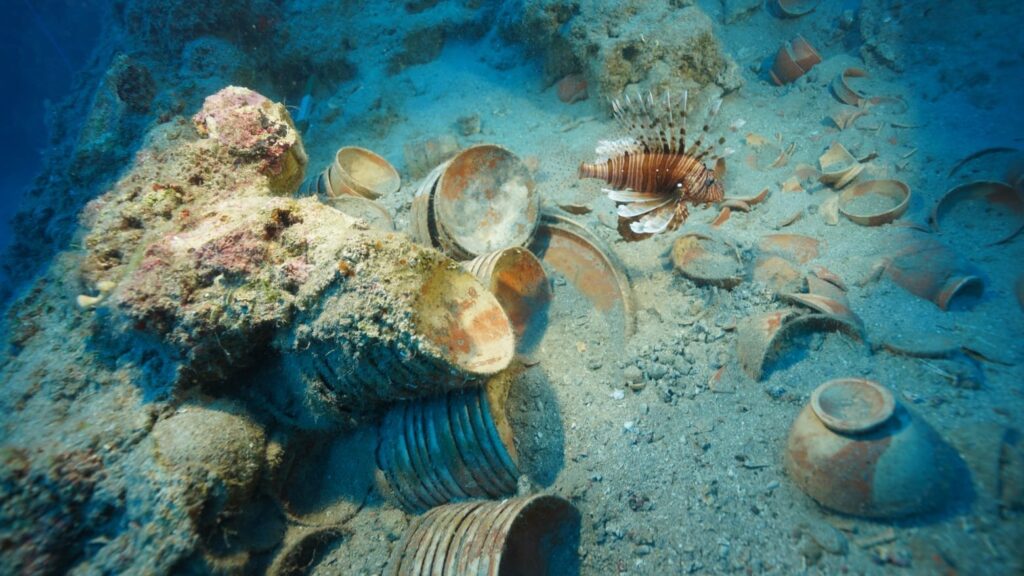
Thousands of ceramic plates, bowls and serving vessels have emerged from a 2,100-year-old shipwreck off Türkiye’s Mediterranean coast, revealing a cargo linked to one of the ancient world’s best-known centers of fine tableware production.
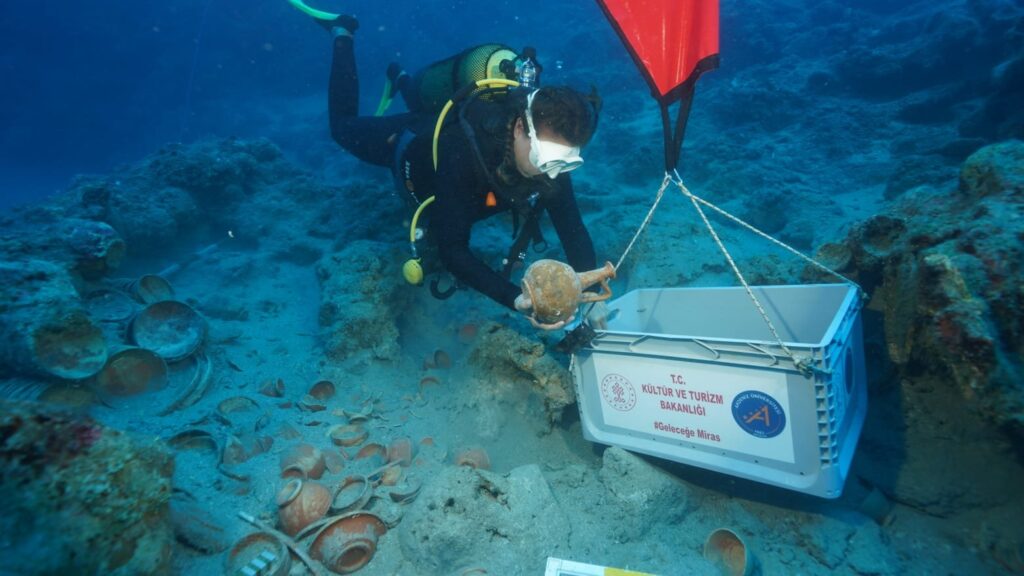
The wreck lies off Adrasan in Antalya, where underwater excavations launched in 2025 have been recovering an unusually large shipment of ceramics from depths of between 42 and 55 meters. According to Türkiye’s Minister of Culture and Tourism Mehmet Nuri Ersoy, archaeologists have identified tableware in 122 different forms and sizes among the cargo.
The ceramics are associated with the region around ancient Rhosus, identified with modern Arsuz on the Gulf of İskenderun. More than two millennia ago, wares connected with this Mediterranean port were apparently prestigious enough to attract the attention of the Roman statesman and orator Cicero.
A Ship Filled With Tableware
Rather than carrying a mixed cargo, the Adrasan vessel appears to have transported ceramics on an exceptional scale. Plates, bowls and trays were packed together for shipment across the Mediterranean when the ship sank during the Late Hellenistic or Early Roman period.
The scale of the discovery became clear during the first major excavation season. Akdeniz University’s Underwater Archaeology Research Center reported that 6,511 intact ceramic pieces were recovered from Adrasan in 2025 and transferred to Antalya Museum. Thousands of additional fragments were taken to the university’s Conservation and Restoration Laboratory in Kemer.
The latest assessment adds another important dimension to that enormous assemblage. Ersoy said the cargo includes 122 different forms and sizes, offering archaeologists an unusually detailed view of the variety of tableware circulating through Mediterranean markets around 2,100 years ago.
Such a large collection does more than illustrate ancient dining habits. Preserved together inside a single commercial cargo, the vessels can provide evidence for production, packaging, distribution, and consumer demand at a moment when maritime trade connected ports across the eastern Mediterranean.
The Pottery That Reached Cicero’s Letters
The name Rhosus has a remarkable place in the written record of the Roman world. While serving as governor of Cilicia around 50 BC, Marcus Tullius Cicero wrote to his close friend Titus Pomponius Atticus and mentioned that he had ordered Rhosica vasa — literally, vessels or wares associated with Rhosus.
That brief reference has attracted archaeological attention for decades. Scholars have proposed that Cicero’s Rhosica vasa may have been connected with Eastern Sigillata A, a widely distributed class of fine red-gloss tableware produced somewhere around the Gulf of İskenderun. Archaeological and clay-distribution evidence supports a production zone in this region, although the precise identification of Cicero’s vessels remains debated.
The Adrasan wreck therefore offers a striking physical counterpart to a world glimpsed in ancient correspondence: coastal workshops producing tableware in large quantities, merchants loading those vessels onto ships, and customers around the Mediterranean seeking ceramics associated with particular production centers.
Clay Packing Preserved the Cargo
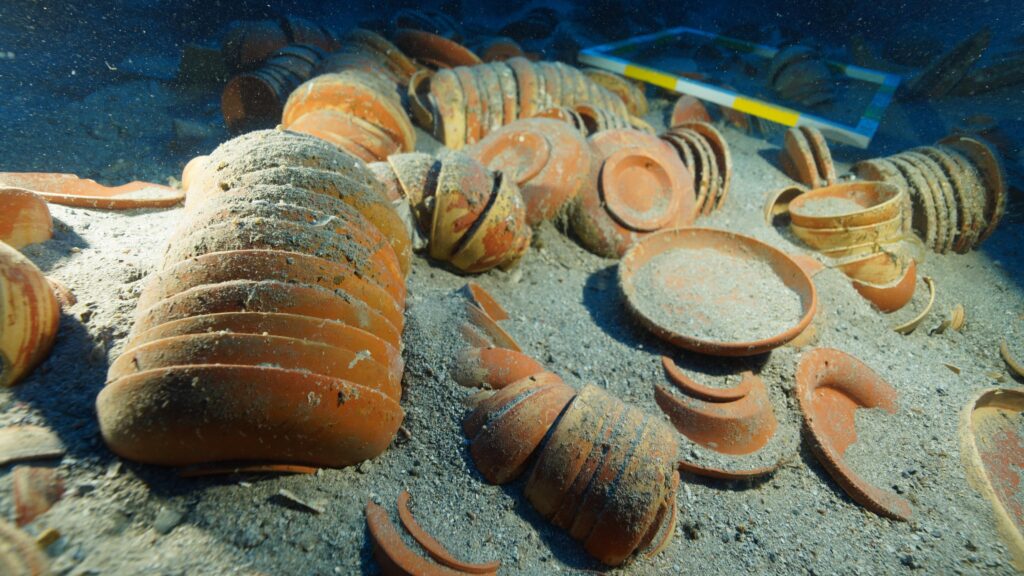
One of the wreck’s most unusual features is not the ceramics themselves, but the material ancient merchants used to protect them during transport. According to Ersoy, they packed clay between the vessels inside crates, reducing the risk of plates and bowls striking one another during the sea voyage.
That packing method also helped preserve the cargo after the ship sank. For archaeologists, the survival of so many complete vessels is especially valuable because shipwrecks often leave behind heavily fragmented cargo scattered across the seabed.
At Adrasan, however, many vessels remain intact enough for researchers to reconstruct both their shapes and the way merchants prepared them for maritime transport. Together, they preserve something close to a commercial shipment frozen in time.
A Mediterranean Trade Route Beneath the Sea
Excavating the wreck is technically demanding. Archaeologists are working at depths of 42 to 55 meters, with underwater robotic systems supporting operations on the seabed.
The Adrasan project forms part of a much wider program of underwater archaeological research along Türkiye’s Mediterranean coast. In 2025 alone, teams from Akdeniz University documented ten shipwrecks during surveys in Antalya and Fethiye, while excavation also continued at the much older Middle Bronze Age wreck off Kumluca.
Yet the Adrasan wreck stands apart because of the extraordinary concentration of tableware preserved within it.
Some 2,100 years ago, its cargo was merchandise rather than archaeology. The plates, bowls and trays were packed for customers somewhere beyond the horizon, part of the constant movement of goods between workshops, ports and dining tables around the Mediterranean.
The ship never completed that journey. Instead, its cargo remained beneath the sea for more than two millennia.
Now, thousands of vessels are resurfacing together, providing rare archaeological evidence for an ancient ceramic trade whose reputation was significant enough to leave traces not only on the Mediterranean seabed, but also in the surviving letters of Cicero.
