12 March 2026 The Future is the Product of the Past

A woman in the Czech Republic found a medieval jackpot during a walk

A woman walking in the town of Kutná Hora in the Central Bohemian Region of the Czech Republic found a nearly 900-year-old treasure of more than 2,150 medieval silver coins, known as denarii.

The woman found some silver coins while walking through a field in Kutnohorsku and contacted officials, the Institute of Archaeology of the Academy of Sciences of the Czech Republic said in a May 16 news release.

The treasure consisted of more than 2,150 silver coins minted between 1085 and 1107. Experts believe they were manufactured in Prague and imported to Bohemia. The trove was stored in a ceramic container that was destroyed over the years, but archaeologists discovered the bottom of the container.

“The [discovery was] made of coin alloy, which, in addition to silver, also contains an admixture of copper, lead, and trace metals,” the Institute of Archaeology of the Czech Academy of Sciences (ARUP) stated in the press release. “Determining this particular composition can also help determine the origin of the silver used.”
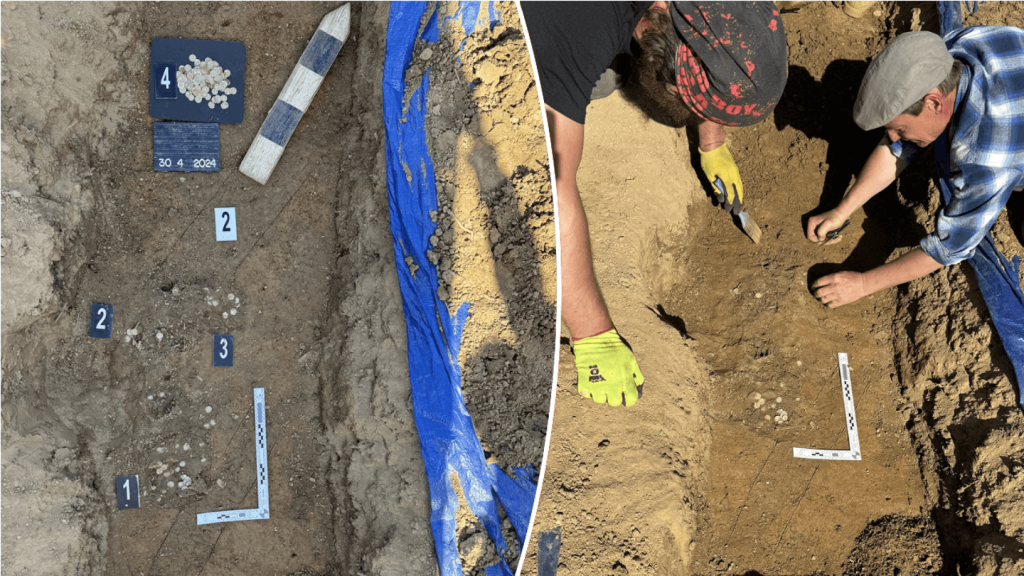
The discovery of the treasure is one of the largest archaeological finds of the past 10 years, experts say. Photo: Institute of Archaeology of the Academy of Sciences of the Czech Republic

Dubbed one of the greatest finds of the last decade, institute archaeologist Filip Velímský believes the discovery is like winning a prize in the lottery—even if someone else was the loser. “It was probably placed in its place during the first quarter of the 12th century, at a time of internal political instability,” he said.


📣 Our WhatsApp channel is now LIVE! Stay up-to-date with the latest news and updates, just click here to follow us on WhatsApp and never miss a thing!!


“At that time, there were disputes in the country between the members of the Přemysl dynasty about the princely throne of Prague,” he said. According to ARUP, battles were common during the period and the depot could have been cash “for paying wages or spoils of war.”

Czech officials call the discovery “one of the largest finds of the last decade.”
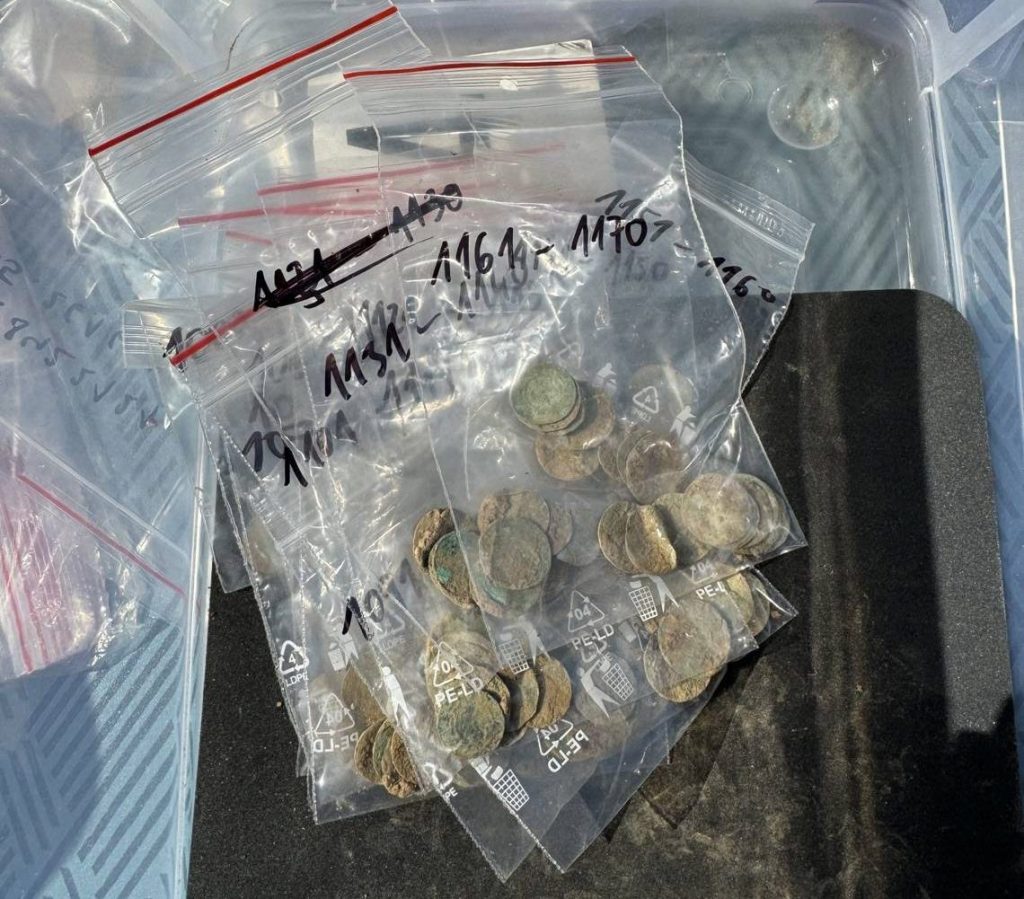
Some of the 900-year-old coins in plastic bags. Photo: Institute of Archaeology of the Academy of Sciences of the Czech Republic

According to the experts, that owner couldn’t have been just anyone. “Unfortunately, for the turn of the 11th to 12th century, we lack data on the purchasing power of contemporary coins,” he said. “But it was a huge, unimaginable – and at the same time, unavailable – amount for an ordinary person. It can be compared to winning a million in the jackpot.”

The artifacts were taken to a laboratory for further analysis and documentation, a process that will likely take a year. The artifacts will then be put on display in an exhibit expected to debut in 2025.

Archaeology of the Czech Academy of Sciences (ARUP)

Cover Photo: Archaeology of the Czech Academy of Sciences (ARUP)

Related Articles

Hellenistic cremation tomb found in Istanbul’s Haydarpasa excavations

11 April 2022

11 April 2022

A brick tomb belonging to the Hellenistic period (330 BC – 30 BC) was found during the Haydarpaşa excavations, which...

Needle-Carved Image of a Sasanian King Unearthed in Southern Iran’s Ancient City of Istakhr

13 November 2025

13 November 2025

Archaeologists have uncovered a rare needle-carved rock image believed to depict a Sasanian king, etched into the cliffs of the...

Time Team Cracks Sutton Hoo Mystery: ‘Master Count’ Bucket Was a Burial Urn

20 May 2025

20 May 2025

In a remarkable breakthrough at the historic Sutton Hoo site in Suffolk, England, archaeologists have revealed that a 6th-century Byzantine...

Sassanid-Era Inscription Linked to Royal Festival Discovered Near Persepolis

25 January 2026

25 January 2026

Archaeologists in Iran have uncovered a rare Sassanid-era rock inscription that sheds new light on royal festivals and calendrical traditions...

Archaeologists Unearth Cisterns at Izmir’s Ancient “City of Mother Goddess”

2 June 2021

2 June 2021

In the ancient city of Metropolis, in western Turkey, in the province of Izmir, something that played an important role...

Ancient objects found in Jerusalem could be hand grenades used 1000 years ago, New study says

27 April 2022

27 April 2022

New analysis into the residue inside ancient ceramic pots from 11th–12th century Jerusalem has found that they were potentially used...

People may have been cooking curries in South-East Asia for at least 2000 years

22 July 2023

22 July 2023

Archaeologists have found remnants of eight spices on a sandstone slab from an archaeological site in Vietnam, showing the early...

Interesting discovery at Crowland digs, a human poo from the Saxon period or coprolite found

16 August 2021

16 August 2021

Excavations in Abbey Church Field in Crowland, near Peterborough, have also yielded such amazing finds results for archaeologists. The archaeological...

Ancient cooking vessel found in northern Minnesota dates back more than 1,600 years

28 February 2022

28 February 2022

Dating of Ceramic sherds found in 2003 at the Boundary Waters Canoe Area Wilderness in northern Minnesota revealed the vessel...

A Roman sarcophagus bearing the title of “Emperor’s Protector” was found for the first time in Anatolia

29 April 2022

29 April 2022

A sarcophagus carrying the title of “Emperor’s protector” was discovered in the province of Kocaeli in western Turkey. With the...

Remarkable Roman Villa Full of Strange Artifacts Discovered from a Bronze Age Site in England

3 April 2024

3 April 2024

Archaeologists have uncovered a “richly decorated” remarkable Roman villa complex during excavations at Brookside Meadows in Grove, a village in...

A relief of a man holding his Phallus was found in Sayburç, one of the Taş Tepeler

18 October 2021

18 October 2021

In Sayburç, one of the Taş Tepeler in Şanlıurfa, a five-figure scene consisting of humans, leopards, and a bull was...

New research, prove that Romans were breeding small bulldogs

11 June 2023

11 June 2023

Researchers have proven that breeding small brachycephalic (shorter-nosed) dogs took place already in ancient Rome. Research on a 2,000 years...

Archaeologists discovered an enigmatic complex of rooms, interiors of which covered with figural scenes unique to Christian art

7 April 2023

7 April 2023

Archaeologists of the Polish Center of Mediterranean Archaeology at the University of Warsaw discovered an enigmatic complex of rooms made...

Archaeologists Discover Old Bulgarian Inscription and Rich Finds at Nikopol Fortress Excavations

2 September 2025

2 September 2025

This summer’s archaeological season at the Nikopol Fortress has yielded one of the most remarkable discoveries in recent years: an...