
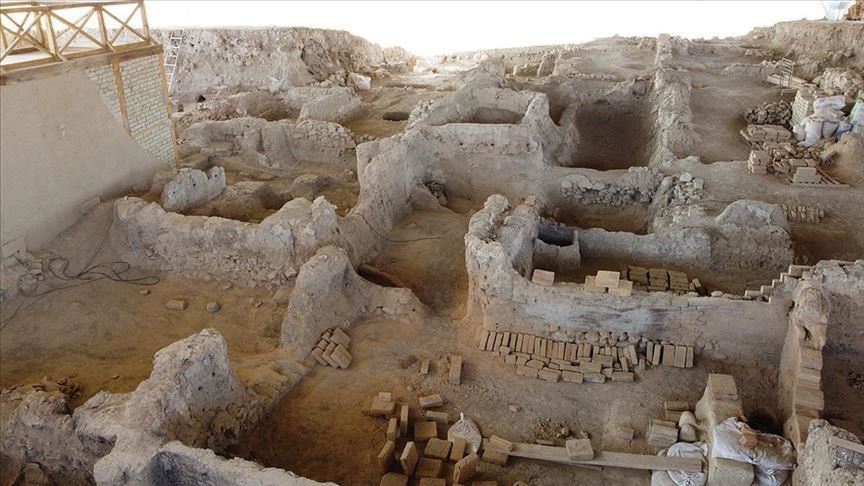
Excavations carried out between 2016 and 2018 at Beycesultan Höyük (Beycesultan Mound) in western Anatolia have yielded an extraordinary discovery: the earliest evidence of indigo-dyed and single-needle looped textiles in the region.
At Beycesultan Höyük, researchers have uncovered the earliest known evidence of indigo-dyed textiles and the sophisticated single-needle looping technique known as nålbinding in Anatolia. The findings, led by Associate Professor Çiğdem Maner of Koç University, were published in the internationally respected journal Antiquity, offering new insight into Bronze Age craftsmanship, trade, and social hierarchy.
A Regional Powerhouse in Bronze Age Anatolia
Located in the fertile Çivril Plain of Denizli Province, Beycesultan is one of western Anatolia’s largest settlement mounds, covering approximately 35 hectares. Its strategic position near ancient trade routes linking the Aegean, central Anatolia, and the Mediterranean made it a key hub throughout the Bronze Age. Excavations first began in the 1950s under British archaeologist Seton Lloyd, who revealed more than 40 cultural layers spanning from the Late Chalcolithic to the end of the Bronze Age.
Among the most significant earlier discoveries was the so-called “Burnt Palace,” a monumental Middle Bronze Age structure destroyed by fire in the early second millennium BC. The scale and architectural sophistication of this complex suggested that Beycesultan functioned as a regional administrative center—possibly even a capital—long before the emergence of classical Anatolian kingdoms.
Systematic excavations resumed in 2007 under Turkish leadership, and it was during campaigns in 2016 and 2018 that two extraordinary burnt textile fragments were uncovered inside fire-destroyed buildings. Because organic materials rarely survive in Anatolia’s humid soils, the preservation of these textiles—carbonized by ancient fires—provides an exceptionally rare archaeological opportunity.
The Earliest Nålbinding in Anatolia
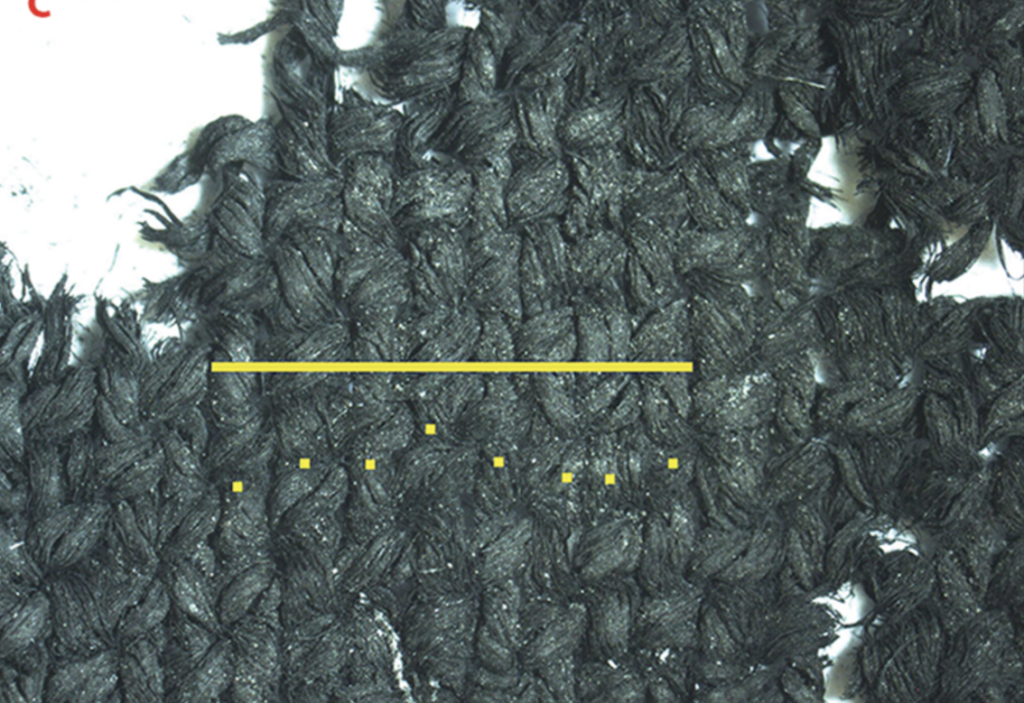
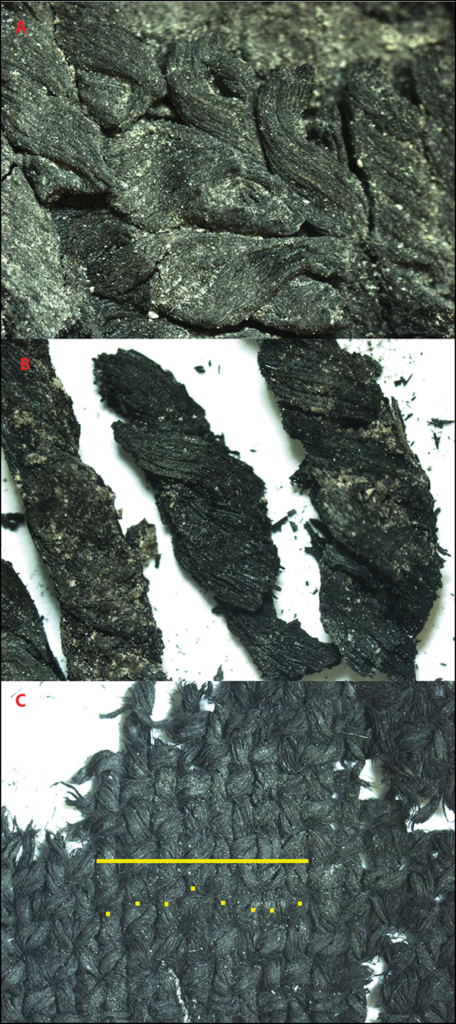
The first textile fragment, dated by radiocarbon analysis to approximately 1915–1745 BC, initially appeared unusual under microscopic examination. Unlike woven fabrics, it displayed no clear warp and weft structure. Advanced optical microscopy and scanning electron microscopy revealed that the fabric had been created using nålbinding, a single-needle looping technique that predates traditional knitting.
In nålbinding, loops are formed and interlocked using a single needle, creating a durable and flexible textile. While impressions of similar techniques have been identified on Early Bronze Age pottery in the Caucasus, the Beycesultan fragment represents the first preserved physical example of nålbinding from Anatolia or the wider Near East.
Even more striking was the fiber itself. SEM analysis confirmed that the yarn was made from hemp rather than wool or flax. Hemp cultivation continues in parts of the Çivril Plain today, suggesting a deep agricultural continuity in the region. The yarn’s twist and thickness indicate controlled, skilled production rather than casual domestic manufacture.
The Oldest Blue Textile of Bronze Age Anatolia
The discovery’s most captivating aspect lies in its color. High-performance liquid chromatography testing identified indigotin—the key molecular compound responsible for indigo blue dye. The dye was most likely derived from Isatis tinctoria, commonly known as woad, a plant that grows naturally in Anatolia.
This makes the Beycesultan fragment the earliest scientifically confirmed indigo-dyed textile from Bronze Age Anatolia.
Blue textiles in the second millennium BC were not everyday garments. Cuneiform tablets from Mesopotamia and the Hittite world describe blue wool and garments as luxury items worn by royalty and elites. Blue fabrics were listed among tribute payments and diplomatic gifts exchanged between rulers. The Akkadian term uqnû referred to lapis lazuli–colored wool, underscoring the prestige associated with the color.
Archaeological parallels further highlight this symbolic value. Blue textiles were discovered in the tomb of Tutankhamun in Egypt, while Aegean frescoes depict elites wearing garments accented with vivid blue details. The Beycesultan find now demonstrates that western Anatolia was also capable of producing such high-status goods locally.
A Textile Workshop Frozen in Time
The second textile fragment, dated to approximately 1700–1595 BC, was found in a room filled with spindle whorls, loom weights, bronze needles, a weaving comb, and various craft tools. Unlike the first fragment, this textile was a plain tabby weave, produced on a vertical warp-weighted loom. Though heavily carbonized, microscopic examination suggests it was also made from plant fibers.
The dense concentration of textile tools indicates that the building functioned as a workshop. The range of spindle whorl weights suggests production of different yarn thicknesses, implying a level of specialization. Such diversity points to organized, possibly professional textile manufacturing rather than purely household activity.
Taken together, the two fragments reveal a community that mastered multiple production techniques—both loom weaving and advanced looping methods—while also possessing chemical knowledge of plant-based dye extraction.
Beycesultan in the Broader Bronze Age World
During the early second millennium BC, Anatolia was deeply integrated into international trade networks through Assyrian merchant colonies. Textiles were among the most valuable commodities exchanged between Anatolia and Mesopotamia. The presence of indigo-dyed hemp fabric at Beycesultan suggests participation in these wider economic systems.
Although no cuneiform tablets have yet been discovered at the site, the scale of architecture, evidence of workshops, and now the production of luxury textiles reinforce the interpretation that Beycesultan functioned as a powerful regional center. Its inhabitants were not merely consumers of imported prestige goods—they were producers of them.
The discovery also expands scholarly understanding of plant fiber use in the Bronze Age. While wool has often dominated discussions of ancient textiles, the Beycesultan findings highlight hemp as a significant and possibly underrecognized material in Anatolian craft industries.
Rewriting Textile History in Anatolia
The 2025 findings from Beycesultan challenge long-held assumptions about technological development in Bronze Age Anatolia. They demonstrate that artisans possessed advanced knowledge of fiber processing, dye chemistry, and textile engineering nearly four millennia ago.
The presence of the earliest known nålbinding in the region, combined with the oldest indigo-dyed textile identified in Anatolia, firmly places Beycesultan among the most important archaeological sites for understanding early textile innovation.
As excavations continue, Beycesultan may yield further evidence of production systems, trade connections, and elite consumption patterns. For now, these ancient blue threads provide vivid testimony to the sophistication and creativity of Bronze Age Anatolian craftspeople—artisans whose technological achievements are only now coming fully to light.
Maner Ç, Abay E, Karadağ R, Torgan Güzel E. Untwisting Beycesultan Höyük: the earliest evidence for nålbinding and indigo-dyed textiles in Anatolia. Antiquity. 2025;99(403):118-134. doi:10.15184/aqy.2024.194
