
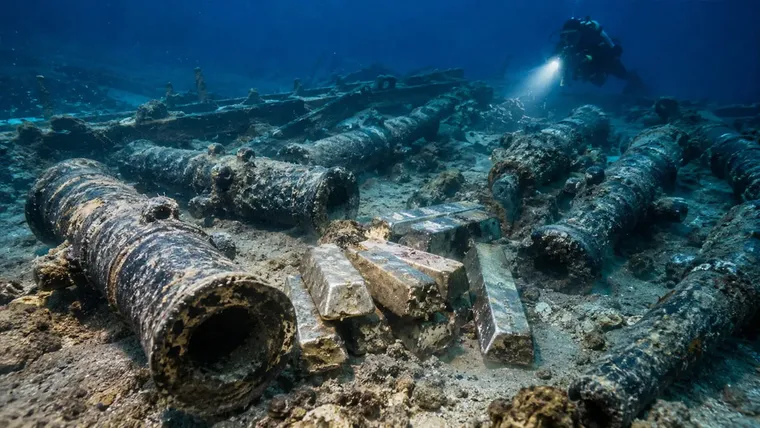
The Cádiz shipwreck known as Delta I is beginning to tell a sharper story: a 17th-century vessel linked to French service, Swedish artillery, Dutch arms networks, and silver that may have moved outside Spain’s tightly controlled Atlantic trade system.
The wreck itself is not a brand-new discovery. Delta I was found during dredging works connected to the new container terminal at the Port of Cádiz, and its recovery from the seabed was completed in July 2024. What is new is the published interpretation of its cargo and artillery, recently highlighted by CádizDirecto and based on the study by archaeologists Ernesto J. Toboso Suárez and Josefa Martí Solano, titled Extracción y documentación de la artillería procedente del pecio Delta I. Bahía de Cádiz, included in the proceedings of the I Congreso Iberoamericano de Arqueología Náutica y Subacuática.
A shipwreck raised from the mud of Cádiz harbor
Delta I had remained buried under sand and mud in the Bay of Cádiz after being identified during port works. The Andalusian Institute of Historical Heritage reported in April 2024 that the wreck was dated to the 17th century and preserved the lowest part of the vessel, with about 20 meters of length and seven to eight meters of beam. At that stage, officials said the site had yielded 27 Swedish Finbanker iron cannons, 22 silver ingots from the mines of Oruro and Potosí in present-day Bolivia, a bronze bell bearing the inscription “Jesús, María y José 1671,” shipboard objects, and animal remains.
The Port Authority of the Bay of Cádiz later confirmed that Delta I was lifted on July 27, 2024, after four months of technical and archaeological preparation. The operation was supervised by specialists from the Junta de Andalucía, the Centro de Arqueología Subacuática, and maritime archaeology teams. Divers worked in near-zero visibility at a depth of about six meters before the wreck was moved to Muelle Nº 5, lifted with two 350-ton mobile cranes, and placed under controlled conditions for study.
A French ship armed with Swedish cannons
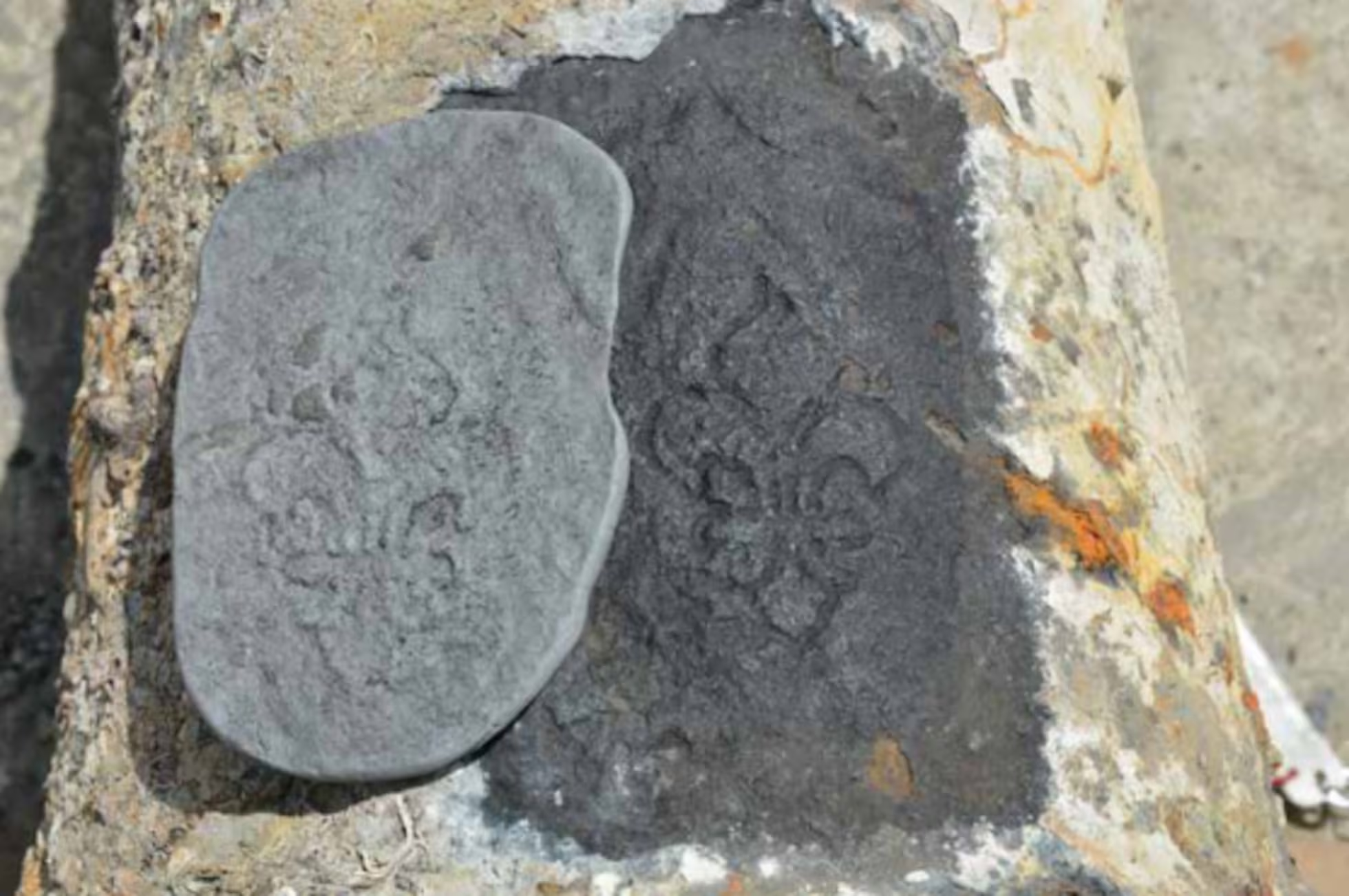
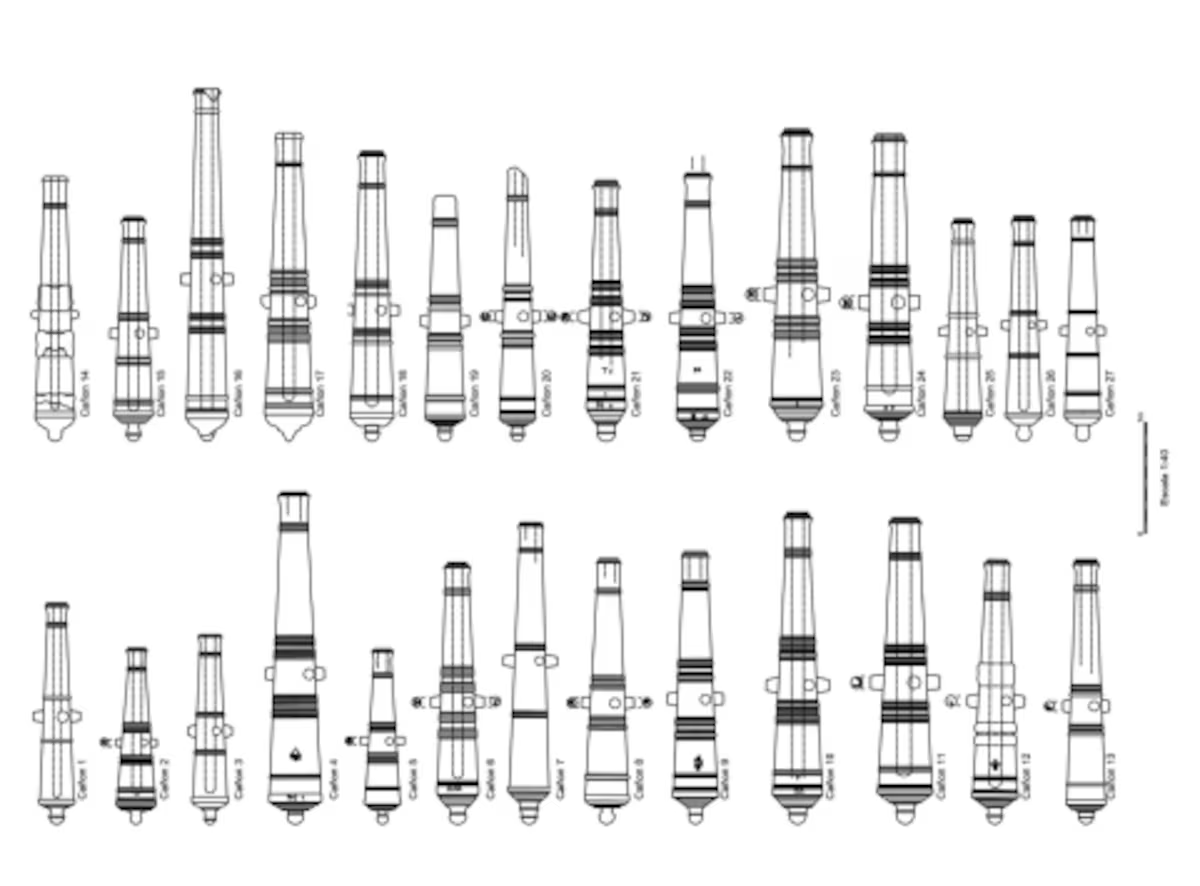
The new study focuses especially on the 27 cannons recovered from the wreck. According to the report cited by El País, Toboso and Martí identify the vessel as an Ibero-Atlantic-built ship operating in the service of France. Its artillery appears to have been Swedish-made, likely traded through Dutch intermediaries, who were active players in the European arms market during the 17th century.
The cannons were not uniform. Researchers documented five different calibers dating to the third quarter of the 17th century. Some were badly damaged. Three pieces had lost essential firing components, including the muzzle or one of the trunnions used to mount a cannon on its carriage. The absence of surviving gun carriages has led researchers to consider several possibilities: some cannons may have already been unusable and carried as ballast, or the damage may have occurred during combat or shortly before the ship went down.
This is one of the reasons Delta I matters. It is not only a shipwreck with valuable objects. It is a material trace of the military economy of the Atlantic, where ships, weapons, metals, and merchants crossed political borders even in periods of rivalry and war.
Silver ingots and the question of contraband
The most striking part of the new interpretation concerns the silver. CádizDirecto reports that 18 silver ingots weighing roughly half a ton were documented with the artillery, and one of them bears the date 1667. El País, citing the same study, states that the ingots were probably shipped as contraband.
There is a small but important distinction here. The 2024 official inventory from the Junta de Andalucía referred to 22 silver ingots, while the newly discussed study and recent media reports focus on 18 ingots. For publication, the safest wording is therefore to say that the official preliminary inventory recorded 22 ingots, while the new study highlights 18 silver ingots with an approximate total weight of half a ton.
The contraband interpretation fits the wider economic setting of the time. Spain heavily taxed and regulated the trade in precious metals arriving from the Americas. Although Seville officially held the monopoly over transatlantic commerce, Cádiz had become increasingly important because of its natural harbor and its role in loading and unloading Atlantic vessels. The presence of silver and foreign-linked artillery in the same wreck points to a maritime world where official rules and practical trade often moved in different directions.
A disturbed site, but not a lost story
The archaeological context is not simple. Researchers acknowledge that the site is “descontextualized” because dredging and underwater works altered the original position of the finds. That means the exact arrangement of the cannons around the vessel cannot yet be reconstructed with certainty. It also remains unclear whether the cannons shifted after the wrecking event or were moved during later port activity.
Even with those limits, Delta I is an unusually valuable case for underwater archaeology in Spain. The port works that exposed the site also led to the identification of other wrecks in the area, including Delta II and Delta III. The Bay of Cádiz, shaped by centuries of Atlantic commerce, naval traffic, colonial routes, and military conflict, remains one of the richest underwater archaeological landscapes in southern Europe.
What researchers still want to know
The vessel’s original name remains unknown. So do the exact circumstances of its sinking. The Centro de Arqueología Subacuática has been comparing archaeological evidence with archival records in an effort to identify the ship, clarify its nationality, reconstruct its construction process, and understand why it was in Cádiz when it sank.
The investigation includes 3D modeling, photogrammetry, detailed timber recording, and dendroarchaeological analysis of the wood. Samples are being studied to determine the species and origin of the timber used in the ship’s construction, with collaboration involving institutions including the CSIC and universities in Wales, Lisbon, and Alicante.
For now, Delta I remains an anonymous wreck with unusually eloquent cargo. Its cannons point toward northern European arms production and French naval service. Its silver points toward the pressure and leakage points of Spain’s Atlantic fiscal system. Its location, in Cádiz, places it at one of the great maritime crossroads of the early modern world.
The ship’s name may still be missing, but the evidence already recovered from its timbers, guns, and silver bars is enough to show that this was not an ordinary wreck. It was part of a larger system: war, trade, empire, tax control, and smuggling, all converging in the muddy waters of the Bay of Cádiz.
Cover Image Credit: The Andalusian Institute of Historical Heritage
