A seemingly unremarkable shipwreck off the Carmel coast has turned into one of the most consequential archaeological discoveries for understanding ancient warfare and trade. Beneath shallow waters near Dor Lagoon, archaeologists uncovered heavy, unworked masses of iron—known as blooms—dating to the late 7th or early 6th century BCE. Their presence is forcing a major reassessment of how iron, the backbone of ancient military power, was produced, transported, and distributed across the eastern Mediterranean.
The findings, recently published in npj Heritage Science, suggest that raw iron—not finished weapons or refined metal—was being transported by sea on a scale previously unrecognized.
A Cargo That Defies Expectations
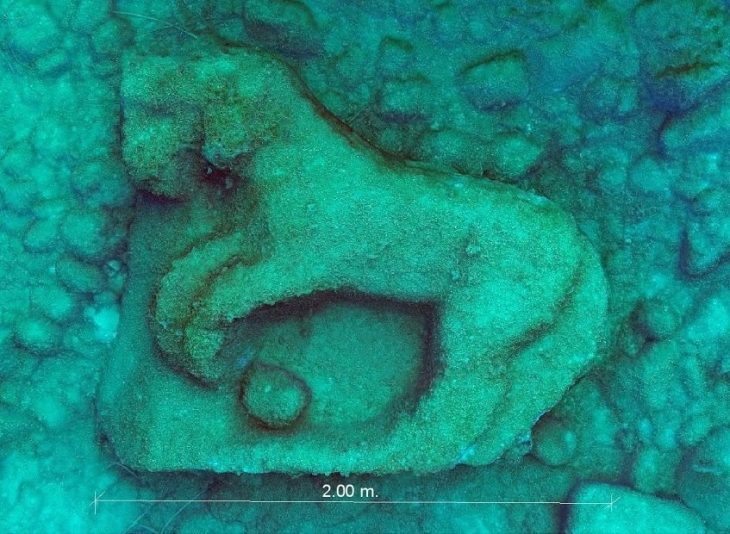
At first glance, the wreck did not seem extraordinary. Archaeologists recovered typical maritime artifacts: fragments of amphorae, an anchor, ballast stones, and organic remains such as grape seeds. But the real surprise lay in nine dense iron masses, each weighing between 5 and 10 kilograms.
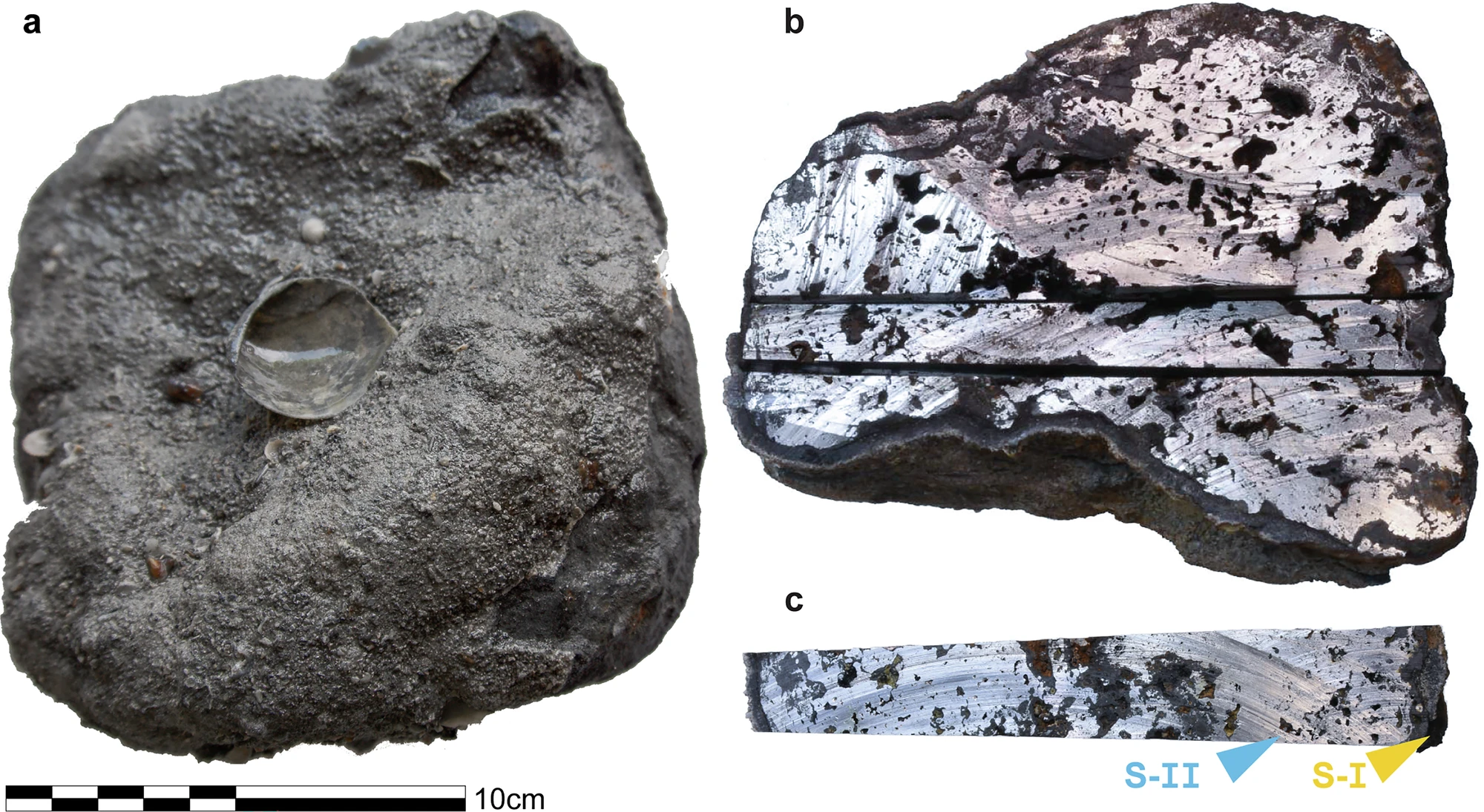
These were not finished tools or weapons. They were iron blooms—spongy, semi-processed lumps formed during early-stage smelting. In traditional models of Iron Age metallurgy, such blooms were expected to be immediately forged into usable forms while still hot. Their discovery in raw, unworked condition—especially as cargo—was entirely unexpected.
Scientific analysis confirmed that these blooms had not undergone any forging or refinement. Their internal structure retained pores, slag inclusions, and uneven carbon distribution, all hallmarks of metal in its earliest stage of production.
📣 Our WhatsApp channel is now LIVE! Stay up-to-date with the latest news and updates, just click here to follow us on WhatsApp and never miss a thing!!
Dating the Wreck: A Precise Window into Turbulent Times
The dating of the shipwreck is unusually robust. A small charred oak twig embedded inside one of the iron blooms provided a reliable radiocarbon anchor. Combined with organic remains from the cargo—particularly grape seeds and resin from wine amphorae—researchers narrowed the ship’s final voyage to around 639–631 BCE, within a broader range spanning the late 7th to early 6th century BCE.
This period corresponds to a volatile geopolitical landscape. The Neo-Assyrian Empire was collapsing, Babylon was rising, and Egypt—under its Saite dynasty—was reasserting influence across the Levant. Control over resources like iron would have been strategically critical.
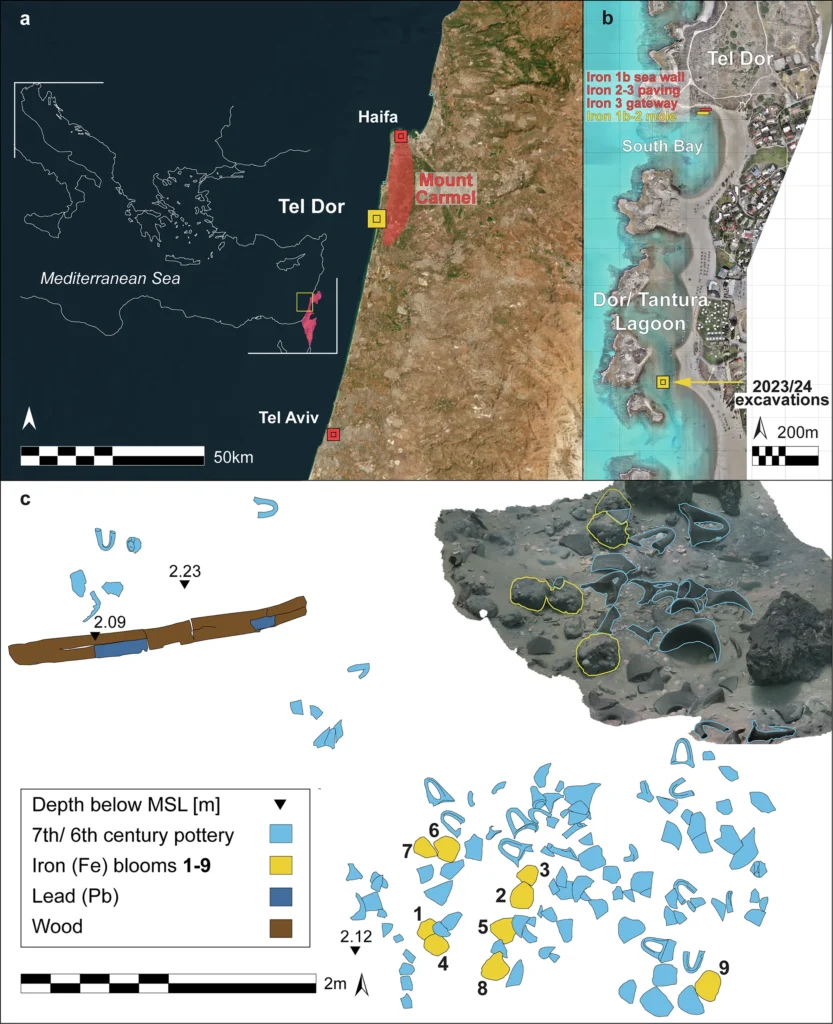
Map and excavation context of Tel Dor in the Levant, including Iron Age harbor remains and the 2023–2024 excavation area. The plan shows iron blooms (1–9) alongside amphora fragments and a wooden anchor; inset 3D model highlights five blooms. Colors indicate materials, and black triangles mark depth below mean sea level. Credit: Eshel, T.,et al. , 2026, npj Heritage Science
Rethinking the Ancient War Economy
Iron was not just another commodity. By this time, it had become essential for tools, agriculture, construction—and most importantly, warfare. Weapons such as swords, daggers, and arrowheads depended on reliable iron supply.
Until now, scholars believed that iron circulated primarily as finished or semi-finished products—bars or billets—ready for use or minor modification. The Dor shipwreck challenges this assumption directly.
The discovery demonstrates that raw iron blooms were deliberately transported across the sea, likely to be refined at their destination. This implies a more complex and decentralized production system than previously imagined.
Instead of a single location handling all stages—from ore to weapon—production was split:
Smelting occurred in one region, possibly near ore sources.
Raw blooms were shipped across long distances.
Final forging and weapon production took place in urban centers.
This separation of labor suggests a sophisticated economic network, where metallurgy was distributed across specialized zones rather than centralized.
Why Ship Raw Iron?
At first glance, transporting unfinished metal seems inefficient. Blooms require reheating and further processing, which consumes additional fuel and labor. But the Dor discovery reveals a crucial advantage: the slag coating around the blooms acted as a natural protective layer.
This slag shield prevented corrosion during long sea voyages, allowing the iron to survive underwater for over 2,600 years. Finished iron objects, by contrast, would have been far more vulnerable to degradation.
In effect, ancient traders may have intentionally shipped iron in its raw state because it was more durable in transit.
Expanding Trade Networks in the Ancient Mediterranean
The cargo also sheds light on the scale and reach of Iron Age trade. Alongside the iron blooms, archaeologists found amphorae linked stylistically to Cyprus and the Aegean world. This suggests that the ship was part of a broader maritime network connecting:
The Levantine coast
Egypt
Cyprus
The Aegean
These connections were likely facilitated by Phoenician merchants, who dominated Mediterranean trade routes during this period.
Rather than a tightly controlled imperial supply system, the evidence points to a more flexible and dynamic marketplace. Iron may have circulated through commercial networks involving private traders, local workshops, and regional powers.

A Shift in Archaeological Interpretation
The implications extend beyond trade. For decades, archaeologists have debated whether ironworking debris found in ancient cities represented local smelting or secondary processing.
The Dor blooms provide a missing piece of the puzzle. Their existence supports the idea that many urban centers were not producing iron from ore but were instead refining imported raw material.
This distinction is critical. It reshapes how archaeologists interpret slag, furnace remains, and workshop debris across the region.
Warfare, Supply, and Power
In practical terms, the discovery reframes how ancient armies were supplied. Rather than relying solely on centralized production, military equipment may have been produced locally from imported raw materials.
This system would have allowed greater flexibility. Cities could maintain their own weapon production capabilities without needing direct access to ore deposits. Control over trade routes, rather than mines alone, becomes a key factor in military power.
A Discovery That Changes the Narrative
The Dor shipwreck does more than add another data point to Iron Age archaeology. It challenges a long-standing model of metallurgy and trade, revealing a system that was more adaptable, interconnected, and strategically organized than previously understood.
By showing that raw iron itself was a traded commodity, the discovery opens a new chapter in the study of ancient economies—and the hidden logistics behind early warfare.
Further research is ongoing, and scientists hope to pinpoint the exact origin of the iron and reconstruct the ship’s route. But even now, the message is clear: the foundations of ancient power were not just forged in fire—they were carried across the sea in their rawest form.
Eshel, T., Ioffe, A., Langgut, D. et al. Earliest iron blooms discovered off the Carmel coast revise Mediterranean trade in raw metal ca. 600 BCE. npj Herit. Sci. 14, 155 (2026). https://doi.org/10.1038/s40494-026-02409-7
Cover Image Credit: Eshel, T.,et al., 2026, npj Heritage Science