
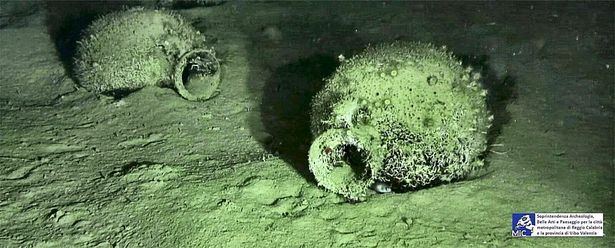
An ancient shipwreck carrying more than 300 amphorae has been identified off the Ionian coast of Calabria, offering a rare underwater glimpse into the maritime trade of Magna Graecia more than 2,400 years ago.
The wreck was found off Monasterace, in the province of Reggio Calabria, during feasibility studies for an offshore wind project. According to Acciona Energía, which announced the find, the shipwreck dates between the 5th and 4th centuries BC and was discovered in coordination with the Superintendency of Archaeology, Fine Arts and Landscape for the Metropolitan City of Reggio Calabria and the Province of Vibo Valentia.
The discovery was first identified in 2023 and later presented at the 8th National Conference on Underwater Archaeology, held at the Archaeological Park of Campi Flegrei. Italian cultural authorities describe it as one of the more important recent underwater archaeological finds in the Mediterranean.
A cargo from the world of Magna Graecia
The amphorae provide the first major clue to the ship’s date and role. Their forms point to production in different centers of Magna Graecia and Sicily, suggesting that the vessel was part of the regional maritime network that linked Greek-founded cities across southern Italy and the wider Mediterranean.
Magna Graecia, or “Greater Greece,” refers to the Greek-speaking colonies established in southern Italy and Sicily from the 8th century BC onward. By the 5th and 4th centuries BC, cities such as Kroton, Sybaris, Taras, Syracuse and nearby Kaulon had become major centers of trade, agriculture and cultural exchange.
The wreck lies close to the ancient city of Kaulon, near modern Monasterace. Founded by Achaean settlers before 700 BC, Kaulon was one of the Greek poleis of Calabria and maintained close links with other Greek cities in southern Italy. Its destruction by Dionysius I of Syracuse in 388 BC falls within the same broad period as the shipwreck, although no direct connection between the sinking and those political events has been established.
What the cargo can tell us
Amphorae were the transport containers of the ancient Mediterranean. Their shape, clay fabric, stamps and residues can reveal where they were made, what they carried and how goods moved between ports.
In this case, researchers are especially interested in the wine trade along the Ionian coast of Magna Graecia. Acciona’s statement says the wreck may provide valuable evidence for ancient trade routes, maritime exchange, and the production and distribution of wine in southern Italy and Sicily.
The amphorae may also preserve organic residues. If confirmed through laboratory analysis, these traces could help identify the cargo more precisely and clarify whether the ship was carrying wine, oil or other agricultural products.
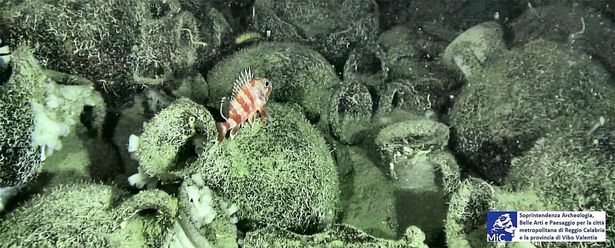
For archaeologists, the value of the find is not only the number of amphorae but the context. A large cargo, still mostly preserved on the seabed, can show how a merchant vessel was loaded, how its cargo shifted during sinking, and how later human activity changed the site.
A disturbed wreck, not an untouched time capsule
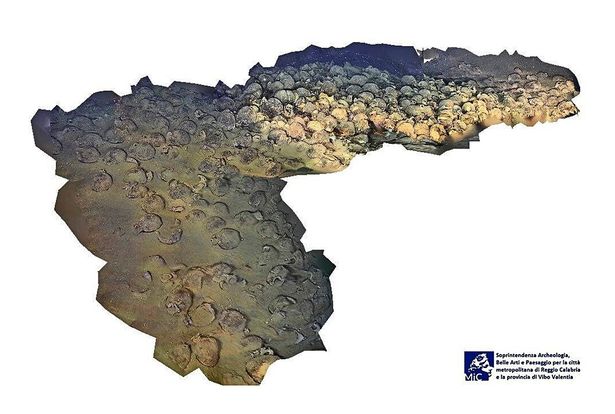
The Monasterace wreck is not completely undisturbed. Photogrammetric surveys launched in 2025 showed that the amphorae form two distinct clusters separated by about ten meters. Researchers believe this unusual gap was probably caused not by the ancient shipwreck event itself, but by later trawling activity on the seabed.
That detail has changed the conservation strategy. Under the 2001 UNESCO Convention on the Protection of Underwater Cultural Heritage, keeping underwater heritage in place is normally considered the first option. But UNESCO also allows recovery when it significantly contributes to protection or knowledge, especially when objects are endangered.
Because the amphorae appear to be at risk from further damage, the Italian Ministry of Culture is supporting a project for the full study, recovery, conservation and future public presentation of the cargo. The program is being carried out through the competent Superintendency and includes underwater archaeologists, restorers, geologists, biologists and other specialists.
Discovery during an offshore wind survey
The wreck was found through preventive archaeology linked to an offshore wind project. Acciona Energía said the seabed surveys were designed to identify archaeological, environmental and technical constraints before development. The results were submitted to the competent Italian authorities, which then activated protection procedures for the site.
The company also said the project’s preliminary design has been adjusted to avoid both the archaeological area and other environmentally sensitive zones. ANSA likewise reported that the discovery was made during feasibility work for an Acciona offshore wind project and that the Ministry of Culture is funding the research, recovery, and conservation program.
Before the amphorae are raised, the site will be documented in high detail. Researchers plan further photogrammetry, systematic recording of each vessel, sampling, and conservation analysis. Only after the condition of the ceramics is better understood will the team define the safest recovery and restoration protocols.
The wreck off Monasterace therefore tells two stories at once. One belongs to the Greek cities of southern Italy, whose ships moved wine and other goods through the Mediterranean. The other is a modern one: how archaeology, infrastructure planning and underwater heritage protection increasingly meet on the seafloor.
Ministry of Culture / SABAP Regg
Cover Image Credit: Ministry of Culture / SABAP Reggio Calabria
